Parotid region
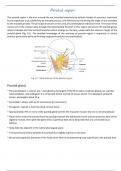
The parotid region is the area around the ear, bounded anteriorly by anterior border of masseter, superiorly
by the zygomatic arch, posteriorly by mastoid process, and inferiorly by line joining the angle of the mandible
to the mastoid process. The principal structures in this area are parotid gland and facial nerve. The facial nerve
comes out of the cranial cavity through the stylomastoid foramen in this region and enters the parotid gland,
where it divides into five terminal branches which emerge on the face, underneath the anterior margin of the
parotid gland (Fig. 8.1). The detailed knowledge of the anatomy of parotid region is important in clinical
practice particularly while performing surgical procedures on parotid gland.
* The parotid (para = around, otic = ear) gland is the largest of the three pairs of salivary glands, viz. parotid,
submandibular, and sublingual. It is composed almost entirely of serous alveoli. It is lobulated, yellowish
brown, and weighs about 25 g.
* Pyramidal in shape, with up to 5 processes (or extensions)
* The gland’s capsule is from the deep cervical fascia
* Approximately 75% or more of the parotid gland overlies the masseter muscle; the rest is retromandibular
* Facial nerve enters the parotid fossa by passing between the stylohyoid muscle and the posterior belly of the
digastric muscle, then splits the gland into a superficial lobe and a deep lobe that are connected by an
isthmus
* Deep lobe lies adjacent to the lateral pharyngeal space
* Transverse facial artery parallels the parotid duct slightly superior to the duct
* Buccal and zygomatic branches of the facial nerve form an anastomosing loop superficial to the parotid duct
, Location
The parotid gland lies in the pyramidal fossa, posterior to the ramus of the mandible called retromandibular
fossa (parotid bed).
Boundaries of Parotid gland
Anteriorly: by the posterior border of the ramus of mandible.
Posteriorly: by the mastoid process.
Superiorly: by the external acoustic meatus and posterior part of temporomandibular joint.
Medially: by styloid process.
The parotid bed is lined by muscles, probably to make it soft as under:
1. Ramus of the mandible is covered by two muscles: masseter laterally and the medial pterygoid medially.
2. Mastoid process is covered by two muscles: sternocleidomastoid laterally and posterior belly of digastric
muscle medially.
3. Styloid process is enveloped by three slender muscles: styloglossus, stylopharyngeus, and stylohyoid.
The parotid gland is too soft to be palpable in healthy individual, but one can identify the bony boundaries of
the parotid bed.
The parotid region is the area around the ear, bounded anteriorly by anterior border of masseter, superiorly
by the zygomatic arch, posteriorly by mastoid process, and inferiorly by line joining the angle of the mandible
to the mastoid process. The principal structures in this area are parotid gland and facial nerve. The facial nerve
comes out of the cranial cavity through the stylomastoid foramen in this region and enters the parotid gland,
where it divides into five terminal branches which emerge on the face, underneath the anterior margin of the
parotid gland (Fig. 8.1). The detailed knowledge of the anatomy of parotid region is important in clinical
practice particularly while performing surgical procedures on parotid gland.
* The parotid (para = around, otic = ear) gland is the largest of the three pairs of salivary glands, viz. parotid,
submandibular, and sublingual. It is composed almost entirely of serous alveoli. It is lobulated, yellowish
brown, and weighs about 25 g.
* Pyramidal in shape, with up to 5 processes (or extensions)
* The gland’s capsule is from the deep cervical fascia
* Approximately 75% or more of the parotid gland overlies the masseter muscle; the rest is retromandibular
* Facial nerve enters the parotid fossa by passing between the stylohyoid muscle and the posterior belly of the
digastric muscle, then splits the gland into a superficial lobe and a deep lobe that are connected by an
isthmus
* Deep lobe lies adjacent to the lateral pharyngeal space
* Transverse facial artery parallels the parotid duct slightly superior to the duct
* Buccal and zygomatic branches of the facial nerve form an anastomosing loop superficial to the parotid duct
, Location
The parotid gland lies in the pyramidal fossa, posterior to the ramus of the mandible called retromandibular
fossa (parotid bed).
Boundaries of Parotid gland
Anteriorly: by the posterior border of the ramus of mandible.
Posteriorly: by the mastoid process.
Superiorly: by the external acoustic meatus and posterior part of temporomandibular joint.
Medially: by styloid process.
The parotid bed is lined by muscles, probably to make it soft as under:
1. Ramus of the mandible is covered by two muscles: masseter laterally and the medial pterygoid medially.
2. Mastoid process is covered by two muscles: sternocleidomastoid laterally and posterior belly of digastric
muscle medially.
3. Styloid process is enveloped by three slender muscles: styloglossus, stylopharyngeus, and stylohyoid.
The parotid gland is too soft to be palpable in healthy individual, but one can identify the bony boundaries of
the parotid bed.