

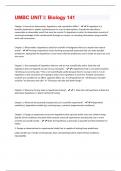
UMBC UNIT I: Biology 141 Chapter 1: How do an observation, hypothesis, and a predictio n differ? - ✔✔ A hypothesis is a testable statement to explain a phenomenon or a set of observations. A prediction describes a measurable or observable result that must be correct if a hypothesis is valid. An observation consists of receiving knowledge of t he outside world through our senses, or recording information using scientific tools and instruments. Chapter 1: What makes a hypothesis useful for scientific investigation that try to explain the natural world? - ✔✔ Forming a hypothesis means forming a pr oposed statement that can make testable predictions. Saying that the hypothesis is true means that the predictions you've made are also true. and vice versa. Chapter 1: Give examples of hypothesis that are and are not scientifically useful. State the null hypothesis that corresponds to each of your examples. - ✔✔ A hypothesis that is not useful would be "all dinosaurs eat only cake." This is not scientifically useful because there's no way to test it. A null hypothesis is the conclusion we're going to draw if our hypothesis is incorrect. Possible conclusions could be our variable has no affect, opposite affect, etc. A null hypothesis for "all dinosaurs eat cake" could be "no dinosaurs eat cake" or "Dinosaurs eat cake and other things." Chapter 1: What are t he key steps in hypothesis testing? - ✔✔ 1. State the null hypothesis 2.State the alternative hypothesis 3. Select method of testing Chapter 1: What are the essential characteristics of a scientific experiment? - ✔✔ Independent variable (x), dependent varia ble (y), control groups, constants (experimental conditions). Chapter 1: Design an experiment to test the hypothesis that squirrels prefer nuts over chicken wings. Specify which conditions should be held constant across all experiments and describe one or more controls you would include. - ✔✔ State the hypothesis as precisely as possible and the predictions it makes 2. Design an observational or experimental study that is capable of testing those predictions Large sample size, include control groups, have c onstant/equivalent experimental conditions, repeatability Chapter 1: What is the difference between a hypothesis and a scientific theory? - ✔✔ A hypothesis typically address more specific issues while a theory is an explanation for a more general phenomeno n. Chapter 1: What is the hypothesis of Spontaneous Generation and how Does Cell Theory challenge that hypothesis? - ✔✔ Spontaneous generation hypothesis states that organisms could arise spontaneously under certain conditions while the cell theory challen ges that and states all organisms are made up of cells and cells can only be created from preexisting cells (cells from cells hypothesis). Chapter 1: Explain Pasteur's experiment, including the purpose of the swan -necked flasks. - ✔✔ In order to test whether cells are created/aren't created from preexisting cells he conducted an experiment. This experiment involved him setting up two flasks: o ne with a normal neck with contact to the outside and another with a swan necked shape neck. the swan neck shaped flask was purposefully designed so that the cells in the flask wouldn't have contact to the outside. In both the flasks he placed nutrients an d boiled them. In the straight necked flask the cells that were boiled were killed but preexisting cells from the air entered the flask forming new cells. In the swan necked flask however, the cells that were boiled died and the preexisting cells form outs ide entered the flask yet got stuck in the neck. This led to no cells being regrown in the broth. Chapter 1: Why does Pasteur boil the broth in both types of flasks? For each type of flasks, what is the outcome predicted by Spontaneous Generation? By Cell Theory? - ✔✔ Pasteur boiled the broth to kill any preexisting cells and to see whether the broth needed contact form the outside cells to regrow or not. This experiment debunked the spontaneous generation hypothesis and proved the cell theory. Chapter 1: What observed patterns support the theory of evolution by natural selection? Be sure to define the terms evolution and population in your answer. - ✔✔ Evolution is a change in the characteristics of a population over time. A population is a group of individ uals of the same species living in the same area at the same time (fish, lions, worms, etc.) The observes patterns were that species are related by common ancestry and characteristics of species can be modified from generation to generation (descent modifi cation). Chapter 1: What are the two conditions required for natural selection to occur. - ✔✔ Individuals within a population vary in characteristics that are heritable --meaning, traits that can be passed on to offspring. And in a particular environment, c ertain version of these heritable traits help individuals survive better or reproduce more than do other versions. Chapter 1: How does artificial selection differ from natural selection? How would you artificially select for a particular characteristic? - ✔✔ Natural selection occurs when heritable variation in certain traits
Exam (elaborations)
UMBC UNIT I: Biology 141 | 109 Questions and Answers(A+ Solution guide)
Rating
Sold
-
Pages
15
Grade
A+
Uploaded on
20-09-2023
Written in
2023/2024
Chapter 1: How do an observation, hypothesis, and a prediction differ? - A hypothesis is a testable statement to explain a phenomenon or a set of observations. A prediction describes a measurable or observable result that must be correct if a hypothesis is valid. An observation consists of receiving knowledge of the outside world through our senses, or recording information using scientific tools and instruments. Chapter 1: What makes a hypothesis useful for scientific investigation that try to explain the natural world? - Forming a hypothesis means forming a proposed statement that can make testable predictions. Saying that the hypothesis is true means that the predictions you've made are also true. and vice versa. Chapter 1: Give examples of hypothesis that are and are not scientifically useful. State the null hypothesis that corresponds to each of your examples. - A hypothesis that is not useful would be "all dinosaurs eat only cake." This is not scientifically useful because there's no way to test it. A null hypothesis is the conclusion we're going to draw if our hypothesis is incorrect. Possible conclusions could be our variable has no affect, opposite affect, etc. A null hypothesis for "all dinosaurs eat cake" could be "no dinosaurs eat cake" or "Dinosaurs eat cake and other things." Chapter 1: What are the key steps in hypothesis testing? - 1. State the null hypothesis 2.State the alternative hypothesis 3. Select method of testing Chapter 1: What are the essential characteristics of a scientific experiment? - Independent variable (x), dependent variable (y), control groups, constants (experimental conditions). Chapter 1: Design an experiment to test the hypothesis that squirrels prefer nuts over chicken wings. Specify which conditions should be held constant across all experiments and describe one or more controls you would include. - State the hypothesis as precisely as possible and the predictions it makes 2. Design an observational or experimental study that is capable of testing those predictions Large sample size, include control groups, have constant/equivalent experimental conditions, repeatabilityChapter 1: What is the difference between a hypothesis and a scientific theory? - A hypothesis typically address more specific issues while a theory is an explanation for a more general phenomenon. Chapter 1: What is the hypothesis of Spontaneous Generation and how Does Cell Theory challenge that hypothesis? - Spontaneous generation hypothesis states that organisms could arise spontaneously under certain conditions while the cell theory challenges that and states all organisms are made up of cells and cells can only be created from preexisting cells (cells from cells hypothesis).
Show more
Read less
Institution
UMBC UNIT I: Biology 141
Course
UMBC UNIT I: Biology 141
Content preview
Written for
- Institution
- UMBC UNIT I: Biology 141
- Course
- UMBC UNIT I: Biology 141
Document information
- Uploaded on
- September 20, 2023
- Number of pages
- 15
- Written in
- 2023/2024
- Type
- Exam (elaborations)
- Contains
- Questions & answers
Subjects
$8.49
Get access to the full document:
Wrong document? Swap it for free
Within 14 days of purchase and before downloading, you can choose a different document. You can simply spend the amount again.
Written by students who passed
Immediately available after payment
Read online or as PDF

Also available in package deal
Package deal
UMBC Biology 141 Exam Bundle With Complete Solutions.
6
2023
$ 15.99
More info

