Montag, 14. Oktober 2019
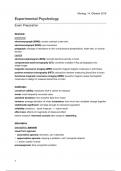
Experimental Psychology
Exam Preparation
devices:
peripheral
electromyograph (EMG): muscle contract under skin
electrooculograph (EOG): eye movement
polygraph: changes of resistance in skin conductance (perspiration), heart rate, or muscle
tension
central
electroencephalogram (EEG): records electrical activity in brain
computerized axial tomography (CT): combines multiple X-Ray photography into
single image
magnetic resonance imaging (MRI): powerful magnet realigns molecules in soft tissue
positron emission tomography (PET): radioactive markers measuring blood ow in brain
functional magnetic resonance imaging (fMRI): powerful magnet causes hemoglobin
molecules to realign to measure blood ow in brain
methods:
construct validity: measures what it claims to measure
mode: most frequently occurred value
standard deviation: how close/far data from mean
variance: average deviation of mean covariance: how much two variables change together
statistically signi cant: set large enough to represent population
reliability: tendency - same measure —> same result
e ect size: e ects of magnitude of observed e ect
before research: informed consent after research: debrie ng
disorders:
perception: agnosia
visual form agnosia:
- associative agnosia: semantic, can’t describe
- apperceptive agnosia: copying is problem, can’t recognize objects
—> action system normal
prosopagnosia: face recognition problem
1
ff ff fi fl ff fi fl
, Montag, 14. Oktober 2019
eye:
akinetopsia: motion blindness (V5) (DF; mailing letter)
achromatopsia: cortical color blindness (V4)
cataract: lense is cloudy
macular degenerations: degeneration of fovea —> dark spot
glaucoma: worsenig/loss of peripheral vision —> rods <— too much pressure in eye
sight:
myopia: nearsighted, eye too long —> concave lens
hyperopia: farsighted, eye too short —> convex lens
astigmatism: Imperfections in the spherical curvature of the cornea
(Hornhautverkrümmung)
presbyopia: near point decreases at age —> lens - sti (can be changed -> dominant eye)
blindsight: seeing without perceiving, damage to V1
attention: neglect (Vernachlässigung):
- hemispatial/unilateral inattention: can’t actively perceive/process stumuli
- extinction: when shown two objects can only pay attention to one
- balint’s syndrome: only able to perceive 1 object at a time (bilateral posterior lesions)
memory: amnesia
concussion: loss of consciousness, moments —> weeks
functional amnesia: often due to personality disorder
organic amnesia: attributable to organ
anterograde amnesia: inability to transfer information from STM to LTM —> hippocampus
damage - unable to form new memory, Clive Wearing, H.M.
retrograde amnesia: inability to to retrieve information that was acquired before a
particular date —> fugue state
childhood amnesia: everybody - not remembering information before three years old
Korsakoff Syndrome: long-term alcoholism (lack of vitamin b1)
writing: dyslexia - unable to recognize written words, problem understanding alphabetic
principle, phonemes —> abstractions
- surface dyslexia: direct route damage —> no exceptions
- phonological dyslexia: phonological route damage —> no pseudo-words
- deep dyslexia: phonological route damage + semantic problems —> no pseudo-words +
semantics
language: aphasia - trouble producing/understanding speech
- motor aphasia: Broca’s area, telegram style, grammatical problem
2
ff
Experimental Psychology
Exam Preparation
devices:
peripheral
electromyograph (EMG): muscle contract under skin
electrooculograph (EOG): eye movement
polygraph: changes of resistance in skin conductance (perspiration), heart rate, or muscle
tension
central
electroencephalogram (EEG): records electrical activity in brain
computerized axial tomography (CT): combines multiple X-Ray photography into
single image
magnetic resonance imaging (MRI): powerful magnet realigns molecules in soft tissue
positron emission tomography (PET): radioactive markers measuring blood ow in brain
functional magnetic resonance imaging (fMRI): powerful magnet causes hemoglobin
molecules to realign to measure blood ow in brain
methods:
construct validity: measures what it claims to measure
mode: most frequently occurred value
standard deviation: how close/far data from mean
variance: average deviation of mean covariance: how much two variables change together
statistically signi cant: set large enough to represent population
reliability: tendency - same measure —> same result
e ect size: e ects of magnitude of observed e ect
before research: informed consent after research: debrie ng
disorders:
perception: agnosia
visual form agnosia:
- associative agnosia: semantic, can’t describe
- apperceptive agnosia: copying is problem, can’t recognize objects
—> action system normal
prosopagnosia: face recognition problem
1
ff ff fi fl ff fi fl
, Montag, 14. Oktober 2019
eye:
akinetopsia: motion blindness (V5) (DF; mailing letter)
achromatopsia: cortical color blindness (V4)
cataract: lense is cloudy
macular degenerations: degeneration of fovea —> dark spot
glaucoma: worsenig/loss of peripheral vision —> rods <— too much pressure in eye
sight:
myopia: nearsighted, eye too long —> concave lens
hyperopia: farsighted, eye too short —> convex lens
astigmatism: Imperfections in the spherical curvature of the cornea
(Hornhautverkrümmung)
presbyopia: near point decreases at age —> lens - sti (can be changed -> dominant eye)
blindsight: seeing without perceiving, damage to V1
attention: neglect (Vernachlässigung):
- hemispatial/unilateral inattention: can’t actively perceive/process stumuli
- extinction: when shown two objects can only pay attention to one
- balint’s syndrome: only able to perceive 1 object at a time (bilateral posterior lesions)
memory: amnesia
concussion: loss of consciousness, moments —> weeks
functional amnesia: often due to personality disorder
organic amnesia: attributable to organ
anterograde amnesia: inability to transfer information from STM to LTM —> hippocampus
damage - unable to form new memory, Clive Wearing, H.M.
retrograde amnesia: inability to to retrieve information that was acquired before a
particular date —> fugue state
childhood amnesia: everybody - not remembering information before three years old
Korsakoff Syndrome: long-term alcoholism (lack of vitamin b1)
writing: dyslexia - unable to recognize written words, problem understanding alphabetic
principle, phonemes —> abstractions
- surface dyslexia: direct route damage —> no exceptions
- phonological dyslexia: phonological route damage —> no pseudo-words
- deep dyslexia: phonological route damage + semantic problems —> no pseudo-words +
semantics
language: aphasia - trouble producing/understanding speech
- motor aphasia: Broca’s area, telegram style, grammatical problem
2
ff