

Chapter 8 The Skeletal System: The Appendicular Skeleton
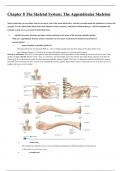
Chapter 8 The Skeletal System: The Appendicular Skeleton Make certain that you can define, and use in context, each of the terms listed below, and that you understand the significance of each of the concepts. Use the volume titled “Brief Atlas of the Skeleton, Surface Anatomy, and Selected Medical Images,” which accompanies the textbook, to help you as you study the individual bones. 1. Identify the names, locations and major surface markings of the bones of the pectoral (shoulder) girdles. (Side note: appendicular skeleton- primary function is in movement. Axial skeletons function is protection of internal ograns) • pectoral girdles or shoulder girdles (2) The human body has two pectoral (PEK-to -¯ ral) or shoulder girdles that attach the bones of the upper limbs to the axial skeleton (Figure 8.1). Each of the two pectoral girdles consists of a clavicle and a scapula. clavicle or collarbone-The clavicle is the anterior bone and articulates with the manubrium of the sternum at the sternoclavicular joint. Each slender, S‐shaped clavicle (KLAV‐i‐kul = key), or collarbone, lies horizontally across the anterior part of the thorax superior to the first rib (Figure 8.2). It is subcutaneous (under the skin) and easily palpable along its length. The bone is S‐shaped because the medial half is convex anteriorly (curves toward you when viewed in the anatomical position), and the lateral half is concave anteriorly (curves away from you). It is rougher and more curved in males. • • • sternal end The medial end, called the sternal end, is rounded and articulates with the manubrium of the sternum to form the sternoclavicular joint. • acromial end The broad, flat, lateral end, the acromial end (a‐KRŌ‐mē‐al), articulates with the acromion of the scapula to form the acromioclavicular joint (see Figure 8.1). • scapula or shoulder blade Each scapula (SCAP‐ū‐la; plural is scapulae), or shoulder blade, is a large, triangular, flat bone situated in the superior part of the posterior thorax between the levels of the second and seventh ribs (Figure 8.3). • spine- A prominent ridge called the spine runs diagonally across the posterior surface of the scapula • acromion The lateral end of the spine projects as a flattened, expanded process called the acromion (a‐KRŌ‐mē‐on;acrom‐ = topmost; ‐omos = shoulder), easily felt as the high point of the shoulder. Tailors measure the length of the upper limb from the acromion. As noted earlier, the acromion articulates with the acromial end of the clavicle to form the acromioclavicular joint • glenoid cavity - Inferior to the acromion is a shallow depression, the glenoid cavity, that accepts the head of the humerus (arm bone) to form theglenohumeral (shoulder) joint (see Figure 8.1). • scapular notch The scapular notch is a prominent indentation along the superior border (see below) through which the suprascapular nerve passes. • superior, lateral (axillary) and medial (vertebral) borders The thin edge of the scapula closer to the vertebral column is called the medial (vertebral) border. The thick edge of the scapula closer to the arm is called the lateral (axillary) border. The medial and lateral borders join at the inferior angle. The superior edge of the scapula, called the superior border, joins the medial border at the superior angle. • superior and inferior angles The medial and lateral borders join at the inferior angle. The superior edge of the scapula, called the superior border, joins the medial border at the superior angle. • coracoid process At the lateral end of the superior border of the scapula is a projection of the anterior surface called the coracoid process (KOR‐a‐koyd = like a crow's beak), to which the tendons of muscles (pectoralis minor, coracobrachialis, and biceps brachii) and ligaments (coracoacromial, conoid, and trapezoid) attach. • supraspinous fossa Superior and inferior to the spine on the posterior surface of the scapula are two fossae: The supraspinous fossa (sū‐pra‐SPĪ‐nus) is a surface of attachment for the supraspinatus muscle of the shoulder, and the infraspinous fossa (in‐fra‐SPĪ‐nus) serves as a surface of attachment for the infraspinatus muscle of the shoulder. On the anterior surface of the scapula is a slightly hollowed‐out area called the subscapular fossa, a surface of attachment for the subscapularis muscle. • infraspinous fossa (see above) • subscapular fossa (see above) 2. Identify the names, locations and major surface markings of the bones of the upper limbs. • upper limbs or upper extremities (2) Each upper limb (upper extremity) has 30 bones in three locations—(1) the humerus in the arm; (2) the ulna and radius in the forearm; and (3) the 8 carpals in the carpus (wrist), the 5 metacarpals in the metacarpus (palm), and the 14 phalanges (bones of the digits) in the hand (Figure 8.4). • humerus The humerus (HŪ‐mer‐us), or arm bone, is the longest and largest bone of the upper limb (Figure 8.5). It articulates proximally with the scapula and distally with two bones, the ulna and the radius, to form the elbow joint. • Head The proximal end of the humerus features a rounded head that articulates with the glenoid cavity of the scapula to form the glenohumeral (shoulder) joint. • glenohumeral joint (see above) • anatomical neck Distal to the head is the anatomical neck, which is visible as an oblique groove. It is the former site of the epiphyseal (growth) plate in an adult humerus. • greater tubercle The greater tubercle is a lateral projection distal to the anatomical neck. It is the most laterally palpable bony landmark of the shoulder region and is immediately inferior to the palpable acromion of the scapula mentioned earlier. • lesser tubercle The lesser tubercle projects anteriorly. • intertubercular sulcus Between the two tubercles there is a groove named the intertubercular sulcus. • surgical neck The surgical neck is a constriction in the humerus just distal to the tubercles, where the head tapers to the shaft; it is so named because fractures often occur here. • body or shaft The body (shaft) of the humerus is roughly cylindrical at its proximal end, but it gradually becomes triangular until it is flattened and broad at its distal end. • deltoid tuberosity Laterally, at the middle portion of the shaft, there is a roughened, V‐ shaped area called the deltoid tuberosity. This area serves as a point of attachment for the tendons of the deltoid muscle • capitulum Several prominent features are evident at the distal end of the humerus. The capitulum (ka‐PIT‐ū‐lum; capit‐ = head) is a rounded knob on the lateral aspect of the bone that articulates with the head of the radius. • radial fossa The radial fossa is an anterior depression above the capitulum that articulates with the head of the radius when the forearm is flexed (bent). • Trochlea The trochlea (TROK‐lē‐a = pulley), located medial to the capitulum, is a spool‐ shaped surface that articulates with the trochlear notch of the ulna. • coronoid fossa The coronoid fossa (KOR‐ō‐noyd = crown‐shaped) is an anterior depression that receives the coronoid process of the ulna when the forearm is flexed. • olecranon fossa The olecranon fossa (ō‐LEK‐ra‐non = elbow) is a large posterior depression that receives the olecranon of the ulna when the forearm is extended (straightened). • medial epicondyle The medial epicondyle and lateral epicondyle are rough projections on either side of the distal end of the humerus to which the tendons of most muscles of the forearm are attached. The ulnar nerve may be palpated by rolling a finger over the skin surface above the posterior surface of the medial epicondyle. This nerve is the one that makes you feel a very severe pain when you hit your elbow, which for some reason is commonly referred to as the funnybone, even though this event is anything but funny. • lateral epicondyle (see above) • ulna The ulna is located on the medial aspect (the little‐finger side) of the forearm and is longer than the radius (Figure 8.6). You may find it convenient to use an aid called a mnemonic device (nē‐MON‐ik = memory) to learn new or unfamiliar information. One such mnemonic to help you remember the location of the ulna in relation to the hand is “p.u.” (the pinky is on the ulna side). • Olecranon At the proximal end of the ulna (Figure 8.6b) is the olecranon, which forms the prominence of the elbow • coronoid process With the olecranon, an anterior projection called the coronoid process (Figure 8.6a) articulates with the trochlea of the humerus. • trochlear notch The trochlear notch is a large curved area between the olecranon and coronoid process that forms part of the elbow joint (see Figure 8.7b). • head The distal end of the ulna consists of a head that is separated from the wrist by a disc of fibrocartilage. • styloid process A styloid process is located on the posterior side of the ulna's distal end. It provides attachment for the ulnar collateral ligament to the wrist.
Document information
- Uploaded on
- September 19, 2023
- Number of pages
- 23
- Written in
- 2023/2024
- Type
- Exam (elaborations)
- Contains
- Questions & answers


