

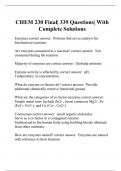
CHEM 230 Final| 339 Questions| With Complete Solutions
Enzymes correct answer: Proteins that act as catalyst for biochemical reactions Are enzymes consumed in a reaction? correct answer: Not consumed during the reaction Majority of enzymes are correct answer: Globular proteins Enzyme activity is affected by correct answer: pH, Temperature, or concentration What do enzyme co factors do? correct answer: Provide additional chemically reactive functional groups What are the categories of co factor enzymes correct answer: Simple metal ions- Include Zn2+, (most common) Mg2+, Fe (Fe2+, Fe3+), and Cu (Cu+, Cu2+) Coenzymes correct answer: small organic molecules Serve as a co factor in a conjugated enzyme Synthesized in the human body using building blocks obtained from other nutrients How are enzymes named? correct answer: Enzymes are named with reference to their function Focal point of naming enzymes correct answer: Type of reaction catalyzed and substrate identity Enzyme substrate correct answer: reactant in an enzyme catalyzed reaction Substance upon which the enzyme acts In the fermentation process, sugar is converted to alcohol. What is the substrate in this reaction? correct answer: Sugar Suffix in naming an enzyme correct answer: Suffix -ase identifies a substance as an enzyme Example: Urease, sucrase, and lipase are all enzyme designations Exception: Suffix -in is still found in the names of some digestive enzymes Example: Trypsin, chymotrypsin, and pepsin What is the prefix when naming an enzyme? correct answer: Type of reaction catalyzed by an enzyme is often used as a prefix Oxidase enzyme catalyzes an oxidation reaction Hydrolase enzyme catalyzes a hydrolysis reaction Maltase correct answer: Enzyme that catalyzes a reaction with maltose lactate dehydrogenase correct answer: Enzyme that catalyzes the dehydrogenation of lactate Fructose Oxidase correct answer: Enzyme that catalyzes the oxidation of fructose maleate isomerase correct answer: Enzyme that catalyzes the rearrangement (isomerization) of a maleate ion How are enzymes grouped? correct answer: Enzymes are grouped into classes based on the types of reactions they catalyze Oxidoreductases correct answer: Oxidation-reduction reactions Transferases correct answer: Functional group transfer reactions Hydrolases correct answer: Hydrolysis reactions Lyases correct answer: Reactions involving addition or removal of groups to form double bonds Isomerase correct answer: Isomerization reactions Ligases correct answer: Reactions involving bond formation with the participation of ATP Oxidereductase correct answer: Catalyzes an oxidation- reduction reaction what does an oxidoreductase require? correct answer: An oxidoreductase requires a coenzyme that is oxidized or reduced as the substrate is reduced or oxidized Example: Lactate dehydrogenase is an oxidoreductase, and NAD+ is the coenzyme in the reaction Transferase correct answer: Catalyzes the transfer of a functional group from one molecule to another Transaminase correct answer: Catalyzes the transfer of an amino group from one molecule to another Subtype of transferase Kinase correct answer: Catalyzes the transfer of a phosphate group from adenosine triphosphate (ATP) to give adenosine diphosphate (ADP) and a phosphorylated product Subtype of transferase Hydrolase correct answer: Catalyzes a hydrolysis reaction Hydrolysis correct answer: Reaction involves the addition of a water molecule to a bond, which causes the bond to break Hydrolysis reaction is central to the process of what? correct answer: digestion Carbohydrase hydrolyzes correct answer: glycosidic bonds in oligo- and polysaccharides Protease effects correct answer: the breaking of peptide linkages in proteins Lipase effects correct answer: the breaking of ester linkages in triacylglycerols Lyase correct answer: Catalyzes the addition or the removal of a group to form a double bond in a manner that does not involve hydrolysis or oxidation Dehydratase correct answer: Effects the removal of the components of water from a double bond Hydratase correct answer: Effects the addition of the components of water to a double bond Isomerase correct answer: Catalyzes the isomerization (rearrangement of atoms) of a substrate in a reaction Converts it into a molecule, isomeric with itself Ligase correct answer: Catalyzes the formation of a bond between two molecules with the participation of ATP What is required in ligase? correct answer: ATP involvement is required as such reactions are energetically unfavorable How does ligase get energy? correct answer: by the hydrolysis of ATP to ADP Active site correct answer: Small part of an enzyme's structure that is involved in catalysis How are active sites formed? correct answer: Formed due to folding and bending of the protein Enzyme- Substrate Complex correct answer: Intermediate
Document information
- Uploaded on
- September 18, 2023
- Number of pages
- 40
- Written in
- 2023/2024
- Type
- Exam (elaborations)
- Contains
- Questions & answers


