Pathophysiology Exam 1- Study Guide With Complete Solution
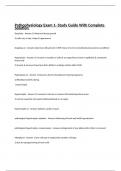
Dysplasia - Answer 1) Abnormal tissue growth 2) cells vary in size, shape & appearance Dysplasia ex - Answer abnormal cells present in PAP smear of cervix (considered precancerous condition) Hyperplasia - Answer 1) increase in number of cells of an organ/tissue (seen in epithelial & connective tissue only 2) muscle & nervous tissue lose their ability to undergo mitosis after birth) Hyperplasia ex - Answer 1) breast & uterine development during pregnancy 2) fibroblast activity during wound repair Hypertrophy - Answer 1) increase in cell size or amount of functioning tissue mass 2) can be caused by increased workload placed on an organ Hypertrophy ex - Answer skeletal, cardiac muscle pathological hypertrophy: adaptive - Answer thickening of heart wall with hypertension pathological hypertrophy: compensatory - Answer enlargement of one kidney after other is removed Metaplasia - Answer 1) one cell type is replaced by another cell type 2) due to reprogramming of stem cells Atrophy - Answer decrease in size of organ caused by a decrease in size/number of individual cells. Atrophy: can be caused by - Answer 1) disuse 2) reduced demand 3) ↓ trophic stimuli 4) ↓ nutrients/blood flow 5) cell injury 6) aging Moist gangrene - Answer area is cold, swollen, pulseless, moist, black Gas gangrene - Answer 1) caused by Clostridium sp. 2) bubbles of H2S present Apoptosis - Answer 1) 'fallen apart' 2) ~cell suicide 3) eliminates worn out, excess, improperly developed or genetically damaged cells Apoptosis: directed by - Answer proteases called caspases Apoptosis ex - Answer 1) programmed death of cells during embryonic development 2) hormone-dependent involution of tissues Necrosis - Answer 1) cell death in an organ or tissue 2) unregulated enzymatic digestion Liquefaction necrosis - Answer cells undergo liquefaction due to cellular enzyme release Coagulation necrosis - Answer 1) gray, firm mass develops 2) ex: hypoxic injuries, infarctions Caseous necrosis - Answer 1) infiltrated with fatlike substances (cheeselike) 2) ex: tubercular lesions, result of immune mechanisms Caspases - Answer 1) proteases that direct Apoptosis phenotype - Answer observed expression of the genotype genotype - Answer genetic composition of an individual dominant - Answer trait will be expressed in the heterozygote recessive - Answer trait will be expressed in the homozygote only allele - Answer 1) alternative forms of the same gene 2) inherit 2 alleles for each gene (1 from mom, 1 from dad) Autosomal Recessive Disorders - Answer seen only when both copies of the gene are affected Autosomal Recessive Disorders: if parents are Aa x Aa (carriers) --> - Answer 1) 25% chance offspring are AA (normal, unaffected) 2) 50% chance offspring are Aa (carriers) 3) 25% chance offspring are aa (affected) Autosomal Recessive Disorders: PKU (phenylketouria) - Answer 1) ↓ liver enzyme converting phe --> tyr 2) 1:15,000 3) ↓ neurological development 4) can be controlled by ↓ dietary intake of phe
Written for
- Institution
- Pathophysiology
- Course
- Pathophysiology
Document information
- Uploaded on
- September 17, 2023
- Number of pages
- 13
- Written in
- 2023/2024
- Type
- Exam (elaborations)
- Contains
- Questions & answers
Subjects
-
pathophysiology exam 1 stuvia
-
pathophysiology exam 1 study guide with complete
-
dysplasia 1 abnormal tissue growth 2 cells vary
-
dysplasia ex abnormal cells present in pap smear o

Also available in package deal