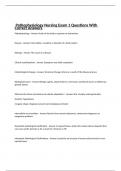
Pathophysiology Nursing Exam 1 Questions With Correct Answers
Pathophysiology - Answer Study of the body's response to dysfunction Disease - Answer Interruption, cessation or disorder of a body system Etiology - Answer The cause of a disease Clinical manifestations - Answer Symptoms and chief complaints Morphological changes - Answer Structural changes that are a result of the disease process Etiological factors - Answer Biologic agents, physical forces, chemicals, nutritional excess or deficiency, genetic factors What are the three mechanisms of cellular adaptation? - Answer Size: atrophy and hypertrophy Number: hyperplasia Irregular shape: dysplasia (severe) and metaplasia (chronic) Intercellular accumulation - Answer Results from normal substances, abnormal endogenous or exogenous products Dystrophic pathological calcification - Answer In injured tissue, dead cells create calcium deposits that can cause aortic stenosis or be a result of a fracture or TB Metastatic Pathological Calcifications - Answer Caused by an increase of serum calcium levels in non-injured tissue Chemical injuries - Answer Lead, carbon tetrachloride, carbon monoxide, ethanol, mercury, street drugs Asphyxiation injuries - Answer Suffocation, strangulation, drowning Hypoxic injuries - Answer Ischemia (lack of blood flow) and anoxia (lack of oxygen) What does cellular aging cause? - Answer Atrophy, decreased functioning Isotonic solutions - Answer Will cause no change to cells 0.9% saline Hypertonic solutions - Answer Will cause cells to shrink/crenate 3% saline or 5% dextrose Hypotonic solutions - Answer Will cause cells to swell 0.45% saline Edema - Answer Accumulation of fluid in interstitial spaces What are causes of edema? - Answer Increased capillary hydrostatic pressure (fluid moves from capillary to interstitial space) Decrease in plasma osmotic pressure (decrease in RBC, plasma and proteins causing fluid to leak into tissues) Increase in capillary permeability (inflammation causes fluid to leak into surrounding tissues) Lymph obstruction What are the functions of Na as a cation? - Answer Neuromuscular irritability, acid base balance through the exchange of water and bicarb, chemical reactions and membrane transport Hypernatremia - Answer Na>147 Intercellular dehydration, convulsions, pulmonary edema, hypotension, tachycardia, pruny fingers Hyponatremia - Answer Na<135 Creates: Hypoosmolality, cellular swelling, dry mucous membranes, peripherial edema, muscle weakness and seizures Causes: low intake, fluid overload (dilutional hyponatremia) and high circulating protein levels (hypoosmolar hyponatremia) What are the functions of K as a cation? - Answer Regulation of electrical neutrality, transmission and conduction, cardiac rhythm and muscle contraction Hypokalemia - Answer K<3.5 Creates: decreased neuromuscular excitability, muscle weakness, smooth muscle dysfunction, dysrhythmias Causes: reduced intake and increased loss Hyperkalemia - Answer K>5.5 Creates: increased neuromuscular iritability (tingling, cramps, restlessness and diarrhea) loss of muscle tone or paralysis Causes: increased intake (salt supplements), decreased renal excretion, insulin deficiency or cell trauma What are the functions of Ca? - Answer Parathyroid hormone secretion, cell receptor functioning and electrical conductivity What are normal levels of Ca in the plasma? - Answer 9-10.5 mg Hypercalcemia - Answer Creates: decreased muscular excitability, muscle weakness, cardiac arrest, kidney stones and constipation Hypocalcemia - Answer Creates: increased neuromuscular excitability, seizures, muscle cramps What is the function of phosphate? - Answer ATP bonds and as a buffer What are normal levels of phosphate? - Answer 2.5-4.5 Hyperphosphatemia - Answer Creates: cell lysis, tetany, parasthesia Causes: low calcium levels
Written for
- Institution
- Pathophysiology
- Course
- Pathophysiology
Document information
- Uploaded on
- September 17, 2023
- Number of pages
- 12
- Written in
- 2023/2024
- Type
- Exam (elaborations)
- Contains
- Questions & answers
Subjects
- pathophysiology stuvia
-
pathophysiology nursing exam 1 questions with cor
-
pathophysiology study of the bodys response to dy
-
disease interruption cessation or disorder of a b

Also available in package deal