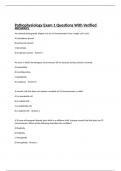
Pathophysiology Exam 1 Questions With Verified Answers
An ordered photographic display of a set of chromosomes from a single cell is a(n): A) metaphase spread. B) autosomal spread. C) karyotype. D) anaphase spread. - Answer c An error in which homologous chromosomes fail to separate during meiosis is termed: A) aneuploidy. B) nondisjunction. C) polyploidy. D) anaplasia. - Answer b A somatic cell that does not contain a multiple of 23 chromosomes is called: A) an aneuploid cell. B) a euploid cell. C) a polyploidy cell. D) a haploid cell. - Answer a A 20-year-old pregnant female gives birth to a stillborn child. Autopsy reveals that the fetus has 92 chromosomes. Which of the following describes this condition? A) Euploidy B) Triploidy C) Tetraploidy D) Aneuploidy - Answer c If a person is a chromosomal mosaic, the person may: A) be a carrier of the genetic disease. B) have a mild form of the genetic disease. C) have two genetic diseases. D) be sterile as a result of the genetic disease. - Answer b The most common cause of Down syndrome is: A) paternal nondisjunction. B) maternal translocations. C) maternal nondisjunction. D) paternal translocations. - Answer c Risk factors for Down syndrome include: A) fetal exposure to mutagens in the uterus. B) increased paternal age. C) family history of Down syndrome. D) pregnancy in women over age 35. - Answer d A 13-year-old girl has a karyotype that reveals an absent homologous X chromosome with only a single X chromosome present. Her condition is called: A) Down syndrome. B) Cri du chat syndrome. C) Turner syndrome. D) Edward syndrome - Answer c A child is diagnosed with cystic fibrosis. History reveals that the child's parents are first cousins. Cystic fibrosis was most likely the result of: A) X inactivation. B) genomic imprinting. C) consanguinity. D) obligate carriers. - Answer c Joey, age 9, is admitted to a pediatric unit with Duchenne muscular dystrophy. He inherited this condition through a: A) sex-linked dominant trait. B) sex-influenced trait. C) sex-limited trait. D) sex-linked recessive trait. - Answer d A 50-year-old male was recently diagnosed with Huntington disease. Transmission of this disease is associated with: A) penetrance. B) recurrence risk. C) expressivity. D) delayed age of onset. - Answer d People who have neurofibromatosis will show varying degrees of the disease; this is because of the genetic principle of: A) penetrance. B) expressivity. C) dominance. D) recessiveness. - Answer b Cystic fibrosis is caused by an _____ gene. A) X-linked dominant B) X-linked recessive C) autosomal dominant D) autosomal recessive - Answer d To express a polygenic trait: A) genes must interact with the environment. B) several genes must act together. C) multiple mutations must occur in the same family. D) in situ cloning must occur. - Answer b The gradual increase in height among the human population over the past 100 years is an example of: A) polygenic trait. B) multifactorial trait. C) crossing over. D) recombination. - Answer b A couple has three offspring: one child with an autosomal dominant disease trait and two who are normal. The father is affected by the autosomal dominant disease, but the mother does not have the disease gene. What is the recurrence risk of this autosomal dominant disease for their next child? A) 50% B) 33% C) 25% D) Impossible to determine - Answer a A 12-year-old male is diagnosed with Klinefelter syndrome. His karyotype would reveal which of the following? A) XY B) XX C) XYY D) XXY - Answer d A 5-year-old male presents with mental retardation and is diagnosed with Fragile X syndrome. Which of the following is most likely to cause this syndrome? A) Translocation B) Inversion C) Nondisjunction D) Duplication at fragile sites - Answer d The outward manifestation of a disease, often influenced by both genes and the environment, is called the disease: A) genotype. B) allele. C) phenotype. D) dominance. - Answer c Which of the following genetic diseases manifests with progressive dementia in middle to later adulthood? A) Duchenne muscular dystrophy B) Cystic fibrosis C) Achondroplasia D) Huntington disease - Answer d Which of the following types of genetic disorders is the most common cause of miscarriage? A) Autosomal dominant B) Autosomal recessive C) X-linked recessive D) Chromosomal - Answer d Which of the following is an accurate characteristic of an autosomal recessive pedigree? A) On average, 50% of the children will have the autosomal recessive disease if one parent has the disease. B) Males are affected more than females. C) On average, 25% of the children are affected by the autosomal recessive disease if both parents are carriers. D) There is a decreased risk of disease with consanguinity. - Answer c Which of the following is an accurate characterization of an X-linked recessive pedigree? A) Disease is seen more often in males than females. B) A pattern of skipped generations is rare. C) Males are gene carriers. D) Mothers usually transmit the disease to their daughters. - Answer a The process by which RNA directs the synthesis of protein is called: A) termination. B) transcription. C) promotion. D) translation. - Answer d A 15-year-old female is diagnosed with Prader-Willi syndrome. This condition is an example of: A) gene imprinting. B) an autosomal recessive trait. C) an autosomal dominant trait. D) a sex-linked trait. - Answer a Adaptive cellular mechanisms function to: A) treat disease. B) protect cells from injury. C) prevent cellular aging. D) speed up cellular death. - Answer b Cellular atrophy involves: A) an increase in cell size. B) a decrease in cell size. C) an increase in the number of cells. D) a decrease in the number of cells. - Answer b The process of cellular atrophy is accomplished through which of the following processes? A) Loss of fluid B) Decreased cell division C) Inhibition of enzyme formation D) Formation of autophagic vacuoles - Answer d In compensatory hyperplasia, growth factors stimulate cell division in response to: A) tissue loss. B) decreased hormonal stimulation. C) ischemia. D) puberty. - Answer a Pathologic hyperplasia can lead to: A) neoplasia (cancer). B) dysplasia. C) metaplasia. D) all of the above. - Answer d In response to an increased workload, such as that caused by high blood pressure (hypertension), myocardial cells in the left ventricle will adapt through the process of: A) atrophy. B) hypertrophy. C) hyperplasia. D) dsyplasia. - Answer b The process of muscle hypertrophy involves an increase in: A) cell division. B) water accumulation. C) protein synthesis. D) plasma membrane thickness. - Answer c Chronic infection of the cervix by the human papillomavirus results in cervical: A) atrophy. B) dysplasia. C) metaplasia. D) hormonal hyperplasia. - Answer b Metaplasia involves the replacement of normal cells by: A) another type of cell. B) abnormal cells of the same tissue type. C) scar tissue. D) cancer cells. - Answer a The most common cause of hypoxic injury is: A) free radicals. B) malnutrition. C) chemical toxicity. D) ischemia. - Answer d Tissue ischemia and a decrease in mitochondrial oxygenation result in: A) cellular dehydration. B) decreased ATP production. C) calcium accumulation outside the cell. D) increased protein synthesis. - Answer b Lysosomal rupture during hypoxic injury leads to: A) cellular acidosis. B) sodium influx. C) cellular adaptation. D) autodigestion of cells. - Answer d Free radical injury can be caused by all of the following factors except: A) tissue damage by antioxidants. B) radiation injury. C) tissue reperfusion following ischemia. D) enzymatic metabolism of chemicals. - Answer a Vitamin E, vitamin C, and beta-carotene are molecules in food that act as: A) poisons. B) free radicals. C) receptor blockers. D) antioxidants. - Answer d Lead poisoning affects nervous system function by which of the following mechanisms? A) Lead blocks oxygen delivery to the brain by binding with hemoglobin. B) Lead interferes with neurotransmitter release. C) Lead causes nervous tissue necrosis. D) Lead inhibits fatty acid oxidation in the brainstem. - Answer b The population group most vulnerable to lead poisoning is: A) children. B) pregnant women. C) male adolescents. D) the elderly. - Answer a Which of the following organs is most frequently affected by ethanol injury? A) Heart B) Kidneys C) Liver D) Stomach - Answer c Which of the following molecules accumulates in liver cells as a result of alcohol abuse? A) Water B) Fat (lipids) C) Protein D) Iron - Answer b Fetal exposure to alcohol during pregnancy can result in: A) low birth weight. B) mental retardation. C) death. D) all of the above. - Answer d Why is carbon monoxide exposure a life-threatening condition? A) Carbon monoxide binds to hemoglobin and prevents normal oxygen transport to tissues. B) Inhalation of carbon monoxide interferes with oxygen diffusion in the lungs. C) Carbon monoxide causes the release of toxic amounts of iron from the tissues. D) Carbon dioxide removal from the tissues is inhibited. - Answer a A contusion injury results in: A) tearing of the skin. B) the removal of superficial skin layers. C) entrance and exit wounds. D) bleeding in the skin or underlying tissues. - Answer d What are the primary factors contributing to oncosis from hypoxic injury? A) Decrease in ATP production and sodium movement into the cell B) Injury to the endoplasmic reticulum and Golgi apparatus C) Increase in ATP production and potassium movement out of the cell D) Accumulation of lipids and pigments in the cell - Answer a Liquefactive necrosis typically occurs after severe hypoxic injury to which of the following organs? A) Brain B) Heart C) Adrenals D) Pancreas - Answer a The process by which cells program themselves to die is called: A) karyolysis. B) apoptosis. C) pyknosis. D) necrosis. - Answer b Osmosis describes the movement of: A) electrolytes. B) glucose. C) water. D) blood. - Answer c
Written for
- Institution
- Pathophysiology
- Course
- Pathophysiology
Document information
- Uploaded on
- September 17, 2023
- Number of pages
- 42
- Written in
- 2023/2024
- Type
- Exam (elaborations)
- Contains
- Questions & answers
Subjects
-
pathophysiology exam 1 stuvia
-
pathophysiology exam 1 questions with verified ans
-
an ordered photographic display of a set of chromo
-
an error in which homologous chromosomes fail to s

Also available in package deal