WGU C955 applied probability and statistics latest update already passed
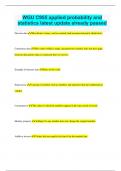
WGU C955 applied probability and statistics latest update already passed Discrete data Has distinct values, can be counted, had unconnected points (think dots) Continuous data Has values within a range, measured not counted, does not have gaps between data points (data is connected lines or curves). Example of discrete data Days of the week Expressions A group of symbols such as numbers and operators that has mathematical validity Commutative The order in which the numbers appear in the sum can be reversed Identity property Adding 0 to any number does not change the original number Additive inverse Values that are equally far from 0 on the number line. Negative When multiplying a positive number by a negative number the result is always Positive Multiplying a negative number by a negative number results in a positive Factors Integers that evenly divide the initial integer Prime number Positive integer with exactly two positive factors consisting of 1 and itself Composite number Has at least one positive factor other than one and itself Factorization Process of breaking up a composite number into its prime factors fundamental theorem of arithmetic Any integer greater than one is either Prime or the product of Prime numbers Principal square root Positive square root of a number Radican Number under radical sign √16=4 Open Circle Represents less than or greatest than on the number line Perfect square Product of any integer with itself yields a perfect square. Whole numbers positive numbers with a whole value Integers Numbers with no fractions or decimal value but can be positive or negative Rational numbers Numbers that can be expressed as a fraction or decimal values that have that end or repeat forever. Includes all integers since all integers can be expressed as fractions. Real numbers Everything that can be included in a number line including pi. Fractions Express numbers which are part of a whole Numerator Number written before the slash or above the fraction bar Proper fraction Numerator is less than denominator and the value of the fraction is less than one Improper fraction Numerator is greater than denominator and therefore is greater than one except with negative fractions Mixed numbers A whole number and proper fraction. A negative sign in front applies to both parts of the mixed number. Multiples Integers created by multiplying one number times another number Fractions Express numbers which are part of a whole Numerator Number written before the slash or above the fraction bar Proper fraction Numerator is less than denominator and the value of the fraction is less than one Improper fraction Numerator is greater than denominator and therefore is greater than one except with negative fractions Mixed numbers A whole number and proper fraction. A negative sign in front applies to both parts of the mixed number. Multiples Integers created by multiplying one number times another number Reciprocal The number which of multiplied by divisor gives you one (like the fraction flipped over) Terminal decimal Has digits that end Ratio Comparison of two numbers Rate A ratio that compares two quantities having different units of measure Proportion True statement in which two ratios are equal to each other. Two days are proportional of they are equivalent. Conditional proportion One part of a proportion is a variable or unknown quantity Celsius to Fahrenheit Celsius x 9/5 + 32 Fahrenheit to Celsius (Fahrenheit - 32) x 5/9 Constant Number with a fixed value. All real numbers are constants Elementary operations Addition, subtraction, multiplication, division Base The number an exponent is written next to Variable Symbol that represents our holds the place of a numerical value Coefficient A number by which a variable is being multiplied. Coefficients are written in front of variables. 16x, 16 is coefficient. If there is no number you assume an invisible1. Term Can be a single constant, a single, or a number of constants and variables multiplied together. Algebraic expression String of terms connected by division, addition, and subtraction. How to write an algebraic expression Constants at end. Write terms with the largest exponents first. Always write in descending order of exponent value with constants at the end. Inverse operation Operations that undo each other. Subtraction is inverse of addition. Division is inverse of multiplication. Like terms Have the same variable with the same exponent Degree of an expression Refers to largest exponent in an expression Linear Has degree of 1 Quadratic Has degree of 2 Cubic Has degree of 3 Constant Has degree of 0 Distributive property Principle used to multiply a single term by multiple terms. If there are parenthesis around multiple terms which are in turn multiplied by a single term, we can use this property.
Written for
- Institution
- WGU C955
- Course
- WGU C955
Document information
- Uploaded on
- September 15, 2023
- Number of pages
- 8
- Written in
- 2023/2024
- Type
- Exam (elaborations)
- Contains
- Questions & answers
Subjects
-
wgu c955 applied probability and statistics latest

Also available in package deal