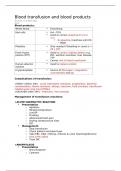
Blood transfusion and blood products
Thursday, 13 October 2022
00:35
Blood products:
Whole blood Everything
Red cells Hct~70%
Used to correct anaemia or blood
loss
In anaemia, transfuse until Hb
~ 80g/l
Platelets Only needed if bleeding or count is <
20 x 109l
Fresh frozen Used to correct clotting defects e.g.
plasma (FFP) DIC, warfarin overdose, liver disease,
TTP
Carries risk of blood transfusion
Human albumin Used to replace protein
solution
Cryoprecipitate Source of fibrinogen, coagulation
concentrates and Igs
Complications of transfusion:
>EARLY (within 24h) - acute haemolytic reactions, anaphylaxis, bacterial
contamination, febrile reactions, allergic reactions, fluid overload, transfusion-
related acute lung injury(TRALI)
>DELAYED (after 24h) - infections, iron overload
Management of transfusion reactions:
>ACUTE HAEMOLYTIC REACTION
Presentation
o Agitation
o Raised temperature
o Low BP
o Flushing
o Abdominal/chest pain
o Oozing venepuncture sites
o DIC
Management
o Stop transfusion
o Check patient and blood type
o Take FBC, U&E, clotting, cultures & urine (haemoglobinuria)
o Give 0.9% saline
o Treat DIC
>ANAPHYLAXIS
Presentation
o Bronchospasm
o Cyanosis
, o Low BP
o Soft tissue swelling
Management
o Stop transfusion
o Maintain airway and give oxygen
>BACTERIAL CONTAMINATION
Presentation
o Fever
o Low BP
o Rigors
Management
o Stop transfusion
o Take FBC, U&E, clotting, cultures & urine
o Start broad-spectrum antibiotics
>TRALI
Presentation
o Dyspnoea
o Cough
o CXR - 'white out'
Management
o Stop transfusion
o Give 100% O2
o Treat as ARDS
o Remove donor from donor panel
>NON-HAEMOLYTIC FEBRILE TRANSFUSION REACTION
Presentation
o Shivering
o Fever
Management
o Slow/stop transfusion
o Give an antipyretic e.g. paracetamol 1g
>ALLERGIC REACTIONS
Presentation
o Urticaria
o Itch
Management
o Slow/stop transfusion
o Chlorphenamine slow IV/IM
>FLUID OVERLOAD
Presentation
o Dyspnoea
o Hypoxia
o Tachycardia
o Raised JVP
o Basal crepitations
Management
o Slow/stop transfusion
o Give O2
, o Give a diuretic e.g. furosemide IV
Massive blood transfusion:
Defined as replacement of an individual's entire blood volume within 24h.
Complications:
Reduced platelets
Reduced calcium
Reduced clotting factors
Increased potassium
Hypothermia
Transfusing patients with heart failure:
If Hb=< 50g/L + heart failure, give packed RBCs 4h/unit with furosemide
(alternate units)
Anticoagulants and warfarin guidelines
Saturday, 22 October 2022
21:27
HEPARIN
>LMWH: dalteparin, enoxaparin, tinzaparin
Prevention and initial treatment of VTE
Accumulates in renal failure, hence decrease dose for prophylaxis
Given subcutaneously ODS or BDS
Long half life
>UNFRACTIONATED HEPARIN:
Given intravenously or subcutaneously
Rapid onset and short half life
OVERDOSE -> STOP INFUSION + IF BLEEDING GIVE PROTAMINE
SULPHATE
Side effects of heparin:
o Increased bleeding
o Heparin induced thrombocytopenia (HIT)
o Osteoporosis(long-term use)
o HIT and osteoporosis UFH>LMWH
o Hyperkalaemia?
Contraindications of heparin:
o Bleeding disorders
o Platelets <60 x 109/L
o Previous HIT
o Peptic ulcer
o Cerebral haemorrhage
o Severe HT
o Neurosurgery
>DOACs: Rivaroxaban, apixaban, dabigatran
, Do not require monitoring so are often favourable to warfarin
Contraindications:
o Severe renal/ liver impairment
o Active bleeding
o Reduced clotting factors
>WARFARIN
Used PO OD as long term anticoagulation
Inhibits activation of vitamin K
Contraindications:
o Peptic ulcer
o Bleeding disorders
o Severe HT
o Pregnancy
o Caution in the elderly and in previous GI bleeds
Warfarin dosage and what if INR is too high?
o Warfarin prevents decrease in INR -> increased deviance from reference
range -> give less warfarin
o
INR Guideline
5-8 + no bleed Withhold 1-2 doses. Restart at a lower
maintenance dose when INR<5
5-8 + minor Stop warfarin and give IV Vit K. Restart
bleed warfarin when INR<5
>8 + no bleed Stop warfarin
>8 + minor Stop warfarin and give IV Vit K. Check INR
bleed daily and give more Vit K if INR too high
after 24h. Restart warfarin at a lower dose
when INR < 5
Any major bleed Stop warfarin. Give prothrombin complex +
vitamin K IV
Haematological malignancies
Tuesday, 27 September 2022
13:43
Neutrophilia is a neutrophil count above 7.5 x 10^9/L
Major causes:
Bacterial infection
Non-infection inflammation
Thursday, 13 October 2022
00:35
Blood products:
Whole blood Everything
Red cells Hct~70%
Used to correct anaemia or blood
loss
In anaemia, transfuse until Hb
~ 80g/l
Platelets Only needed if bleeding or count is <
20 x 109l
Fresh frozen Used to correct clotting defects e.g.
plasma (FFP) DIC, warfarin overdose, liver disease,
TTP
Carries risk of blood transfusion
Human albumin Used to replace protein
solution
Cryoprecipitate Source of fibrinogen, coagulation
concentrates and Igs
Complications of transfusion:
>EARLY (within 24h) - acute haemolytic reactions, anaphylaxis, bacterial
contamination, febrile reactions, allergic reactions, fluid overload, transfusion-
related acute lung injury(TRALI)
>DELAYED (after 24h) - infections, iron overload
Management of transfusion reactions:
>ACUTE HAEMOLYTIC REACTION
Presentation
o Agitation
o Raised temperature
o Low BP
o Flushing
o Abdominal/chest pain
o Oozing venepuncture sites
o DIC
Management
o Stop transfusion
o Check patient and blood type
o Take FBC, U&E, clotting, cultures & urine (haemoglobinuria)
o Give 0.9% saline
o Treat DIC
>ANAPHYLAXIS
Presentation
o Bronchospasm
o Cyanosis
, o Low BP
o Soft tissue swelling
Management
o Stop transfusion
o Maintain airway and give oxygen
>BACTERIAL CONTAMINATION
Presentation
o Fever
o Low BP
o Rigors
Management
o Stop transfusion
o Take FBC, U&E, clotting, cultures & urine
o Start broad-spectrum antibiotics
>TRALI
Presentation
o Dyspnoea
o Cough
o CXR - 'white out'
Management
o Stop transfusion
o Give 100% O2
o Treat as ARDS
o Remove donor from donor panel
>NON-HAEMOLYTIC FEBRILE TRANSFUSION REACTION
Presentation
o Shivering
o Fever
Management
o Slow/stop transfusion
o Give an antipyretic e.g. paracetamol 1g
>ALLERGIC REACTIONS
Presentation
o Urticaria
o Itch
Management
o Slow/stop transfusion
o Chlorphenamine slow IV/IM
>FLUID OVERLOAD
Presentation
o Dyspnoea
o Hypoxia
o Tachycardia
o Raised JVP
o Basal crepitations
Management
o Slow/stop transfusion
o Give O2
, o Give a diuretic e.g. furosemide IV
Massive blood transfusion:
Defined as replacement of an individual's entire blood volume within 24h.
Complications:
Reduced platelets
Reduced calcium
Reduced clotting factors
Increased potassium
Hypothermia
Transfusing patients with heart failure:
If Hb=< 50g/L + heart failure, give packed RBCs 4h/unit with furosemide
(alternate units)
Anticoagulants and warfarin guidelines
Saturday, 22 October 2022
21:27
HEPARIN
>LMWH: dalteparin, enoxaparin, tinzaparin
Prevention and initial treatment of VTE
Accumulates in renal failure, hence decrease dose for prophylaxis
Given subcutaneously ODS or BDS
Long half life
>UNFRACTIONATED HEPARIN:
Given intravenously or subcutaneously
Rapid onset and short half life
OVERDOSE -> STOP INFUSION + IF BLEEDING GIVE PROTAMINE
SULPHATE
Side effects of heparin:
o Increased bleeding
o Heparin induced thrombocytopenia (HIT)
o Osteoporosis(long-term use)
o HIT and osteoporosis UFH>LMWH
o Hyperkalaemia?
Contraindications of heparin:
o Bleeding disorders
o Platelets <60 x 109/L
o Previous HIT
o Peptic ulcer
o Cerebral haemorrhage
o Severe HT
o Neurosurgery
>DOACs: Rivaroxaban, apixaban, dabigatran
, Do not require monitoring so are often favourable to warfarin
Contraindications:
o Severe renal/ liver impairment
o Active bleeding
o Reduced clotting factors
>WARFARIN
Used PO OD as long term anticoagulation
Inhibits activation of vitamin K
Contraindications:
o Peptic ulcer
o Bleeding disorders
o Severe HT
o Pregnancy
o Caution in the elderly and in previous GI bleeds
Warfarin dosage and what if INR is too high?
o Warfarin prevents decrease in INR -> increased deviance from reference
range -> give less warfarin
o
INR Guideline
5-8 + no bleed Withhold 1-2 doses. Restart at a lower
maintenance dose when INR<5
5-8 + minor Stop warfarin and give IV Vit K. Restart
bleed warfarin when INR<5
>8 + no bleed Stop warfarin
>8 + minor Stop warfarin and give IV Vit K. Check INR
bleed daily and give more Vit K if INR too high
after 24h. Restart warfarin at a lower dose
when INR < 5
Any major bleed Stop warfarin. Give prothrombin complex +
vitamin K IV
Haematological malignancies
Tuesday, 27 September 2022
13:43
Neutrophilia is a neutrophil count above 7.5 x 10^9/L
Major causes:
Bacterial infection
Non-infection inflammation