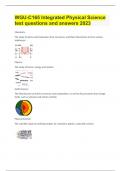
WGU-C165 Integrated Physical Science test questions and answers 2023
Chemistry: The study of atoms and molecules, their structures, and their interactions to form various substances. Physics: The study of forces, energy and motion. Earth Science: This field focuses on Earth's structure and composition, as well as the processes that change Earth, such as volcanic and seismic activity. Physical Science: The scientific study of nonliving matter. Ex: chemistry, physics, and Earth science. Astronomy: The study of the moon, stars, and other objects in space. Controlled Experiment: An experiment in which only one variable is manipulated at a time.. Independent Variable: The variable that is manipulated in an experiment. Dependent Variable: The outcome factor; the variable that may change in response to manipulations of the independent variable. Control Variable: A variable that is kept constant during a controlled experiment. Observational Study: The systems are observed as they appear in nature and researchers do not attempt to change them. Laboratory Experiment: Researchers study the system of interest in a highly controlled artificial setting (lab). Physical Model: A physical representation of an object. Ex: Scaled down version of the solar system. Conceptual Model: A verbal or graphical explanation for how a system works or is organized. Ex: posters, charts. Mathematical Model: Uses different forms of data to represent the way a system or process works. Ex: formulas, graphs, mathematical means. Ex: F=ma (formula). Computer Model: A computer program that models an event or object. Important in explaining and predicting natural phenomena. Ex: weather patterns, solar system. Principle of Falsification: Principle that only falsifiable statements can be subject to scientific inquiry. Hypothesis: A testable prediction, often implied by a theory. Theory: A hypothesis that has been tested with a significant amount of data. Law: A concise statement that is supported by scientific evidence and repeated experiments. Describes a widespread pattern in nature. Intended to be universal. Scientific Investigation: Scientists test their ideas with a variety of different types of investigations. Ex: laboratories, controlled experiments, astronomy, field studies, models. SI System: International System of units based on the metric system and units derived from the metric system. Base Quantities: Seven designated physical quantities (sets) from which all other SI quantities can be derived. (1) Meter (m)-length (2) Kilogram (k)-mass (3) Second (s)-time (4) Kelvin (K)-temperature (5) Amperes (A)-"amp"-electric current (6) Candela (cd)-light intensity (7) Moles (mol)-amount of substance Time: Base quantity that measures how long an event lasts or the break between events. Length: Used to describe the distance between two objects, or the two ends of an object. Mass: Used to describe the amount of matter in an object. Temperature: A measure of how hot or cold something is. Gram: a metric unit of mass equal to one thousandth of a kilogram. Meter: The base unit of length in the metric system. Unit symbol (m). Liter: Basic unit of volume in the metric system. Unit symbol (l). Second: SI base unit for time. Unit symbol (s). Kelvin: Si base unit of temperature. Unit symbol (K). Mega: Metric prefix one million of the base unit. 10^6 Unit symbol (M). Kilo: Metric prefix 1/1000 or 10^3. Unit symbol (k). Deci: Metric prefix 1/10th or 10^(-1) (0.1). Unit symbol (d). Centi: Metric prefix 1/100th or 10^(-2) (0.01). Unit symbol (c). Milli: Metric prefix 1/1000th or 10^(-3) (0.001). Unit symbol (m). Micro: Metric prefix 1/millionth of the base unit. 10^(-6) (0.000001)
Written for
Document information
- Uploaded on
- September 15, 2023
- Number of pages
- 58
- Written in
- 2023/2024
- Type
- Exam (elaborations)
- Contains
- Questions & answers
Subjects
-
wgu c165 integrated physical science

Also available in package deal