Chapter 5: The value of information
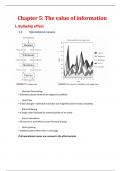
1. Bullwhip effect
1.1 Operational causes
− Demand Forecasting
• Estimates about demand are regularly modified
− Lead Time
• Small changes in demand estimates are magnified and increase variability
− Batch Ordering
• A large order followed by several periods of no order
− Price Fluctuations
• Discounts or promotions cause forward buying
− Order gaming
• Inflated orders when there is shortage
If all operational causes are removed à the effect persists
, 1.2 Behaviour causes
− Overreaction to backlogs
• Panic ordering reactions after unmet demand
− Decision-makers under-weight the supply line
• Misperceptions of feedback and time delays
− Lack of trust
• Perceived risk of other players’
− Bounded rationality
• Misuse of inventory policies
1.3 Quantifying the bullwhip
− Retailer follows a simple periodic review policy
• Base-stock (order-up-to) policy with r=1, and known lead time L
• Simple moving average for forecast (p number of periods)
− The variance of the customer demand seen by the retailer is Var(D)
− The variance of the orders placed by that retailer to the manufacturer, Var(Q)
L: lead time + review point
P: observations (weeks/ months)
− If p=5 and L=1. The variance of the orders placed by the retailer to the manufacturer will
be at least 40 percent larger than the variance of the customer demand seen by the
retailer
− When p is large and L is small, the bull whip effect due to forecasting error is negligible
− The bull whip effect is magnified as we increase the lead time and decrease p
− By increasing the number of observations used in the moving average forecast, the
retailer can significantly reduce the variability of the orders it places to the
manufacturer
1. Bullwhip effect
1.1 Operational causes
− Demand Forecasting
• Estimates about demand are regularly modified
− Lead Time
• Small changes in demand estimates are magnified and increase variability
− Batch Ordering
• A large order followed by several periods of no order
− Price Fluctuations
• Discounts or promotions cause forward buying
− Order gaming
• Inflated orders when there is shortage
If all operational causes are removed à the effect persists
, 1.2 Behaviour causes
− Overreaction to backlogs
• Panic ordering reactions after unmet demand
− Decision-makers under-weight the supply line
• Misperceptions of feedback and time delays
− Lack of trust
• Perceived risk of other players’
− Bounded rationality
• Misuse of inventory policies
1.3 Quantifying the bullwhip
− Retailer follows a simple periodic review policy
• Base-stock (order-up-to) policy with r=1, and known lead time L
• Simple moving average for forecast (p number of periods)
− The variance of the customer demand seen by the retailer is Var(D)
− The variance of the orders placed by that retailer to the manufacturer, Var(Q)
L: lead time + review point
P: observations (weeks/ months)
− If p=5 and L=1. The variance of the orders placed by the retailer to the manufacturer will
be at least 40 percent larger than the variance of the customer demand seen by the
retailer
− When p is large and L is small, the bull whip effect due to forecasting error is negligible
− The bull whip effect is magnified as we increase the lead time and decrease p
− By increasing the number of observations used in the moving average forecast, the
retailer can significantly reduce the variability of the orders it places to the
manufacturer