Chemistry Notes
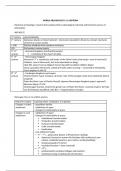
Chemistry Notes What is chemistry? - CORRECT ANSWER-The study of matter, it's properties, the changes that mater undergoes, and the energy associated with these changes. What is matter? - CORRECT ANSWER-Anything that has both mass and volume. The "stuff" of the universe. What is meant by composition? - CORRECT ANSWER-The types and amounts of simpler substances that make up a sample of matter. What are properties? - CORRECT ANSWER-The characteristics that give each substance a unique identity. What are substances? - CORRECT ANSWER-A type of matter that has a defined, fixed composition. What are the three types of matter? - CORRECT ANSWER-Elements, Molecules, and Compounds Elements - CORRECT ANSWER-The simplest type of matter with unique physical and chemical properties. Elements consist of only one type of atom. It cannot be broken down into any simpler substances by physical or chemical means. Molecules - CORRECT ANSWER-A structure that consists of two (diatomic) or more atoms that are chemically bound together and thus behaves as an independent unit. Compounds - CORRECT ANSWER-Consists of two or more different elements that are chemically bound. Two defining features of compounds: - CORRECT ANSWER-1.) Elements are present in fixed parts by mass (fixed mass ratio) [Substance]. 2.) A compounds properties are different from the properties of it's elements. **Compounds can be broken down into simpler substances Mixtures - CORRECT ANSWER-Consists of two or more substances (Elements and/ or compounds) that are physically intermingled and not chemically combined. Three features of mixtures: - CORRECT ANSWER-1.) Not a substance --> To be a substance you must have a fixed mass ratio 2.) Components retain their individual properties 3.) Can be separated into components by physical change What are the three mass laws? - CORRECT ANSWER-1.) The law of mass conservation 2.) The law of definite (or constant) composition 3.) The law of multiple proportions The Law of Mass Conservation: - CORRECT ANSWER-The total mass of substances does not change during a chemical reaction. Mass of reactants = Mass of products ** The change of mass is so small that we cannot measure it and is caused to energy from the chemical change. The Law of Definite (or Constant) Composition: - CORRECT ANSWER-No matter the source, a particular compound is composed of the same elements in the same parts (fractions) by mass. The Law of Multiple Proportions: - CORRECT ANSWER-If elements A&B react to form two compounds, the different masses B that combines with a fixed mass of A can be expressed as a ratio of small whole numbers. Dalton's Atomic Theory (Four Postulates): - CORRECT ANSWER-1.) All mater consists of atoms; tiny indivisible particles of an element that cannot be created or destroyed. 2.) Atoms of an element cannot be converted into atoms of another element. 3.) Atoms of an element are identical in mass and other properties and are different from the atoms of any other element. 4.) Compounds result from the chemical combination of a specific ratio of atoms of different elements. Which of Dalton's postulates explains the law
Written for
- Institution
- ENGLISH
- Course
- ENGLISH
Document information
- Uploaded on
- September 13, 2023
- Number of pages
- 5
- Written in
- 2023/2024
- Type
- Exam (elaborations)
- Contains
- Questions & answers
Subjects