TESTBANK FOR STROKE SCALE ;Attempt History 2023
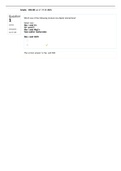
TESTBANK FOR STROKE SCALE ;Attempt History 2023 Hernandez, Delmy 01- NIHSS-English Group A-V3 - 1st Certification Date Result 3/3/2018 4:12:38 AM Passed 89 of 90 (98.89 %) View Responses Patient 1 Topic Question Answer Grade Level of Consciousness 1a. Level of Consciousness: The investigator must choose a response, even if a full evaluation is prevented by such obstacles as an endotracheal tube, language barrier, orotracheal trauma/bandages. A 3 is scored only if the patient makes no movement (other than reflexive posturing) in response to noxious stimulation. 0 = Alert; keenly responsive Correct LOC Questions 1b. LOC Questions: The patient is asked the month and his/her age. The answer must be correct there is no partial credit for being close. Aphasic and stuporous patients who do not comprehend the questions will score 2. Patients unable to speak because of endotracheal intubation, orotracheal trauma, severe dysarthria from any cause, language barrier or any other problem not secondary to aphasia are given a 1. It is important that only the initial answer be graded and that the examiner not "help" the patient with verbal or nonverbal cues. 0 = Answers both questions correctly Correct LOC Commands 1c. LOC Commands: The patient is asked to open and close the eyes and then to grip and 0 = Performs both tasks correctly Correct release the nonparetic hand. Substitute another one step command if the hands cannot be used. Credit is given if an unequivocal attempt is made but not completed due to weakness. If the patient does not respond to command, the task should be demonstrated to them (pantomime) and score the result (i.e., follows none, one or two commands). Patients with trauma, amputation, or other physical impediments should be given suitable onestep commands. Only the first attempt is scored. Best Gaze 2. Best Gaze: Only horizontal eye movements will be tested.Voluntary or reflexive (oculocephalic) eye movements will be scored but caloric testing is not done. If the patient has a conjugate deviation of the eyes that can be overcome by voluntary or reflexive activity, the score will be 1. If a patient has an isolated peripheral nerve paresis (CN III, IV or VI) score a 1. Gaze is testable in all aphasic patients. Patients with ocular trauma, bandages, pre existing blindness or other disorder of visual acuity or fields should be tested with reflexive movements and a choice made by the investigator. Establishing eye contact and then moving about the patient from side to side will occasionally 0 = Normal Correct clarify the presence of a partial gaze palsy. Visual 3. Visual: Visual fields (upper and lower quadrants) are tested by confrontation, using finger counting or visual threat as appropriate. Patient must be encouraged, but if they look at the side of the moving fingers appropriately, this can be scored as normal. If there is unilateral blindness or enucleation, visual fields in the remaining eye are scored. Score 1 only if a clearcut asymmetry, including quadrantanopia is found. If patient is blind from any cause score 3. Double simultaneous stimulation is performed at this point. If there is extinction patient receives a 1, and the results are used to answer question 11. 0 = No visual loss Correct Facial Palsy 4. Facial Palsy: Ask, or use pantomime to encourage the patient to show teeth or raise eyebrows and close eyes. Score symmetry of grimace in response to noxious stimuli in the poorly responsive or noncomprehending patient. If facial trauma/bandages, orotracheal tube, tape or other physical barriers obscure the face, these should be removed to the extent possible. Motor Arms 5a. Motor Arm Left: The limb is placed in the appropriate position: extend the arms (palms down) 90 degrees (if sitting) or 45 degrees (if supine). Drift is scored if 0 = Normal symmetrical movement 0 = No drift, limb holds 90 (or 45) degrees for full 10 seconds Correct Incorrect the arm falls before 10 seconds. The aphasic patient is encouraged using urgency in the voice and pantomime, but not noxious stimulation. Each limb is tested in turn, beginning with the nonparetic arm. Only in the case of amputation or joint fusion at the shoulder, the examiner should record the score as untestable (UN) Motor Arms 5b. Motor Arm Right: Limb is placed in the appropriate position: extend the arms (palms down) 90 degrees (if sitting) or 45 degrees (if supine). Drift is scored if the arm falls before 10 seconds. The aphasic patient is encouraged using urgency in the voice and pantomime, but not noxious stimulation. Each limb is tested in turn, beginning with the nonparetic arm. Only in the case of amputation or joint fusion at the shoulder, the examiner should record the score as untestable (UN) Motor Legs 6a. Left Leg: The limb is placed in the appropriate position: hold the leg at 30 degrees (always tested supine). Drift is scored if the leg falls before 5 seconds. The aphasic patient is encouraged using urgency in the voice and pantomime but not noxious stimulation. Each limb is tested in turn, beginning with the nonparetic leg. Only in the case of amputation or joint fusion at the hip, the examiner should record 0 = No drift, limb holds 90 (or 45) degrees for full 10 seconds 1 = Drift, leg falls by the end of the 5 second period, but does not hit bed Correct Correct the score as untestable (UN) Motor Legs 6b. Right Leg: The limb is placed in the appropriate position: hold the leg at 30 degrees (always tested supine). Drift is scored if the leg falls before 5 seconds. The aphasic patient is encouraged using urgency in the voice and pantomime but not noxious stimulation. Each limb is tested in turn, beginning with the nonparetic leg. Only in the case of amputation or joint fusion at the hip, the examiner should record the score as untestable (UN) Limb Ataxia 7. Limb Ataxia: This item is aimed at finding evidence of a unilateral cerebellar lesion. Test with eyes open. In case of visual defect, ensure testing is done in intact visual field. The finger nosefinger and heel shin tests are performed on both sides, and ataxia is scored only if present out of proportion to weakness. Ataxia is absent in the patient who cannot understand or is paralyzed. Only in the case of amputation or joint fusion, the examiner should record the score as untestable (UN), and clearly write the explanation for this choice. In case of blindness, test by having the patient touch nose from extended arm position. 0 = No drift, leg holds 30 degrees Correct position for full 5 seconds 1 = Present in one limb Correct Sensory 8. Sensory: Sensation or grimace to pinprick when tested, or withdrawal from noxious 2 = Severe or total sensory loss; patient is not aware of being touched in the face, arm and leg Correct stimulus in the obtunded or aphasic patient. Only sensory loss attributed to stroke is scored as abnormal and the examiner should test as many body areas (arms [not hands], legs, trunk, face) as needed to accurately check for hemisensory loss. A score of 2, “severe or total sensory loss,” should only be given when a severe or total loss of sensation can be clearly demonstrated. Stuporous and aphasic patients will, therefore, probably score 1 or 0. The patient with brainstem stroke who has bilateral loss of sensation is scored 2. If the patient does not respond and is quadriplegic, score 2. Patients in a coma (item 1a=3) are automatically given a 2 on this item. Best Language 9. Best Language: A great deal of information about comprehension will be obtained during the preceding sections of the examination. For this scale item, the patient is asked to describe what is happening in the attached picture, to name the items on the attached naming sheet and to read from the attached list of sentences. Comprehension is judged from responses here, as well as to all of the commands in the preceding general neurological exam. If visual loss interferes with the tests, ask the patient to identify objects placed in the hand, repeat, and
Written for
- Institution
-
Cerritos College
- Course
-
STROKE SCA 411
Document information
- Uploaded on
- September 13, 2023
- Number of pages
- 47
- Written in
- 2023/2024
- Type
- Exam (elaborations)
- Contains
- Questions & answers
Subjects
-
testbank for stroke scale attempt history 2023