Constitutional Law Separation of Powers
Meaning of SOP
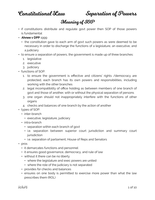
• if constitutions distribute and regulate govt power then SOP of those powers
is fundamental
• Ahnee v DPP 1999
• the constitution gave to each arm of govt such powers as were deemed to be
necessary in order to discharge the functions of a legislature, an executive, and
a judiciary
• to ensure a separation of powers, the government is made up of three branches:
1. legislative
2. executive
3. judiciary
• functions of SOP:
1. to ensure the government is effective and citizens’ rights /democracy are
protected, each branch has its own powers and responsibilities, including
working with the other branches
2. legal incompatibility of office holding as between members of one branch of
govt and those of another, with or without the physical separation of persons
3. one organ should not inappropriately interfere with the functions of other
organs
4. checks and balances of one branch by the action of another
• types of SOP:
• inter-branch
• executive, legislature, judiciary
• intra=branch
• separation within each branch of govt
• i.e. separation between superior court jurisdiction and summary court
jurisdiction
• i.e. separation of parliament, House of Reps and Senators
• pros
• it demarcates functions and personnel
• it ensures good governance, democracy, and rule of law
• without it there can be no liberty
• where the legislature and exec powers are united
• where the role of the judiciary is not separated
• provides for checks and balances
• ensures on one body is permitted to exercise more power than what the law
prescribes them (ROL)
KMB 1 of 10
Meaning of SOP
• if constitutions distribute and regulate govt power then SOP of those powers
is fundamental
• Ahnee v DPP 1999
• the constitution gave to each arm of govt such powers as were deemed to be
necessary in order to discharge the functions of a legislature, an executive, and
a judiciary
• to ensure a separation of powers, the government is made up of three branches:
1. legislative
2. executive
3. judiciary
• functions of SOP:
1. to ensure the government is effective and citizens’ rights /democracy are
protected, each branch has its own powers and responsibilities, including
working with the other branches
2. legal incompatibility of office holding as between members of one branch of
govt and those of another, with or without the physical separation of persons
3. one organ should not inappropriately interfere with the functions of other
organs
4. checks and balances of one branch by the action of another
• types of SOP:
• inter-branch
• executive, legislature, judiciary
• intra=branch
• separation within each branch of govt
• i.e. separation between superior court jurisdiction and summary court
jurisdiction
• i.e. separation of parliament, House of Reps and Senators
• pros
• it demarcates functions and personnel
• it ensures good governance, democracy, and rule of law
• without it there can be no liberty
• where the legislature and exec powers are united
• where the role of the judiciary is not separated
• provides for checks and balances
• ensures on one body is permitted to exercise more power than what the law
prescribes them (ROL)
KMB 1 of 10