Law & Legal Systems Statutory Interpretation
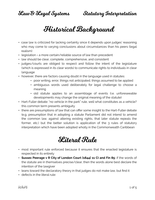
Historical Background
• case law is criticized for lacking certainty since it depends upon judges’ reasoning
who may come to varying conclusions about circumstances than his peers (legal
realism)
• legislation = a more certain/reliable source of law than precedent
• law should be clear, complete, comprehensive, and consistent
• judges/courts are obliged to respect and follow the intent of the legislature
(which is expressed in its clear words) to communicate rights to individuals in clear
language
• however, there are factors causing doubt in the language used in statutes:
• poor writing, error, things not anticipated, things assumed to be applied
• ambiguous words used deliberately for legal challenge to choose a
meaning
• old statute applies to an assemblage of events (i.e. unforeseeable
developments may change the original meaning of the statute)
• Hart-Fuller debate: “no vehicle in the park” rule, well what constitutes as a vehicle?
this common term presents ambiguity
• there are presumptions of law that can offer some insight to the Hart-Fuller debate
(e.g. presumption that in adopting a statute Parliament did not intend to amend
the common law, against altering existing rights, that later statute repeals the
former, etc.) but the better solution is application of the 3 rules of statutory
interpretation which have been adopted wholly in the Commonwealth Caribbean
Literal Rule
• most important rule enforced because it ensures that the enacted legislature is
respected in its entirety
• Sussex Peerage v R City of London Court [1844] 11 CI and Fin 85: if the words of
the statute are in themselves precise/clear, then the words alone best declare the
intention of the lawgiver
• leans toward the declaratory theory in that judges do not make law, but find it
• defects in the literal rule:
KMB 1 of 5
Historical Background
• case law is criticized for lacking certainty since it depends upon judges’ reasoning
who may come to varying conclusions about circumstances than his peers (legal
realism)
• legislation = a more certain/reliable source of law than precedent
• law should be clear, complete, comprehensive, and consistent
• judges/courts are obliged to respect and follow the intent of the legislature
(which is expressed in its clear words) to communicate rights to individuals in clear
language
• however, there are factors causing doubt in the language used in statutes:
• poor writing, error, things not anticipated, things assumed to be applied
• ambiguous words used deliberately for legal challenge to choose a
meaning
• old statute applies to an assemblage of events (i.e. unforeseeable
developments may change the original meaning of the statute)
• Hart-Fuller debate: “no vehicle in the park” rule, well what constitutes as a vehicle?
this common term presents ambiguity
• there are presumptions of law that can offer some insight to the Hart-Fuller debate
(e.g. presumption that in adopting a statute Parliament did not intend to amend
the common law, against altering existing rights, that later statute repeals the
former, etc.) but the better solution is application of the 3 rules of statutory
interpretation which have been adopted wholly in the Commonwealth Caribbean
Literal Rule
• most important rule enforced because it ensures that the enacted legislature is
respected in its entirety
• Sussex Peerage v R City of London Court [1844] 11 CI and Fin 85: if the words of
the statute are in themselves precise/clear, then the words alone best declare the
intention of the lawgiver
• leans toward the declaratory theory in that judges do not make law, but find it
• defects in the literal rule:
KMB 1 of 5