Law & Legal Systems Jury Trials
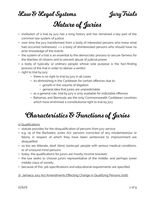
Nature of Juries
• institution of a trial by jury has a long history and has remained a key part of the
common law system of justice
• over time the jury transformed from a body of interested persons who knew what
had occurred (witnesses) —> a body of disinterested persons who should have no
prior knowledge of the events
• the system of a trial is an essential to the democratic process to secure fairness for
the liberties of citizens and to prevent abuse of judicial power
• a body of typically 12 ordinary people whose sole purpose is the fact-finding
process of the trial in order to deliver a verdict
• right to trial by jury:
• there is no right to trial by jury in all cases
• its diminishing in the Caribbean for certain offences due to:
• growth in the volume of litigation
• general idea that juries are unpredictable
• as a general rule, trial by jury is only available for indictable offences
• Bahamas and Bermuda are the only Commonwealth Caribbean countries
which have enshrined a constitutional right to trial by jury
Characteristics & Functions of Juries
1) Qualifications
• statute provides for the disqualification of persons from jury service
• e.g. s5 of the Barbados Juries Act: persons convicted of any misdemeanour or
felony in respect of which they have been sentenced to imprisonment are
disqualified
• so too are illiterate, deaf, blind, bankrupt, people with serious medical conditions,
or of unsound mind persons
• today, the qualifications for jurors are mostly income brackets
• the law seeks to choose jurors representative of the middle, and perhaps lower
middle class of society
• because of this, job specifications and educational requirements are specified
2) Jamaica Jury Act Amendments Effecting Change in Qualifying Persons 2016:
KMB 1 of 9
Nature of Juries
• institution of a trial by jury has a long history and has remained a key part of the
common law system of justice
• over time the jury transformed from a body of interested persons who knew what
had occurred (witnesses) —> a body of disinterested persons who should have no
prior knowledge of the events
• the system of a trial is an essential to the democratic process to secure fairness for
the liberties of citizens and to prevent abuse of judicial power
• a body of typically 12 ordinary people whose sole purpose is the fact-finding
process of the trial in order to deliver a verdict
• right to trial by jury:
• there is no right to trial by jury in all cases
• its diminishing in the Caribbean for certain offences due to:
• growth in the volume of litigation
• general idea that juries are unpredictable
• as a general rule, trial by jury is only available for indictable offences
• Bahamas and Bermuda are the only Commonwealth Caribbean countries
which have enshrined a constitutional right to trial by jury
Characteristics & Functions of Juries
1) Qualifications
• statute provides for the disqualification of persons from jury service
• e.g. s5 of the Barbados Juries Act: persons convicted of any misdemeanour or
felony in respect of which they have been sentenced to imprisonment are
disqualified
• so too are illiterate, deaf, blind, bankrupt, people with serious medical conditions,
or of unsound mind persons
• today, the qualifications for jurors are mostly income brackets
• the law seeks to choose jurors representative of the middle, and perhaps lower
middle class of society
• because of this, job specifications and educational requirements are specified
2) Jamaica Jury Act Amendments Effecting Change in Qualifying Persons 2016:
KMB 1 of 9