Law & Legal Systems Equity
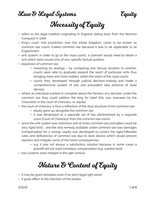
Necessity of Equity
• refers to the legal tradition originating in England dating back from the Norman
Conquest in 1066
• King’s court: had jurisdiction over the whole kingdom, came to be known as
common law courts (called common law because it was to be applicable to all
Englishmen)
• writ system: in order to go to the royal courts, a claimant would need to obtain a
writ which were issued only of very specific factual systems
• expansion of common law
• reasoning by analogy = by comparing one factual situation to another,
courts were able to gradually expand the reach of particular writs thus
bringing more and more matters within the realm of the royal courts
• courts they developed through judicial decision-making and made a
comprehensive system of law and precedent (aka doctrine of stare
decisis)
• where an individual wanted to complain about the fairness of a decision under the
common law they could petition the king for relief (this was overseen by the
Chancellor in the court of chancery, i.e. equity)
• the court of chancery is thus a reflection of the dual structure of the common law
• equity grew up alongside the common law
• it was developed as a separate set of law administered by a separate
court (Court of Chancery) from the common law courts
• since the writ system was restrictive and at times common law principles could be
very rigid/strict, and the only remedy available under common law was damages
(compensation for a wrong), equity was developed to correct the rigid/inflexible
rules and deficiencies of common law due to stare decisis which would prevent
injustice and mitigate some of the harsh consequences
• e.g. it was not always a satisfactory solution because in some cases a
plaintiff did not want monetary compensation (e.g. wanted land)
• two systems were merged in the 19th century
Nature & Content of Equity
• it may be grant remedies even if no strict legal right exists
• it gives effect to the intention of the parties
KMB 1 of 6
Necessity of Equity
• refers to the legal tradition originating in England dating back from the Norman
Conquest in 1066
• King’s court: had jurisdiction over the whole kingdom, came to be known as
common law courts (called common law because it was to be applicable to all
Englishmen)
• writ system: in order to go to the royal courts, a claimant would need to obtain a
writ which were issued only of very specific factual systems
• expansion of common law
• reasoning by analogy = by comparing one factual situation to another,
courts were able to gradually expand the reach of particular writs thus
bringing more and more matters within the realm of the royal courts
• courts they developed through judicial decision-making and made a
comprehensive system of law and precedent (aka doctrine of stare
decisis)
• where an individual wanted to complain about the fairness of a decision under the
common law they could petition the king for relief (this was overseen by the
Chancellor in the court of chancery, i.e. equity)
• the court of chancery is thus a reflection of the dual structure of the common law
• equity grew up alongside the common law
• it was developed as a separate set of law administered by a separate
court (Court of Chancery) from the common law courts
• since the writ system was restrictive and at times common law principles could be
very rigid/strict, and the only remedy available under common law was damages
(compensation for a wrong), equity was developed to correct the rigid/inflexible
rules and deficiencies of common law due to stare decisis which would prevent
injustice and mitigate some of the harsh consequences
• e.g. it was not always a satisfactory solution because in some cases a
plaintiff did not want monetary compensation (e.g. wanted land)
• two systems were merged in the 19th century
Nature & Content of Equity
• it may be grant remedies even if no strict legal right exists
• it gives effect to the intention of the parties
KMB 1 of 6