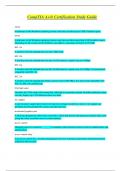
CompTIA A+® Certification Study Guide Completed
CompTIA A+® Certification Study Guide CompTIA A+® Certification Study Guide 32-bit In reference to the Windows operating systems, one that can utilize up to 4 GB of address space. 64-bit In reference to the Windows operating systems, one that can utilize more than 4 GB of address space. Depending on the version, 64-bit Windows can address a maximum of from 8 to 192 GB. 802.11a A wireless network standard that uses the 5 GHz band. 802.11b A wireless network standard that uses the 2.4 GHz band at a speed of up to 10 Mbps. 802.11g A wireless network standard that uses the 2.4 GHz band at a speed of up to 54 Mbps. It is downward-compatible with 802.11b. 802.11n A wireless network standard that defines speeds of up to 600 Mbps. It is downward-compatible with 802.11a, 802.11b, and 802.11g. 8-bit high color Describes the VGA mode color setting that, although it can produce around 16 million different colors, can only display up to 256 different colors at a time. AC adapter A type of power supply that converts AC power to voltages needed for a device. AC adapters are generally used for portable PC systems and other devices. accelerated graphics port A local bus designed for video only, it provides a direct link between the processor and the video card, giving the video card direct access to main memory. access control Managing access to resources. _______ to computers and network resources involves authentication and authorization. access control entry In an access control list, a record containing just one user or group account name and the permissions assigned to that account. access control list A table on each file and folder in the NTFS file system that contains one or more access control entries. accessory bay In a laptop, a compartment that holds a single media device that is switchable with another. ACT The "activity" status light on a NIC that indicates data is being transmitted. activation A method used by several software manufacturers to combat software piracy. active communication A set of behaviors including active listening and active speaking that shows you are fully engaged in the conversation and encourages the other person to also communicate in a positive manner. active listening A set of skills, behaviors, and attitudes to use when listening to another person. active matrix display An LCD technology based on thin-film transistor (TFT) technology. It has a transistor at every pixel, which enables much quicker display changes active partition A primary partition that is marked for use by the system during startup. Windows operating systems can only be booted from this active speaking The appropriate responses that you make during a conversation. ad hoc mode In a Wi-Fi network, the networking mode that allows peer-to-peer communications without the use of a centralized wireless hub, called a wireless access point (WAP). adapter card A printed circuit card that you add to the motherboard to enhance functionality. Also called an expansion card. Video adapters and network interface cards (NICs) are examples of this address bus A group of wires used to identify addresses in main system memory in a computer. The number of wires in an address bus is called the width of the bus and determines the number of unique memory locations that can be addressed using binary math with the two raised to the power of the number of wires in the bus. A 32-bit bus can address up to 4 GB of memory, whereas a 36-bit address bus can address up to 64 GB of memory. Address Resolution Protocol A protocol used to resolve an IP address to a MAC address. Advanced Communications Riser A riser card standard that AMD, 3Com, and others introduced in 2000 to supersede AMR. It uses one PCI slot, provides accelerated audio and modem functions as well as networking, and supports multiple Ethernet NICs. Advanced Configuration and Power Interface A power management standard that includes all the power states of APM, plus two more. It also supports soft power. Advanced Micro Devices AMD manufactures CPUs and other products, and its chief rival is Intel Corporation. Advanced Power Management A power management standard, introduced by Intel in 1992, that defines four power-usage operating levels. Advanced Technology A type of motherboard used in older PC systems; also refers to the 1984 IBM PC AT model. Advanced Technology Attachment The former name of the Parallel AT Attachment (PATA) interface standard. Advanced Technology eXtended A type of motherboard and its variants most commonly used in recent PC systems. adware Software installed on a computer without permission that collects information about a user in order to display targeted advertisements, in the form of either inline banners or pop-ups. Inline banners are advertisements that run within the context of the current page, taking up screen real estate. alternating current The delivery of electricity (as from a wall outlet) in which the flow of electrons reverses periodically and has alternating positive and negative values. amperes (amps) A measurement of the volume of electrons, also called current. It is calculated with the formula amps = watts / volts. analog LCD display An LCD display that uses a DB-15 connector, which means that it accepts analog signals that it converts to digital. analog modem A modulator/demodulator device that allows computers to communicate with one another over existing phone lines. answer file A file used during an unattended installation of Windows. It provides a script of responses to the questions Setup asks so the user does not have to answer them manually. antistatic mat A mat that provides a path to ground for a static charge and is designed for the desktop or floor of a workspace. One placed on the workbench reduces the risk of electrostatic discharge for components placed on it, while one placed on the floor provides the same protection for anyone standing on the mat. antistatic wrist strap A strap designed to discharge static electricity from your body. One end attaches to the wrist, whereas the other end attaches to a grounded object. archive attribute A file attribute set by the OS when a file is created or modified. Backup software often removes this attribute when backing up a file in order to mark it as a backed-up file. arithmetic logic unit A component of a CPU that is responsible for all logical and mathematical operations in the system. aspect ratio The proportion between an image's width and height. Traditional CRT monitors have an aspect ratio of 4:3. Widescreen displays have an aspect ratio of 16:9. asymmetrical digital subscriber line A type of DSL service in which the download speed is higher than the upload speed. asynchronous transfer mode A type of switched network used by phone companies. ATA Packet Interface The protocol for connecting optical drives and tape drives to an ATA channel. attended installation An installation of Windows that is not automated, where the user is required to pay attention throughout the entire process to provide information and to respond to messages. Also called a manual installation. ATV12V A power supply standard that has both the 20-pin connector for the motherboard and a 4-pin 12 V connector. ATX power supply A power supply form factor that pairs with an ATX motherboard and case. audio modem riser A small expansion card introduced in the late 1990s that plugs into a special slot on a motherboard and uses the CPU to perform modem functions and sound functions. It is not plug and play compatible. Audit Policy In Windows, one or more settings found in the Local Security Settings console. authentication A validation of a user account and password that occurs before the security components of Windows will give the user access to the computer. authentication factor Things used for authentication, such as something you know, something you have, or something you are. Authentication involves one or more of these factors and can, therefore, be one-factor, two-factor, or three-factor authentication. authorization The process that authenticates a user and verifies the user account's level of access to a resource. ASR An option available in the Windows XP Backup program for recovering from damage that prevents the operating system from starting. It replaced the Emergency Repair Disk (ERD) process in Windows 2000. Automated System Recovery In Windows XP, this replaces the Emergency Repair process of Windows NT and Windows 2000. It is available from the Windows Backup program (NTBACKUP.EXE). Automatic Private IP Address An address that a DHCP client will assign to itself after requesting an address and failing to receive one from a DHCP server. The address it will assign is in the 169.254 /16 network, which is the range of addresses from 169.254.0.1 to 169.254.255.254. auto-switching power supply A power supply that detects the incoming voltage and switches to accept either 120 or 240 VAC. back door Program code that provides a way for someone to gain access to a computer while bypassing security. Only a person who knows how it works can use it, but once in, that individual has the same access as the host program to all the internal operating system code. background process A process that runs "behind the scenes" with a low priority, does not require input, and rarely creates output. backup media Any writable mass storage device, removable or fixed in place. Balanced Technology eXtended A motherboard form factor introduced in 2003 by Intel as the successor to ATX. bandwidth The amount of data that can travel over a network at a given time. bar code reader A specialized type of scanner that reads bar codes, which are patterns of bars of varying widths printed on labels or directly on items. The bar pattern is converted into a numeric code that is transmitted to a computer as data. basic disk A disk that uses basic storage, which means that it uses the partition table in the master boot record (MBR) to define disk partitions. BIOS A type of computer firmware that is responsible for informing the CPU of installed devices and how to communicate with them. Basic Service Set The wireless nodes (including the WAP) communicating together in infrastructure mode. basic storage A storage type in Windows that uses the partition table in the master boot record (MBR) to define disk partitions. BDD Workbench A tool used to create and manage a distribution share and various installation images. beam-on-blade connector The type of connector used in the ExpressCard interface. bidirectional mode A parallel port mode in which the signals can be transmitted in both directions between the PC and parallel devices connected to the computer. biometric A measurement of a body part, such as a fingerprint or retina scan. biometric device A device that uses a measurement of a body part, such as a fingerprint or retina scan. biometric logon The use of a biometric for authentication. BIOS settings The BIOS configuration settings, also called system settings, accessed via a special BIOS-based menu during system startup. bit width In reference to a memory module, how much information the processor can access from or write to memory in a single cycle. BitLocker drive encryption An encryption technology introduced in Windows Vista Enterprise and Ultimate editions, Windows Server 2008, and also in Windows 7 Ultimate and Enterprise editions. It encrypts the entire boot volume. bluesnarfing The act of covertly obtaining information broadcast from wireless devices using the Bluetooth standard. Bluetooth A wireless standard for using radio waves to communicate between devices Blu-ray disc The high-definition optical disc formatting standard developed by the __ Association whose members include Sony, 20th Century Fox, Dell, Hewlett-Packard, and many other industry leaders. BNC A connector used to attach coaxial cables to computers and network equipment. boot record The first physical sector on a floppy disk or the first sector on a hard drive partition. It contains information about the OS. The __ on a primary active partition is used to start the operating system. boot sequence The order in which the BIOS will search devices for an operating system to start. bridge A network connection device that passes traffic between two networks, using the physical address (MAC address) of the destination device. broadband WAN A wide area network (WAN) connection that allows a large amount of data to be transmitted. Broadband WANs includes cellular, ISDN, DSL, cable, T-carrier, satellite, and fiber. Bubble Jet A popular inkjet printer developed by Canon. bus In a computer, pathways that power, data, and control signals travel from one component to another within the system. C Used to represent the chrominance signal in S-Video. cable select An EIDE drive setting that has the system select the drive's role (master or slave) based on the drive's position on the cable. If the drive is on the end of the cable, it is the master drive, and if it is in the middle of the cable, it is the slave drive. cable tester A tool for testing if a cable can connect properly end-to-end and to determine if a cable has a short. These tools are available for a variety of cable types. cache controller A CPU component that manages the CPU cache. capacity In power supplies, the amount of wattage the power supply can handle. capture card A category of adapter card that accepts and records video signals to a PC's hard drive. card services A service on a laptop that configures a card after socket services has recognized it. CardBus The PCMCIA standard that succeeds the PC Card. case The box that houses the main computer system. case fan A cooling fan mounted directly on the case, as opposed to a power supply fan, which is inside the power supply. cathode ray tube (CRT) monitor A display device that contains a cathode ray tube and uses an electron gun to activate phosphors behind the screen at the front of the tub. CD-R (CD-Record) A drive that can write once to a special CD-R disc. CD-ROM drive A drive on a computer that can play music CDs and read data CDs, but cannot write to CDs. CD-RW A drive that can write either to CD-R discs or to specially designed CD-RW discs. In the case of the CD-RW discs, the drive can write more than once to the same portion of disc, overwriting old data. cellular WAN Data communications over the cellular telecommunications networks. central processing unit The primary control device for a computer system. It is simply a chip containing a set of components that manages all the activities. Also called a processor. Centronics A 36-pin connector mounted to a device's parallel interface. channel service unit A device required at both ends of a T-carrier system connection. charging In the laser printing process, the stage in which the printer's high-voltage power supply (HVPS) conducts electricity to the primary corona wire so it can pass the voltage on to the printer's electro-photosensitive drum. chipset One or more chips designed to work closely with the CPU. Two parts of this chipset are the Northbridge and the Southbridge. chrominance The signal in a television transmission that contains the color of the image. cleaning In the laser printing process, the stage in which the image is removed from the photosensitive drum so it can accept the next image. cleaning blade In the laser printing process, a blade that removes residual toner from the drum. client/server-based network A network in which dedicated computers called servers store data and provide print services or other capabilities to computers running the appropriate client service or services. clock speed In a CPU, the speed at which it can potentially execute instructions, measured in millions of cycles per second—megahertz (MHz)—or billions of cycles per second—gigahertz (GHz). cluster The minimum disk space that a file can use, allocated in the file system. CMOS settings A misnomer, referring to the BIOS settings that are stored in a CMOS chip. coaxial cable Cabling that contains a single copper wire surrounded by several layers of insulating plastic and a woven wire sheath that provides protection. Code Division Multiple Access The cellular network standards used by Verizon and Sprint-Nextel. code signing A practice begun in Windows 2000 in which all of the operating system code is digitally signed to show that it has not been tampered with. color depth The number of colors used by a display. Color Quality A Windows display setting that allows you to adjust the number of colors, or color depth, used by the display. communication network riser A riser card that is similar to audio modem riser (AMR) except that it is plug and play-compatible and supports LANs in addition to audio, modem, and sound. compact disc An optical disc created and read by a mechanism using a laser. (2) Compact Disc File System A file system used by operating systems for organizing, reading, and writing optical discs. CD-ROM Laser discs sold at retail stores that contain music (audio CDs) or software (data CDs). CompactFlash A type of solid-state storage that is commonly used in a variety of devices, such as digital cameras. CMOS A chip that retains system settings such as the time, keyboard settings, and boot sequence. component video A video signaling method in which analog video information is transmitted as two or more discrete signals. Two general types are RGB Video and S-Video. composite video The traditional transmission system for television video signals, which combines the color and brightness information with the synchronization data into one signal. The TV circuitry then separates the two signals from the composite signal. computer platform The hardware architecture, including the CPU, BIOS, and chipset. COMx A generic reference to a PC's serial communications port, in which the x represents the port number. connector The plug at the end of a cable or the port or connection point on a computer or device. continuity RIMM A special terminating stick that must be inserted into the open RIMM sockets. contrast ratio The difference in value between a display's brightest white and darkest black. Modern LCD displays have a contrast ratio of 500:1 or greater. Control Panel A Windows folder that contains numerous applets you can use to adjust the configuration of many different aspects of the OS. (8) control unit In a CPU, the component that is primarily responsible for directing all the activities of the computer and the interactions of its components. cookies Small text files a Web browser saves on the local hard drive at the request of a Website. copy A file operation in which the file or folder remains in the source location, and a duplicate is created in the target (destination) location CPU fan A cooling fan located on a CPU. CrossFire A multi-GPU solution developed by ATI. customer premises equipment A T-1 multiplexer or a special LAN bridge that connects to the telephone company's channel service unit (CSU), which encodes data for transmission over a T-carrier circuit. data migration The moving of data from one storage device to another. datagram The chunks into which the TCP protocol packages data. In addition to the data, each datagram contains information, stored in a header, which is used by the TCP protocol on the receiving end to reassemble the chunks of data into the original message. daughter card A type of riser card that connects directly into a motherboard and adds no additional functionality of its own, but extends the expansion bus and allows expansion cards to be added in a different physical orientation. DB-25 A 25-pin D-shell connector. DB-9 A 9-pin D-shell connector. DC Controller A device found in laptops that monitors and regulates power usage. The features vary by manufacturer, but typically, they provide short-circuit protection, give "low battery" warnings, and can be configured to shut down the computer automatically when the power is low. DDR2 SDRAM A RAM standard that replaces the original DDR standard. Using far less power than DDR1, a stick of DDR2 SDRAM has 240 pins. DDR3 SDRAM A RAM standard that replaces the original DDR2 standard and requires far less power, while providing almost twice the bandwidth. A stick of ___ has 240 pins, but is keyed so it will not fit into a socket designed for DDR2. DDR3 SO-DIMMs have 204 pins. dead pixel A dark spot on an LCD screen caused when a transistor is permanently off. Debugging Mode A Windows Advanced Options menu choice used to send debugging information about the Windows startup over a serial cable to another computer running a special program called a debugger. default gateway In an IP configuration, the address of the local router that acts as a gateway from the local network to other IP networks. degaussing The process of using an oscillating magnetic field to reduce and randomize the magnetic field that builds up on the shadow mask of a CRT monitor. demilitarized zone In computer networking, a network located between a private network and the Internet with a firewall on both sides. DoS attack This attack occurs when someone sends a large number of requests to a server, overwhelming the server so it stops functioning on the network. developing In the laser printing process, this is the step in which the cover on the printer's toner cartridge is opened and the toner particles are attracted to the relatively less negatively charged areas of the drum. device driver Program code that allows an operating system to control the use of a physical device. Device Manager A Windows GUI utility that allows an administrator to view the status of devices and install, remove, and update device drivers DHCP Server A server running the Dynamic Host Configuration Protocol (DHCP) service. This server allocates IP addresses to DHCP client computers. dialer A program that causes a modem to dial phone numbers surreptitiously. dial-up A WAN connection that uses an analog modem rather than a network card and uses standard phone cables rather than network cables. digital LCD display An LCD display that accepts a digital signal. Early LCD displays accepted an analog signal and converted it to digital internally. Digital Light Processing An optical semiconductor used in small projectors and in rear-projection televisions. digital linear tape A technology developed in the 1980s for storing data. Variations of this format are in use today. digital signature Encrypted data placed in a file to guard against tampering. DSL A WAN connection that uses existing copper telephone wire for the communication circuit. To accomplish this, the modem splits the existing phone line into two bands; voice transmission uses the frequencies below 4000 Hz, whereas data transmission uses everything else. digital versatile disc A disc designed to store all types of data usable by a computer. This term also refers to the drives that read and write to these discs. There are various types of DVD drives and media. digital video discs The original digital discs created in 1995 for storing video. (1) digital video interface It has several modes, including one that offers downward compatibility with analog displays. It requires a special connector, which comes in several variations to support it digital video recorder A device that records video content to disk. digitizing tablet An input device that uses a stylus. Available as an external device, it uses touch screen technology and is usually at least the size of a sheet of paper. Also called a digitizer. DIN connector A round connector that gets its name from Deutsche Industrie Norm, a German standards organization. Normally a round connector with a circular or semicircle of pins. DIP switch Dual inline package. A very tiny slide that indicates two states. Motherboard and other circuit cards often have one or more groupings of ____ for configuring options. direct current The type of electrical current delivered by a battery in which the electrons flow in only one direction. direct memory access channel A system resource that certain devices, such as sound cards and hard drives, can use to move data between the device and system RAM without involving the processor. direct thermal printer A type of thermal printer in which a heated print head burns dots into the surface of heat-sensitive paper. Directory Services Restore Mode In Windows, an Advanced Option that is only available in Windows Servers in the role of domain controllers, although it appears on the menu in non-domain controllers. Disable Automatic Restart An Advanced Options choice that will temporarily disable the Automatically Restart option on the Advanced page of System Properties. discretion Not revealing information about someone that would be harmful to or embarrass him or her. display A screen device for video output. Also called a monitor. Display Brightness Key A key on a laptop that, when pressed along with the FN key, changes the laptop display brightness at the hardware level. On some laptops, when this key combination is pressed, a small brightness control panel will display on the screen. Use the up (↑) or right (→) arrow key to increase the brightness, and use the left (←) or down (↓) arrow key to decrease the brightness. Display Mode Key A key on a laptop that is pressed along with the FN key to change display modes so the output will be only to the laptop's display, only to an external display, or simultaneously to both displays. The DISPLAY MODE key is normally a function key, such as F7, that displays a display symbol. display power-management signaling A VESA standard for power management in display devices. display resolution The displayable number of pixels, expressed as x and y numbers, such as 1024 × 768, 1152 × 864, and 1280 × 1024. DisplayPort A digital display interface standard developed by the Video Electronics Standards Association that supports both video and audio signals, contains HDCP copy protection, and is unique because it is royalty-free to manufacturers. distributed denial of service (DDoS) attack This attack occurs when a massive number (up to hundreds of thousands) of computers send DoS attacks to a server, making it unavailable. Distributed File System A service implemented on Windows Servers that hides the complexity of the network from end users in that it makes files that are distributed across multiple servers appear as if they are in one place. distribution server A server containing source files for installing software onto client computers. The shared folder containing these files is a software distribution point. distribution share A shared folder on a distribution server containing the source files for a remote installation. DMA controller A specialized chip that controls DMA channels. DNS Server A server that manages DNS names. docking station A more advanced and more expensive alternative to a port replicator. In addition to the ports normally found on a port replicator, it may include full-size expansion slots and drives. domain In a Microsoft Windows network, an administrative organization with a centralized security accounts database maintained on one or more special servers called domain controllers. This centralized database contains accounts for users, groups, and computers participating in the domain, and it is used to authenticate a user for access to any resource in the domain. DNS The Internet service that manages access to Internet domain names and the naming system it uses for computers and resources connected to the Internet or in a private network. dot matrix printer A type of printer that uses a matrix of pins striking paper through an ink ribbon to create dots on the paper, forming alphanumeric characters and graphic images. dotted decimal notation The format in which IP addresses are usually shown, with decimal numbers separated by "dots" as in 192.168.100.2. double-data rate SDRAM RAM that doubles the rate of speed at which a standard SDRAM can process data double-sided DVD A DVD of any type that can store data on both sides of the disc. drive image An exact duplicate of an entire hard drive's contents, including the OS and all installed software. drive lock password A password that locks your hard drive and is often stored in a TPM chip drive path When a mount point exists between a partition or volume to a folder on another volume, the drive path is the path (including a drive letter) to that partition or volume. drive-by download A program downloaded to a computer without the user's consent. The user unwittingly initiates the download by some simple act, such as browsing to a Website or opening an e-mail message written in HTML. Or a user may initiate a drive-by download by installing an application. driver signing The practice of applying a digital signature to device driver code. DIMM A memory module (stick) that installs into matching DIMM sockets found on many motherboards. The word "dual" refers to the separate pins or connections on both sides of the module and socket. dual layer Pertaining to a DVD drive and disc that can store data in two pitted layers on each data side, with each layer having a different reflectivity index. dual-core CPU A CPU containing two CPU cores. DVD+R Digital versatile disc (DVD) discs that can be written to, but data cannot be overwritten. This standard is newer than DVD-R. This term also refers to the drives that can write to these discs. DVD+RW Digital versatile disc (DVD) discs that can be rewritten to, and data can also be overwritten. This standard is newer than DVD-RW. This term also refers to the drives that can write to these discs. DVD-10 A double-sided, single-layer digital versatile disc (DVD) that stores 9.4 GB of data, or over four hours of video. DVD-18 A double-sided, double-layer digital versatile disc (DVD) that stores 17.08 GB of data, or over eight hours of video. DVD-5 A single-sided, single-layer digital versatile disc (DVD) that stores 4.7 GB of data, or over two hours of video. DVD-9 A single-sided, double-layer digital versatile disc (DVD) that stores 8.54 GB of data, or over four hours of video. DVD-Data discs A blanket term used for DVD discs regardless of the type of data they contain. DVD-R Digital versatile disc (DVD) discs that can be written to once, but data cannot be overwritten. This term also refers to the drives that can write to these discs. DVD-RAM The digital versatile disc (DVD) encoding format used for data storage. DVD-ROM The read-only DVD discs sold at retail stores, containing video or software and having a maximum capacity of 15.9 GB of data. This term also applies to the drives that can only read DVDs. DVD-ROM drive A DVD drive that cannot write to but can read DVD discs. DVD-RW Digital versatile disc (DVD) discs that can be written to, and data can also be overwritten. This term also refers to the drives that can write to these discs. DVD-Video The original digital versatile disc (DVD) encoding format used for movies sold at retail. DVI-A A DVI mode that supports downward compatibility with analog displays. DVI-D A DVI mode that supports digital video signals and is partially compatible with HDMI. See also digital video interface and High-Definition Multimedia Interface. DVI-I A DVI mode that supports both analog and digital video signals. DXDIAG Windows run-line utility for testing the DirectX support. Launch this program when experiencing video problems and/or audio problems when running DirectX applications. dynamic disk A disk type introduced with Windows 2000 that contains space allocated in volumes without the limits imposed on basic disks. On a dynamic disk, the number of volumes are unlimited, and a volume can extend to include available space on any hard disk in the computer. Dynamic Host Configuration Protocol (DHCP) The protocol used by DHCP servers and clients. A DHCP server allocates IP addresses within the scope of addresses configured on the server by an administrator. DHCP clients request IP addresses and other IP configuration settings from DHCP Servers. DRAM Memory chips that provide much slower access than SRAM chips but that can store several megabytes of data on a single chip (or hundreds of megabytes, or even gigabytes, when they are packaged together on a "stick"). dynamic storage A method for allocating disk space on hard disks in which configuration information for each dynamic disk is located on the disk space beyond the first physical sector. This configuration information is stored outside of any volume on the hard disk. edition A subpackaging of a Windows revision that contains the core OS plus a special set of features that is offered as a separate product targeted to a certain type of end user. EEPROM A ROM chip that is erasable using an electrical charge. EMI The disruption of signal transmission caused by the radiation of electrical and magnetic fields. Electric motors are a common source of EMI. EMP A large burst of electromagnetic energy, as from a nuclear explosion, that has the potential to damage communications and power lines within a large geographic area, depending on the size and location of the pulse electronic KVM switch A KVM switch that uses software and special keyboard commands to switch among controlled computers. Also called anactive KVM switch. electro-photosensitive drum In a laser printer, a metal drum with an electro-photosensitive coating to which a charge can be applied by a laser beam. ESD The sudden and uncontrolled movement of electricity from an object with a greater charge to one with a lesser charge. Also called static electricity. embedded systems A special-purpose computer designed for a certain task and installed within a device. ERD A special disk used for recovering an OS failure in Windows 2000. Emergency Repair Process A Windows 2000 recovery tool requiring an up-to-date emergency repair disk (ERD) or recent emergency repair information stored on the local hard disk Enable Boot Logging An Advanced Options menu choice that creates a log of the Windows startup in a file named NTBTLOG.TXT and saved in thesystemroot folder (normally C:Windows). Enable Low Resolution Video In Windows Vista and Windows 7, an Advanced Options menu choice that starts Windows normally, except that the video mode is changed to the lowest resolution, using the currently installed video driver. This option does not switch to the basic Windows video driver. Enable VGA Mode In Windows 2000 and Windows XP, an Advanced Options menu choice that starts Windows normally, except that video mode is changed to the lowest resolution, using the currently installed video driver. This option does not switch to the basic Windows video driver. encrypted authentication A security service in which authentication credentials are encrypted (user name and password) before transmission over a network. Encrypting File System (EFS) A security feature of many Windows versions that allows it to encrypt files on an NTFS volume encryption The conversion of data into a special format that cannot be read by anyone unless they have a software key to convert it back into its usable form. ECP mode A mode for parallel ports that allows access to special features in the PC called DMA channels. This mode is approximately ten times faster than regular bidirectional mode and is designed for printers and scanners. EIDE A standard for hard drives that attach to the Parallel AT Attachment (PATA) interface. EPP mode A parallel port mode that has the same performance as ECP but is used with parallel devices other than printers and scanners. EPROM Erasable programmable read-only memory. A ROM chip that is erasable and reprogrammable through the use of specialized software. erasure lamp In a laser printer, a high-intensity lamp that, when shone on a portion of the electro-photosensitive drum, removes any remaining charge on that portion of the drum. ECC A method of memory error-checking that is more sophisticated than parity checking. Like parity checking, it adds an extra bit per byte. In addition, software in the system memory controller uses an algorithm to both detect and correct errors Ethernet A group of networking standards created by the IEEE 802.3 subcommittee even parity A memory error-checking method in which the parity bit is used to ensure that the total number of 1s in the data stream is even. exception In router configuration, a term that is used to describe traffic that is allowed, as in allowing traffic using a certain port number through the router. expansion bus A grouping of wires built into a PC that, based on certain protocols, transfers data, control signals, and power to printed circuit boards (adapter cards) that are plugged into connectors in it. ExpressCard A PCMCIA card standard that comes in two interfaces: PCIe and USB 2.0 extended partition A partition type that can exist on a basic disk and have one or more logical drive letters assigned to it. A Windows operating system cannot boot from this type of partition EVGA A VESA standard for graphics adapters with a maximum graphics resolution of 1024 × 768 pixels extension magnet A long-handled tool with a magnet on one end, used to pick up small objects containing iron. external cache In a CPU, special memory that resides outside the CPU's core and is used to temporarily store instructions and data in order to increase the processing speed. Also called Level 2 (L2) cache and Level 3 (L3) cache, depending on the design of the CPU and motherboard. External Serial ATA (eSATA) An extension of the SATA standard for external SATA devices, with speeds triple that of USB 2.0. Fast Ethernet Using the same cabling as 10BaseT or 100Base-T, operates at 100 Mbps and uses different network interface cards. fast page mode (FPM) An early technology for increasing the performance of DRAM. FAT file system A file system in which one of the basic structures is a table used for allocating space. FAT12 A version of the FAT file system for very small drives—mainly for floppy drives, using a 12-bit file allocation table. FAT16 A version of the FAT file system used by MS-DOS for hard drives, using a 16-bit file allocation table. FAT32 A version of the FAT file system used by hard drives and some flash drives (thumb drives, etc.), using a 32-bit file allocation table. fiber-optic cable A cable medium that transmits light pulses rather than electrical signals, so it is not susceptible to electromagnetic interference (EMI). FRU A component that you can install into a system onsite, such as memory modules, heat sinks, and CMOS batteries file Information organized as a unit into a container. The author (creator) of a file controls how much information the file contains. FAT The file system component in the ___file system in which the OS creates a table that serves as a map of where files reside on disk file signature verification A process applied to digitally signed code to unencrypt the signature data and use the information to verify the program code was not modified since the signature was added. file system The logical structure on disk that allows the operating system to save and retrieve files. FTP A protocol for computer-to-computer (host-to-host) transfer of files over a TCP/IP network, regardless of the operating system in use. firewall A computer (or dedicated device) that sits between a private network and an untrusted network and examines all traffic in and out of the network it is protecting. It will block any traffic it recognizes as a potential threat, using a variety of techniques. firmware Software instructions stored in ROM chips. It exists on most PC components and on the motherboard. fixed input power supply A power supply that only accepts one input power voltage. flash BIOS BIOS that can be electronically upgraded. flash memory A type of solid-state storage that is commonly used in a variety of devices, such as digital cameras, which often use CompactFlash. flash ROM A technology for ROM that can be reprogrammed using special software. flashing The act of electronically upgrading BIOS. flat panel display (FPD) A computer display that uses liquid crystal or plasma technology and does not require the bulk of a large picture tube. The screen enclosure can be as thin as one to two inches. floating-point unit (FPU) A type of arithmetic logic unit (ALU) that is used to perform specialized functions, such as division and large decimal number operations. Also called a math coprocessor. floppy disk A magnetic storage device that contains a thin internal plastic disk, capable of receiving magnetic charges contained in the thin magnetic coating on the disk. floppy disk drive A drive used for reading from and writing to removable floppy disks. Fn key A special modifier key on a laptop keyboard that when pressed together with certain alphanumeric keys, changes the output of the pressed key. It is often called the function key. Foreign In Disk Management, the status given to a dynamic disk that has not had its configuration information (stored on the disk) imported into Windows. This status occurs when a dynamic disk is moved to a different Windows computer or when a dynamic disk fails. form factor On a motherboard, the type and location of components, as well as the size of the board itself. format A process that places the logical structure of a file system on a partitioned volume. frame relay A type of switched network used by phone companies. fraud The use of deceit and trickery to persuade someone to hand over money or valuables. FSB An internal bus in a CPU that connects it to memory and video. full-duplex In reference to networks, communications in both directions at the same time. fusing In the laser printing process, the step at which the heat-sensitive toner is fused to the paper by heated fusing rollers. fusing lamp In a laser printer, the lamp that heats the fusing rollers. fusing rollers In the laser printer, the heated rollers that fuse the toner to the paper. gadget A small program, such as those that can be run from the Windows Sidebar. Gigabit Ethernet Also called 1000Base-T, this networking standard supports speeds up to 1 Gbps. GSM The cellular network standards used by AT&T and T-Mobile. graphical processing unit (GPU) A processor on a graphics adapter used to render graphics images for the display, saving the CPU for other functions. GUI A user interface that takes advantage of the video system's graphics capabilities for manipulated graphic elements that represent objects and tasks. grayware Threats that are not truly malicious code, but can have indirect negative effects, such as decreasing performance or using up bandwidth. Grayware includes spyware, adware, spam, and spim. hacker A perpetrator of malicious software attacks against computers and networks. half-duplex In networks, when data can travel in either direction, but only in one direction at a time hard disk drive A magnetic storage device that stores data on metal platters that have a coating that holds data in the form of changes to small magnetic particles in the coating HAL A component of the Windows operating system that resides in a file and is loaded into memory during the kernel loading phase of the Windows startup. HD-DVD The high-definition optical disc formatting standard, promoted by Toshiba, that was defeated by the Blu-ray Disc standard as the widely accepted high-definition standard. heat sink A heat dissipation device, usually a passive metal object with a flat surface attached to a component, such as a chip. h-hold A CRT video setting, also known at horizontal hold, that holds the image horizontally on the screen. hibernate A Windows sleep mode that uses hard drive space to save all the programs and data that are in memory at the time you choose this mode. The computer then completely shuts down and requires no power while it is hibernating. hidden attribute A file attribute that is given to a file to indicate it should not be visible in Windows Explorer unless View settings override the attribute and allow the file to be shown. High-Bandwidth Digital Content Protection A feature of HDMI that prevents people from illegally copying HD DVDs. See also High-Definition Multimedia Interface (HDMI). HDMI An interface standard for use with DVD players, digital television (DTV) players, set-top cable or satellite service boxes, and other devices. It combines audio and video signals into an uncompressed signal and has a bandwidth of up to 5 GB/second. Only one specially designed cable is required where previously several were required. high-voltage power supply (HVPS) Any power supply that provides high voltage, such as those in laser printers and CRTs. horizontal position A setting on an LCD display that adjusts the viewable area of the display horizontally. hot spot A physical area where a Wi-Fi network connects to the Internet. hot swapping The act of safely installing/uninstalling or attaching/removing a device while a computer is up and running. hot-swappable drive A drive that can be safely installed and removed while a computer is up and running without damaging the data stored on the drive. hub [1] A device that is the central connecting point of a LAN. It is little more than a multiport repeater taking incoming signals on one port and repeating them to all other ports. Ethernet __ have been largely replaced by Ethernet switches. [2] A multiport connecting device for USB devices. hyper threading A CPU technology that allows two threads to execute at the same time within a single execution core. This technology is considered to be partially parallel execution. Intel introduced it in the Pentium 4 Xeon CPU. Also known as simultaneous multithreading (SMT). HTML The language of Web pages. Web designers use this language to create Web page code, which your Web browser converts into the pages you view on your screen. HTTP The information transfer protocol of the World Wide Web (WWW). Included in HTTP are the commands Web browsers use to request Web pages from Web servers and then display them on the screen of the local computer. I/O address An assigned address or range of addresses on a system's address bus that, together with an interrupt request line (IRQ), allows a device to be recognized by the processor. icon In an operating system GUI, a tiny graphic representing an application, folder, disk, menu item, or other entity. identity theft This occurs when someone collects personal information belonging to another person and uses that information to fraudulently make purchases, open new credit accounts, and even obtain new driver's licenses and other forms of identification in the victim's name. IEC-320 connector A slide switch on the exterior of a PC power supply used to switch between two input voltages. IEEE The Institute of Electrical and Electronics Engineers, an international nonprofit organization that sets standards as part of its charter. IEEE 1284 A parallel interface standard that supports bidirectional communication and transfer rates of up to 2 MBps. IEEE 1394 An external serial bus standardized by the IEEE. Apple first developed it as FireWire. Other manufacturers call it or Lynx. It can support up to 63 daisy-chained devices. Since the introduction of the faster update, IEEE 1394b, the original standard is called IEEE 1394a. IEEE 1394a The original version of the IEEE 1394 standard that supports speeds up to 400 Mbps. IEEE 1394b The second version of the IEEE 1394 standard; it supports speeds up to 3.2 Gbps and distances of up to 100 meters. IEEE 1394c-2006 The third version of the IEEE 1394 standard; it is a departure from the old standards in that it uses Category 5e twisted pair cable with RJ-45 connectors, combining Ethernet and FireWire. impact printer A type of printer that transfers ink to paper by causing a print head to strike a printer ribbon containing ink against the paper. inactive KVM switch A type of KVM switch that is controlled through a mechanical switch on the box Independent Basic Service Set (IBSS) A small group of computers communicating wirelessly with one another without the use of a centralized wireless access point (WAP). industry standard architecture (ISA) A very old expansion bus standard, seen in the early IBM PC. Infrared (IR) Light waves in the infrared spectrum. Infrared Data Association (IrDA) An organization that creates specifications for infrared wireless communication. infrastructure mode A wireless mode requiring a wireless access point (WAP). ink cartridge A small cassette containing an ink reservoir used to provide the medium for certain printers. It will only fit a certain model printer. inkjet A type of printer that uses one of several technologies to apply wet ink to paper to create text or graphic printouts I/O In reference to computers, the pathways or methods for what goes into a computer in the form of data and instructions and similarly what comes out of the computer in many forms, including an onscreen display, a printout sent to a printer, or data sent to another device or computer. Integrated Access Device (IAD) A device that converts digital signals from the broadband connection to voice for the analog phone and the analog voice signals to digital signals for the digital network. IDE An early PC hard drive interface. Integrated Service Digital Network (ISDN) An early international standard for sending voice and data over digital telephone wires. ISDN uses existing telephone circuits or higher-speed conditioned lines to get speeds of either 64 Kbps or 128 Kbps. the lines also have the ability to carry voice and data simultaneously over the circuit. Intel Corporation One of the two prevailing CPU manufacturers. Intel x86 Specification An Intel specification for the PC 32-bit architecture defining CPUs, motherboards, and other components. internal bus The bus within a CPU that connects the CPU to external components. internal cache memory In a CPU, special memory that resides within the CPU's core and is used to temporarily store instructions and data in order to increase the processing speed. Also called L1 cache. InterNational Committee on Information Technology Standards (INCITS) A standards organization, of which the T10 SCSI committee maintains the SCSI standard. Internet The worldwide interconnection of networks that can be accessed with various Internet-based software. The World Wide Web is one of the many services of the Internet. ICMP A subprotocol of IP that detects and reports problems that can cause errors. Internet Explorer (IE) A Web browser created by Microsoft. Internet Message Access Protocol (IMAP) A protocol used by e-mail clients for communicating with e-mail servers. This protocol is replacing the POP protocol. IMAP allows users to connect to e-mail servers and not only retrieve e-mail, which removes the messages from the server, as they can do with the POP protocol, but also manage their stored messages without removing them from the server. IP One of the main protocols of the TCP/IP protocol suite, IP manages logical addressing of network packets so routing protocols can route the packets over the network. ISP A company in the business of providing Internet access to users. internetwork An interconnected network. The Internet is the largest example. IRQ An assigned channel over which a device can send a signal to the processor to get its attention. intranet A private internetwork. inverter A device that converts DC current to AC. An inverter is required in a laptop to provide the AC current required by the display. IP packet filtering A firewall service that inspects (or filters) each packet that enters or leaves the network, applying a set of security rules defined by a network administrator, and not allowing packets that fail inspection to pass between networks. IP router A network connection device that routes IP packets between networks. IPCONFIG A command-line utility installed on a Windows computer with the TCP/IP protocol suite; it's used to view the IP configuration of a network connection and to perform certain administrative tasks. jargon The use of words, often technical and uncommon, that both parties understand in the same way. jumper On a circuit board, a small connector that slides down on a pair of pins jutting up from the board. Multiple pins are often side-by-side, and a jumper joins a pair of them. key fob A small device containing a microchip used to generate unique passwords for logging on to a computer or a network. keystroke logger A hardware device or a program that monitors and records a user's every keystroke, usually without the user's knowledge. KVM over IP A remote KVM switch that captures the keyboard, video, and mouse signals, encodes them into IP packets, and sends them over an IP network. KVM switch A device that in its traditional configuration as a local KVM switch connects a single keyboard, video display, and mouse to two or more computer systems, allowing the user to switch control from one computer to another. land A raised area on an optical disc that is alternated with depressed areas to be interpreted as data. LGA A processor packaging that uses pads on the processor that come in contact with pins in the socket on the motherboard, permitting a higher density than possible with PGA. laptop A small, easily transported computer, generally weighing less than 7 pounds and with roughly the same dimensions as a 1- to 2-inch-thick stack of magazines laser beam A coherent and concentrated light beam, also simply called a laser. laser printer A printer that uses a light beam (laser) in the printing process. Last Known Good Configuration A Windows Advanced Options menu choice that restores a group of registry keys containing system settings such as services and drivers. latency The amount of time it takes a packet to travel from one point to another. LED A tiny bulb light found on many devices, often used to indicate operational status. letterbox The black box that appears around an image, such as a widescreen video when it is displayed on a screen with a 4:3 aspect ratio. line printer A printer that creates printed output line by line. liquid cooling system A cooling system that uses liquid to transfer heat away from components. LCD A display device that uses liquid crystals to display images. lit pixel A pixel that is permanently turned on, causing the pixel to show constantly as red, green, or blue. Also called a stuck pixel. lithium-ion (Li-ion) battery A type of rechargeable battery used in laptops and other portable devices. local area network (LAN) A network that covers a relatively small area, such as a building, home, office, or campus. The typical distances are measured in hundreds of meters. local group account In Windows, a security account that contains one or more local user accounts, and when a computer is a member of a Windows domain, may also contain domain user or group accounts. local remote KVM switch A remote KVM switch that uses either Cat 5 or USB cabling. The distance it can be from the computers it controls is a function of the length limits of the cabling; it normally uses a proprietary protocol and special hardware. local user account A security account that exists in a local security accounts database. logical block address (LBA) A method for supporting up to 8.3 GB capacity hard drives. Both the BIOS and hard drive system must use this long filename (LFN) A file or folder name that breaks the 8.3 file-naming convention used in the FAT file system. This term continues to be used on newer file systems. loopback plug A plug designed for testing a specific port type (e.g., serial, parallel, or USB). The plug does not connect to a cable but reroutes the sending pins to the receiving pins. Using special software on the computer, a loopback test is performed in which signals are both sent and received. low-voltage differential (LVD) A technology for transferring serial data at high speeds LPT A name used by the Windows operating systems to identify any parallel port. LPT1 The name used by the Windows operating systems to identify the first parallel port. LPT2 The name used by the Windows operating systems to identify the second parallel port. Lucent connector (LC) A fiber-optic connector that has a snap coupling and, at 1.25 mm, is half the size of the SC connector. luminance The signal in a television transmission that contains the brightness of the image. magnetic mass storage Device that stores digital data on magnetized media, such as floppy disks, the metal platters in hard disk drives, and magnetic tape media used in tape drives. malware Software created to perform malicious acts. Also called malicious software. mass storage device A device that stores a large amount of information, even when it is powered off. MBR The first physical sector on a hard disk, which contains the initial boot program that the BIOS loads into memory during bootup. It also contains the partition table. master drive The role of the first EIDE drive on a PATA channel. master file table (MFT) A part of the NTFS file system used to store a transaction-based database, with all file accesses treated as transactions, and if a transaction is not complete, NTFS will roll back to the last successful transaction. MSDS A standardized document that contains general information, ingredients, and fire and explosion warnings as well as health, disposal, and safe transportation information about a particular product Mechanical Transfer Registered Jack (MT-RJ) connector A fiber-optic connector that resembles an RJ-45 network connector and is less expensive and easier to work with than ST or SC connectors. Media Access Control (MAC) address The hardware address of a network device, also called the Ethernet address (on Ethernet devices) or NIC address. media bay A compartment in a portable computer's case that holds a single media device that can be swapped with another. For instance, you may swap an optical drive, a secondary hard drive, or a floppy drive into and out of a single bay. memory A computer's temporary working space, usually in DRAM chips. memory address A logical memory address defined in a processor's address bus that allows the system to access physical RAM or ROM memory locations. memory bank In reference to a memory module, the number of memory modules required to match the data bus width of the processor. MCC The portion of the chipset that controls communications between the CPU and system RAM. metropolitan area network (MAN) A network that covers a metropolitan area, usually using high-speed fiber-optic cable (operating in the gigabits-per-second range). microcode One of many low-level instructions built into the control unit of a CPU. Also called a microprogram. MicroDIMM A RAM module designed for subcompact and laptop computers. It is half the size of a SoDIMM module. MMC Introduced in Windows 2000, a user interface for Windows administration tools that is flexible and configurable. Microsoft Product Activation (MPA) Microsoft's product activation program. Microsoft Windows Vista Home Premium A version of Windows Vista that includes Windows Media Center, which supports advanced multimedia functions. Microsoft Windows XP Media Center A version of Windows XP that includes Windows Media Center, which supports advanced multimedia functions. MIMO (multiple input/multiple output) A technology that makes 802.11n speeds possible, using multiple antennas to send and receive digital data in simultaneous radio streams that increases performance. Mini PCI A standard used in laptops that is based on PCI mini-audio connector Audio connectors that use a 1/8" single pin plug. miniconnector A common connector used to connect a power supply to floppy drives. mini-DIN-6 A connector commonly used for PC keyboards. It is much smaller than the original DIN connector. mini-notebook The smallest laptop type, weighing less than 3 pounds. See also netbook and mini-notebook. mirrored set Two disk drives used for RAID 1, in which data is written to both drives at the same time, a practice called mirroring. mirroring The act of writing to two disk drives at the same time, creating identical drives. mobo Slang for motherboard. modding The practice, mostly among gamers, of modifying a computer case. mode In fiber-optics, a single light wave passing down a cable. modem Traditionally, this term only applied to the type of device described in the definition for analog modem. Now, it is also used for the digital devices in DSL and cable data communications. molex connector A common connector used to connect a power supply to internal peripherals. motherboard The circuit board in a computer to which all other components directly or indirectly connect. Also called a mainboard, system board, mobo, or planar board. mount point The connecting point of a mounted drive to a folder on an NTFS volume. mounted drive A drive that is mapped to an empty folder on an NTFS volume and is assigned a drive path rather than drive letters. MSCONFIG The filename for the System Configuration Utility, which allows you to test various scenarios for Windows startup for troubleshooting purposes. multifunction device (MFD) A device that combines two or more devices, such as a printer, scanner, and fax machine. multifunction printers (MFDs) A printer that includes one or more other functions, such as a scanner and fax machine. multi-GPU solution The use of two or more video adapters (hence the term "GPU") to drive a single display for the purpose of increasing performance. Multilingual User Interface (MUI) The code used to provide multiple language support to Windows. Multimedia Terminal Adapter (MTA) On a cable network, the device used at the customer site for the analog/digital conversion. multimeter A handheld device used to measure electrical resistance, voltage, and/or current. multimode fiber (MMF) Fiber-optic cable in which multiple light waves can pass simultaneously. Usually larger in diameter than single-mode fiber; and each wave uses a certain portion of the fiber cable for transmission. multi-monitor The use of more than one monitor on a single computer. multiplexing In telecommunications, a technique that combines multiple messages or signals onto a single transmission channel. musical instrument digital interface (MIDI) A standard for interconnecting electronic musical instruments to communicate with computers and among themselves. NetBEUI A non-routable network protocol suite for use only in small networks. NetBIOS A protocol developed in the 1980s by IBM for managing names on a network. Also used by Microsoft in early networking. Replaced by DNS on TCP/IP networks. netbook A scaled-down laptop in the ultra-portable category, designed for Internet access. See also ultra-portable and mini-notebook. NETSTAT A command-line command, installed with the TCP/IP protocol suite, which provides statistical information about the TCP/IP protocols and network connections involving your computer, depending on the switches you use when you enter the command. network address translation (NAT) A TCP/IP protocol developed as a solution to the dwindling number of IP addresses on the Internet and that also serves to hide IP addresses on a private network from the Internet. network client Software that runs on the computers in a network and that receives services from servers. network interface card (NIC) An adapter used to connect a computer or other device to a network medium. network operating system (NOS) An operating system that runs on a network server and provides file sharing and access to other resources, account management, authentication, and authorization services. New Low-profile eXtended (NLX) An Intel standard for motherboards targeted to the low-end consumer market that includes built-in components, while saving space and fitting into a smaller case nickel metal hydride (NiMH) batteries A now-obsolete type of rechargeable battery used in laptops and other portable devices, replaced by lithium-ion batteries. nickel-cadmium (NiCD) The type of battery used in the first portable PCs, which was heavy and inefficient. nonvolatile memory Memory that does not require power to keep stored data intact. Also called flash memory. Northbridge
Written for
- Institution
- CompTIA A+
- Course
- CompTIA A+
Document information
- Uploaded on
- September 12, 2023
- Number of pages
- 64
- Written in
- 2023/2024
- Type
- Exam (elaborations)
- Contains
- Questions & answers
Subjects
-
comptia a certification study guide

Also available in package deal