Week seventeen – Marx and Exploitation
Lecture
Marx’s Economic Theories:
Marx also distinguished between labour and labour power; the capitalist purchases labour
power and the worker’s labour for a fixed period of time, let’s say a day. This has an
exchange value. The capitalist pays the worker enough to keep the labourer alive and
working for a day.
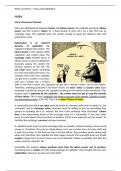
Exploitation is an inherent
dynamic of capitalism: the
capitalist employs the worker. This
labour power is very unique within
capitalism, and creates value. The
exchange value (market price) of
labour power is only its subsistence
(basically paying the worker the
minimal amount to live on). The
use value (how useful something
is) is the most important factor. For
example, how much use a capitalist
can get from a worker in six hours.
Let’s say a worker has a 10-hour
shift. In the first 6 hours, the capitalist has got their ‘money’s worth’ out of the worker.
Therefore, anything produced in the final 4 hours are extra ‘value’ or surplus value (have
exceeded in profit the amount the capitalist is paying for the labour of the workforce). This
surplus value is exploited by the capitalist – the worker does not get to reap the rewards
of their labour. This is what ‘underpins the Marxist account of the market, capitalist society
and international order’ [Clift: 66]. This is the Labour Theory of Value.
A commodity has both a use value (must be useful to someone other than its owner i.e. the
consumer) and an exchange value (someone must be willing to give up something they
possess in exchange for it i.e. money). But how is the exchange value calculated? Labour
time is the determining factor of the exchange value of a commodity. If one item takes
twice as much labour time to produce as another, it’ll be more expensive on the market. To
facilitate the exchange, currency has been invented.
A capitalist wants to get as much exchange value as possible, without having to invest much
money in. Therefore, they rely on cheap labour. Let’s say a worker has a ten-hour shift and
is paid £10 an hour. In the first two hour’s of their labour, they produce goods valuing well
about £20, therefore, the capitalist has their wages covered. The next eight hours are totally
surplus: trying to get as much money out of an individual’s labour as possible. But does the
worker reap the rewards? No.
Essentially, the worker’s labour produces more than the labour power cost to produce.
Everything else is surplus, but this surplus belongs to capitalist. Marx thought this was very
exploitative. However, he does not call it theft.
, Week seventeen – Marx and Exploitation
So why does exploitation happen in the first place?
The defining feature of capitalism is the the means of production are owned by the
capitalist class. Whilst the workers own their labour power, this is pointless if they have
nothing to use to produce anything. The capitalist need labour power, and the workers
need production.
Why does competition between capitalist for labour drive wages up until all the value
produced by labour goes to the worker?
When wages rise for this reason, capitalists have incentive to reduce the labour they need.
If they can produce just as much with less labour, then that’s more profit. This means
capitalists are always interested in labour-saving technology, which risks job losses for the
working-classes. This creates an ‘Industrial Reserve Army of the Unemployed’; those who
are willing to work for very little. The existence of unemployed workers drives wages down,
meaning capitalist can then re-hire lots and lots of workers. This can be seen as a boom and
bust system.
Are there any issues with the Labour Theory of Value?
Yes! There are products on the market which require very little labour to produce, and yet
costs millions. For example, Leonardo da Vinci’s Salvator Mundi sold for $450 million. There
are also really expensive pieces of untouched land out there.
So is Labour Theory of Value a doomed theory?
Not really – G. A. Cohen offers a simple reinterpreation of this theory. He argues that labour
doesn’t create value (it isn’t the labour behind a product which determines its price) but
labourers do create the things that have value (the products). The capitalist takes the
majority of the profit behind this. Marx obviously argued that this is not theft/ injustice.
Cohen believes Marx was a) slightly confused about this and b) didn’t think about all the
times we produce things for other people that aren’t injustices, like helping out an elderly
neighbour without being paid.
Allen Wood also argues that the exploitation in Marx’s theory involves using someone else’s
vulnerability to extract a benefit for yourself. Wood argues that there is nothing
exploitative about using material owened by another and paying them ‘interest for it’,
unless the workers are vulnerable to the owners. And in capitalism, the workers are
vulnerable because they do not own the means of production, and are dependent on the
capitalists for production. Wood argues that this isn’t an injustice as the workers are getting
a wage, but it is still bad for the workers: even if you would rather be offered the
exploitative job opportunity than not, you would be better off still if you weren’t so
vulnerable in the system. This means the worker has good reason to want to change the
conditions which make this exploitation possible. Marx, however, is very reluctant to talk
about the moral wrongness of capitalism, but Wood argues that capitalist exploitation is
morally bad:
Lecture
Marx’s Economic Theories:
Marx also distinguished between labour and labour power; the capitalist purchases labour
power and the worker’s labour for a fixed period of time, let’s say a day. This has an
exchange value. The capitalist pays the worker enough to keep the labourer alive and
working for a day.
Exploitation is an inherent
dynamic of capitalism: the
capitalist employs the worker. This
labour power is very unique within
capitalism, and creates value. The
exchange value (market price) of
labour power is only its subsistence
(basically paying the worker the
minimal amount to live on). The
use value (how useful something
is) is the most important factor. For
example, how much use a capitalist
can get from a worker in six hours.
Let’s say a worker has a 10-hour
shift. In the first 6 hours, the capitalist has got their ‘money’s worth’ out of the worker.
Therefore, anything produced in the final 4 hours are extra ‘value’ or surplus value (have
exceeded in profit the amount the capitalist is paying for the labour of the workforce). This
surplus value is exploited by the capitalist – the worker does not get to reap the rewards
of their labour. This is what ‘underpins the Marxist account of the market, capitalist society
and international order’ [Clift: 66]. This is the Labour Theory of Value.
A commodity has both a use value (must be useful to someone other than its owner i.e. the
consumer) and an exchange value (someone must be willing to give up something they
possess in exchange for it i.e. money). But how is the exchange value calculated? Labour
time is the determining factor of the exchange value of a commodity. If one item takes
twice as much labour time to produce as another, it’ll be more expensive on the market. To
facilitate the exchange, currency has been invented.
A capitalist wants to get as much exchange value as possible, without having to invest much
money in. Therefore, they rely on cheap labour. Let’s say a worker has a ten-hour shift and
is paid £10 an hour. In the first two hour’s of their labour, they produce goods valuing well
about £20, therefore, the capitalist has their wages covered. The next eight hours are totally
surplus: trying to get as much money out of an individual’s labour as possible. But does the
worker reap the rewards? No.
Essentially, the worker’s labour produces more than the labour power cost to produce.
Everything else is surplus, but this surplus belongs to capitalist. Marx thought this was very
exploitative. However, he does not call it theft.
, Week seventeen – Marx and Exploitation
So why does exploitation happen in the first place?
The defining feature of capitalism is the the means of production are owned by the
capitalist class. Whilst the workers own their labour power, this is pointless if they have
nothing to use to produce anything. The capitalist need labour power, and the workers
need production.
Why does competition between capitalist for labour drive wages up until all the value
produced by labour goes to the worker?
When wages rise for this reason, capitalists have incentive to reduce the labour they need.
If they can produce just as much with less labour, then that’s more profit. This means
capitalists are always interested in labour-saving technology, which risks job losses for the
working-classes. This creates an ‘Industrial Reserve Army of the Unemployed’; those who
are willing to work for very little. The existence of unemployed workers drives wages down,
meaning capitalist can then re-hire lots and lots of workers. This can be seen as a boom and
bust system.
Are there any issues with the Labour Theory of Value?
Yes! There are products on the market which require very little labour to produce, and yet
costs millions. For example, Leonardo da Vinci’s Salvator Mundi sold for $450 million. There
are also really expensive pieces of untouched land out there.
So is Labour Theory of Value a doomed theory?
Not really – G. A. Cohen offers a simple reinterpreation of this theory. He argues that labour
doesn’t create value (it isn’t the labour behind a product which determines its price) but
labourers do create the things that have value (the products). The capitalist takes the
majority of the profit behind this. Marx obviously argued that this is not theft/ injustice.
Cohen believes Marx was a) slightly confused about this and b) didn’t think about all the
times we produce things for other people that aren’t injustices, like helping out an elderly
neighbour without being paid.
Allen Wood also argues that the exploitation in Marx’s theory involves using someone else’s
vulnerability to extract a benefit for yourself. Wood argues that there is nothing
exploitative about using material owened by another and paying them ‘interest for it’,
unless the workers are vulnerable to the owners. And in capitalism, the workers are
vulnerable because they do not own the means of production, and are dependent on the
capitalists for production. Wood argues that this isn’t an injustice as the workers are getting
a wage, but it is still bad for the workers: even if you would rather be offered the
exploitative job opportunity than not, you would be better off still if you weren’t so
vulnerable in the system. This means the worker has good reason to want to change the
conditions which make this exploitation possible. Marx, however, is very reluctant to talk
about the moral wrongness of capitalism, but Wood argues that capitalist exploitation is
morally bad: