Silverthorn
Chapter 1: introduction to physiology
● Physiology: is the study of the normal functioning of a living organism and its component
parts, including all its chemical and physical processes. The term physiology literally means
“knowledge of nature.”
-closely tied to anatomy
● Genome: collective term for all the genetic information contained in the DNA of a species.
-One gene codes for many proteins
-proteomics: study of proteins
● Emergent properties, which are properties that cannot be predicted to exist based only on
knowledge of the system’s individual components. An emergent property is not a property of
any single component of the system, and it is greater than the simple sum of the system’s
individual parts. Emergent proper- ties result from complex, nonlinear interactions of the
different components.
-Most complex: emotion, intelligence, brain function
● The integration of function across many levels of organization is a special focus of
physiology.
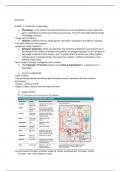
● Levels of organization
-Cells: smallest
-Cell membrane/plasma membrane: lipid and protein barrier; separates cells from external
environment
-Tissues: collection of cells
-Organs: made of tissues and form organ systems
● Organ systems
-Immune system:includes lymphatic system & closely associated with circulatory system
Function: ‘why’ of the system or event
Chapter 1: introduction to physiology
● Physiology: is the study of the normal functioning of a living organism and its component
parts, including all its chemical and physical processes. The term physiology literally means
“knowledge of nature.”
-closely tied to anatomy
● Genome: collective term for all the genetic information contained in the DNA of a species.
-One gene codes for many proteins
-proteomics: study of proteins
● Emergent properties, which are properties that cannot be predicted to exist based only on
knowledge of the system’s individual components. An emergent property is not a property of
any single component of the system, and it is greater than the simple sum of the system’s
individual parts. Emergent proper- ties result from complex, nonlinear interactions of the
different components.
-Most complex: emotion, intelligence, brain function
● The integration of function across many levels of organization is a special focus of
physiology.
● Levels of organization
-Cells: smallest
-Cell membrane/plasma membrane: lipid and protein barrier; separates cells from external
environment
-Tissues: collection of cells
-Organs: made of tissues and form organ systems
● Organ systems
-Immune system:includes lymphatic system & closely associated with circulatory system
Function: ‘why’ of the system or event