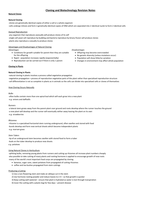
Cloning and Biotechnology Revision Notes
Natural Clones
Natural Cloning
-clones are genetically identical copies of either a cell or a whole organism
-cells undergo mitosis and form 2 genetically identical copies of DNA which are separated into 2 identical nuclei to form 2 identical cells
Asexual Reproduction
-any organism that reproduces asexually will produce clones of its self
-single-cell yeast cell reproduce by budding and bacteria reproduce by binary fission will produce clones
-plants also reproduce a sexually to produce clones
Advantages and Disadvantages of Natural Cloning
Advantages Disadvantages
Conditions for growth suitable for parent then they are suitable Offspring may become overcrowded
for the offspring No genetic diversity (unless mutations occur)
Rapid – population increases rapidly (exponentially) Population will show little/no variation
Reproduction can be carried out if there is only 1 parent Changes in environment may affect whole population
Cloning in Plants
Natural Cloning in Plants
-natural cloning in plants involves a process called vegetative propagation
-vegetative propagation = process of reproduction vegetative parts of the plant rather than specialised reproductive structure
-cell differentiation is not as complete in plants as in animals so the cells can divide into specialised cells or clones of themselves
How Cloning Occurs Naturally
Bulbs
-often bulbs contain more than one apical bud which will each grow into a new plant
-e.g. onions and daffodils
Runners
-a lateral stem grows away from the parent plant over ground and roots develop where the runner touches the ground
-a new plant will develop and the runner will eventually wither away leaving the plant on its own
-e.g. strawberries
Rhizomes
-rhizome is a specialised horizontal stem running underground, often swollen and stored with food
-bunds develop and form new vertical shoots which become independent plants
-e.g. marram grass
Stem Tubers
-tip of an underground stem becomes swollen with stored food to form a tuber
-buds on the tuber develop to produce new shoots
e.g. potatoes
Using Natural Clones in Horticulture
-splitting bulbs, removing young plants from runners and cutting up rhizomes all increase plant numbers cheaply
-also possible to take cutting of many plants and rooting hormone is applied to encourage growth of new roots
-many of the world’s most important food corps are propagated by cloning
bananas, sugar cane, sweet potatoes from propagated of cutting rhizomes
coffee and tea bushes propagated from stem cuttings
Producing a Cutting
1) Use a non-flowering stem and make an oblique cut in the stem
2) Use hormone rooting powder and reduce leaves to 2-4 – so that growth is quicker
3) Keep cutting well-watered – ensure that plant is hydrated as water is lost through transpiration
4) Cover the cutting with a plastic bag for few days – prevent disease
Natural Clones
Natural Cloning
-clones are genetically identical copies of either a cell or a whole organism
-cells undergo mitosis and form 2 genetically identical copies of DNA which are separated into 2 identical nuclei to form 2 identical cells
Asexual Reproduction
-any organism that reproduces asexually will produce clones of its self
-single-cell yeast cell reproduce by budding and bacteria reproduce by binary fission will produce clones
-plants also reproduce a sexually to produce clones
Advantages and Disadvantages of Natural Cloning
Advantages Disadvantages
Conditions for growth suitable for parent then they are suitable Offspring may become overcrowded
for the offspring No genetic diversity (unless mutations occur)
Rapid – population increases rapidly (exponentially) Population will show little/no variation
Reproduction can be carried out if there is only 1 parent Changes in environment may affect whole population
Cloning in Plants
Natural Cloning in Plants
-natural cloning in plants involves a process called vegetative propagation
-vegetative propagation = process of reproduction vegetative parts of the plant rather than specialised reproductive structure
-cell differentiation is not as complete in plants as in animals so the cells can divide into specialised cells or clones of themselves
How Cloning Occurs Naturally
Bulbs
-often bulbs contain more than one apical bud which will each grow into a new plant
-e.g. onions and daffodils
Runners
-a lateral stem grows away from the parent plant over ground and roots develop where the runner touches the ground
-a new plant will develop and the runner will eventually wither away leaving the plant on its own
-e.g. strawberries
Rhizomes
-rhizome is a specialised horizontal stem running underground, often swollen and stored with food
-bunds develop and form new vertical shoots which become independent plants
-e.g. marram grass
Stem Tubers
-tip of an underground stem becomes swollen with stored food to form a tuber
-buds on the tuber develop to produce new shoots
e.g. potatoes
Using Natural Clones in Horticulture
-splitting bulbs, removing young plants from runners and cutting up rhizomes all increase plant numbers cheaply
-also possible to take cutting of many plants and rooting hormone is applied to encourage growth of new roots
-many of the world’s most important food corps are propagated by cloning
bananas, sugar cane, sweet potatoes from propagated of cutting rhizomes
coffee and tea bushes propagated from stem cuttings
Producing a Cutting
1) Use a non-flowering stem and make an oblique cut in the stem
2) Use hormone rooting powder and reduce leaves to 2-4 – so that growth is quicker
3) Keep cutting well-watered – ensure that plant is hydrated as water is lost through transpiration
4) Cover the cutting with a plastic bag for few days – prevent disease