Communication and Homeostasis Revision Notes
Need for Communication and Homeostasis
-All living things need to maintain certain conditions in order to survive. These include; temperature, pH, freedom of toxins, water levels.
-Environmental changes may cause stress on the organism (cooler environment, greater heat loss) - change physiology or behaviour to
survive.
-Many cells are not exposed to the external environment because they are surrounded by tissue fluid.
-Build up of toxins must be removed in order for cells to survive.
-Blood maintains the composition of fluid, remove toxins and bring in useful substances.
Multi-cellular Organisms
Made up of specialised cells, tissues and organs
Cells need to interact – ones close together and ones that are distant
Protect form internal and external stimuli
A Good Communication System
Covers the whole body
Enable cells to communicate with each other
Enable specific and rapid communication
Both short term and long term responses
Cell Signaling
-where one cell will release a chemical signal that is detected by another. The cell receiving the signal will respond to it.
-2 Systems work by cell signaling
Neuronal System – network of neurons that transmit signals across synapses. Allow rapid responses.
Hormonal System – endocrine organ releases hormones into the blood that are recognised by target cells. Allow long term responses.
Homeostasis
-maintenance of the internal environment in a constant state despite external changes
-body pH levels -blood glucose levels -body temperature -body water levels all need to be maintained
Response Pathway
Stimulus → Receptor → Communication System (cell signaling) → Effector → Response
Sensory Receptors – monitor external and internal environments (temperature receptors on skin surface)
Communication System – transmit messages from receptors to effectors (neuronal or hormonal system)
Effectors – bring about a response (muscle or glands)
Negative Feedback
-process taken to return any deviance from the constant state back to the constant state
-blood pressure, temperature, blood glucose and blood water levels are all maintained by negative feedback
Temperature Regulation
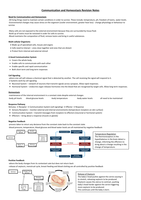
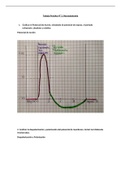
The thermoreceptors in the
hypothalamus in the brain detect a
change, informing the effectors to
bring about a change resulting in the
change of temperature.
Positive Feedback
-where the body changes from its contestant sate but does not return back
-release of oxytocin, menstrual cycle, breast feeding and blood clotting are all controlled by positive feedback
Release of Oxytocin
The baby's head pushes against the cervix causing it
to stretch, releasing oxytocin to be produced.
Oxytocin causes the uterus to contract, pushing
baby's head harder against the cervix triggering
more oxytocin to be produced.
This continues until the baby is born.
Need for Communication and Homeostasis
-All living things need to maintain certain conditions in order to survive. These include; temperature, pH, freedom of toxins, water levels.
-Environmental changes may cause stress on the organism (cooler environment, greater heat loss) - change physiology or behaviour to
survive.
-Many cells are not exposed to the external environment because they are surrounded by tissue fluid.
-Build up of toxins must be removed in order for cells to survive.
-Blood maintains the composition of fluid, remove toxins and bring in useful substances.
Multi-cellular Organisms
Made up of specialised cells, tissues and organs
Cells need to interact – ones close together and ones that are distant
Protect form internal and external stimuli
A Good Communication System
Covers the whole body
Enable cells to communicate with each other
Enable specific and rapid communication
Both short term and long term responses
Cell Signaling
-where one cell will release a chemical signal that is detected by another. The cell receiving the signal will respond to it.
-2 Systems work by cell signaling
Neuronal System – network of neurons that transmit signals across synapses. Allow rapid responses.
Hormonal System – endocrine organ releases hormones into the blood that are recognised by target cells. Allow long term responses.
Homeostasis
-maintenance of the internal environment in a constant state despite external changes
-body pH levels -blood glucose levels -body temperature -body water levels all need to be maintained
Response Pathway
Stimulus → Receptor → Communication System (cell signaling) → Effector → Response
Sensory Receptors – monitor external and internal environments (temperature receptors on skin surface)
Communication System – transmit messages from receptors to effectors (neuronal or hormonal system)
Effectors – bring about a response (muscle or glands)
Negative Feedback
-process taken to return any deviance from the constant state back to the constant state
-blood pressure, temperature, blood glucose and blood water levels are all maintained by negative feedback
Temperature Regulation
The thermoreceptors in the
hypothalamus in the brain detect a
change, informing the effectors to
bring about a change resulting in the
change of temperature.
Positive Feedback
-where the body changes from its contestant sate but does not return back
-release of oxytocin, menstrual cycle, breast feeding and blood clotting are all controlled by positive feedback
Release of Oxytocin
The baby's head pushes against the cervix causing it
to stretch, releasing oxytocin to be produced.
Oxytocin causes the uterus to contract, pushing
baby's head harder against the cervix triggering
more oxytocin to be produced.
This continues until the baby is born.