Transport in Plants
Transport in Plants
Plants Need For A Transport System
-all animals need to take in substances and remove waste products to survive
-bigger plants have a smaller SA:Vol so they need specialised exchange surfaces and transport systems
-plants need oxygen, water, nutrients and minerals
-rate of respiration is low so therefore the rate of oxygen is low so demand can be met by diffusion
-need a transport system to move
Water and minerals from the roots up to the leaves
Sugars from the leaves to the rest of the plant
Distribution of Vascular Tissues
-Dicotyledonous plants have two seeded leaves and veins in the leaf
-Xylem and Phloem found together in bundles
Phloem – transports assimilates (sugars etc) travel upwards or downwards in the tissue
Xylem – transports water and soluble mineral ions upwards or downwards in the tissue
-May also contain other types of tissues such as collenchyma and sclerenchyma to give the bundle strength and support
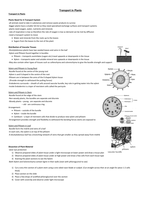
Xylem and Phloem in Young Root
-Bundle found at the centre of the young root
-Xylem is and X shaped in the centre of the root
-Phloem are in between the arms of the X shaped Xylem tissue
(Provide strength to withstand the pulling forces)
-Endodermis surrounds – sheath of cells around vascular bundle, key role in getting water into the xylem
-Inside Endodermis is a layer of meristem cells called the pericycle
Xylem and Phloem in Stem
-Bundle found at the edge of the stem
-Non-woody plants, the bundles are separate and discrete
-Woody plants – young - are separate and discrete
– old - are continuous ring
Arrangement:
Phloem – outside of the bundle
Xylem – inside the bundle
Cambium – a layer of meristem cells that divide to produce new xylem and phloem
-Arrangement provides strength and flexibility to withstand the bending forces stems are exposed to
Xylem and Phloem in Leaf
-Bundle form the midrib and veins of a leaf
-In each vein, the xylem is on top of the phloem
-A dicotyledonous leaf has a branching network of veins that get smaller as they spread away from midrib
Dissection of Plant Material
-wear eye protection
1) Observe prepared slides of plant tissue under a light microscope at lower power and draw a tissue plan
2) Observe prepared slides of plant tissue under at high power and draw a few cells from each tissue type
3) Staining the plant sections to see the Xylem
-Both Xylem and Sclerenchyma contain lignin in their walls (stain with phlorogucinol to see)
1) Cut a very thin section of a plant stem using a one sided razor blade or scalpel. (Cut straight across then at an angle for piece 1-2 cells
thick)
2) Place section on the slide
3) Place a few drops of acidified phloroglucinol over the section
4) Cover with coverslip and observe under light microscope
Transport in Plants
Plants Need For A Transport System
-all animals need to take in substances and remove waste products to survive
-bigger plants have a smaller SA:Vol so they need specialised exchange surfaces and transport systems
-plants need oxygen, water, nutrients and minerals
-rate of respiration is low so therefore the rate of oxygen is low so demand can be met by diffusion
-need a transport system to move
Water and minerals from the roots up to the leaves
Sugars from the leaves to the rest of the plant
Distribution of Vascular Tissues
-Dicotyledonous plants have two seeded leaves and veins in the leaf
-Xylem and Phloem found together in bundles
Phloem – transports assimilates (sugars etc) travel upwards or downwards in the tissue
Xylem – transports water and soluble mineral ions upwards or downwards in the tissue
-May also contain other types of tissues such as collenchyma and sclerenchyma to give the bundle strength and support
Xylem and Phloem in Young Root
-Bundle found at the centre of the young root
-Xylem is and X shaped in the centre of the root
-Phloem are in between the arms of the X shaped Xylem tissue
(Provide strength to withstand the pulling forces)
-Endodermis surrounds – sheath of cells around vascular bundle, key role in getting water into the xylem
-Inside Endodermis is a layer of meristem cells called the pericycle
Xylem and Phloem in Stem
-Bundle found at the edge of the stem
-Non-woody plants, the bundles are separate and discrete
-Woody plants – young - are separate and discrete
– old - are continuous ring
Arrangement:
Phloem – outside of the bundle
Xylem – inside the bundle
Cambium – a layer of meristem cells that divide to produce new xylem and phloem
-Arrangement provides strength and flexibility to withstand the bending forces stems are exposed to
Xylem and Phloem in Leaf
-Bundle form the midrib and veins of a leaf
-In each vein, the xylem is on top of the phloem
-A dicotyledonous leaf has a branching network of veins that get smaller as they spread away from midrib
Dissection of Plant Material
-wear eye protection
1) Observe prepared slides of plant tissue under a light microscope at lower power and draw a tissue plan
2) Observe prepared slides of plant tissue under at high power and draw a few cells from each tissue type
3) Staining the plant sections to see the Xylem
-Both Xylem and Sclerenchyma contain lignin in their walls (stain with phlorogucinol to see)
1) Cut a very thin section of a plant stem using a one sided razor blade or scalpel. (Cut straight across then at an angle for piece 1-2 cells
thick)
2) Place section on the slide
3) Place a few drops of acidified phloroglucinol over the section
4) Cover with coverslip and observe under light microscope