Oral Exam Air Methods Questions &
Answers (Graded A)
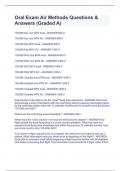
135.609 Day non MTN local - ANSWER-800-2
135.609 Day non MTN XC - ANSWER-800-3
135.609 Day MTN local - ANSWER-800-3
135.609 Day MTN XC - ANSWER-1000-3
135.609 NVG non MTN local - ANSWER-800-3
135.609 NGV non MTN XC - ANSWER-1000-3
135.609 NVG MTN local - ANSWER-1000-3
135.609 NGV MTN XC - ANSWER-1000-5
135.609 Unaided non MTN local - ANSWER-1000-3
135.609 Unaided non MTN XC - ANSWER-1000-5
135.609 Unaided MTN local - ANSWER-1500-3
135.609 Unaided MTN XC - ANSWER-1500-5
Requirement to be able to use the "local" flying area minimums - ANSWER-Pilot must
demonstrate a level of farmilarity with the local flying area by passing examination given
by the certificate holder within the 12 calendar months prior to using the local flying area
135.609c and A021
Where are the local flying areas described? - ANSWER-A021
When must the "cross country" non local wx minimums be utilized? - ANSWER-Any
flight outside the local flying area is a cross country operation. Pilots that have not
passed a local flying area knowledge test within the previous 12 calendar months must
use cross country mins 135.609c A021
You receive a flight request to fly to a hospital 100 miles from your base to pick up a
patient. What information must you obtain prior to departing on this flight? - ANSWER-
Each pilot in command shall before beginning a flight become familiar with all available
information concerning that flight. This information must include for a flight under IFR or
, a flight not in the Vincity of a airport weather reports and forecast fuel requirements
alternates available if the planned flight cannot be completed and any new traffic delays
of which the pilot in command has been advised by ATC. 91.103
What type of weather can you expect from moist unstable air and very warm surface
temperatures? - ANSWER-Strong updrafts in cumulonimbus clouds.
What are the AMC minimum altitude for enroute operations? - ANSWER-Air Methods
helicopter pilot shall when able cruise at minimum of 1000 feet AGL day or night GOM
3.9
What are the AMC SVFR minimums for day and night? - ANSWER-700/2 and 800/3
GOM 3.13
When encountering deteriorating weather in route what options are available per the
AMC GOM? - ANSWER--Divert to an alternate airport
-Return to the departure point land and notify dispatch your hospital personnel the
situation to make arrangements for care of the patient
-If weather conditions and regulations permit continue to fly under IFR
-Execute the double IMC procedure in section 2 of this manual it's a preceding options
are not available GOM 2.16
What are the steps used to maintain aircraft control during a I-IMC recovery? -
ANSWER-•Attitude
•Heading (turn only to avoid known obstacles)
•Power (adjust to climb power)
•Airspeed (adjust to climb airspeed)
When requesting assistance from ATC during an I-IMC encounter, what are the two
request that should be made and in what order? - ANSWER-•Radar vectors to VMC
conditions
•Vectors to the closest appoarch
GOM 2.37
FAR 135.207 is titled "VFR: Helicopter Surface Reference Requirements". What does
this regulation relate to? - ANSWER-It establishes the requirement for helicopter visual
surface reference for VFR flight 135.207
What is required by 135.207 in order to operate a helicopter under VFR at night? -
ANSWER-Visual surface light reference that is sufficient to see in order to safety control
the helicopter 135.207
When does encountering any potentially hazardous meteorological condition in-flight
require any specific action on part of the PIC? - ANSWER-Whenever a pilot encounters
a potentially hazardous meteorological condition in-flight the pilot shall notify an
appropriate ground radio station as soon as practical 135.67
Answers (Graded A)
135.609 Day non MTN local - ANSWER-800-2
135.609 Day non MTN XC - ANSWER-800-3
135.609 Day MTN local - ANSWER-800-3
135.609 Day MTN XC - ANSWER-1000-3
135.609 NVG non MTN local - ANSWER-800-3
135.609 NGV non MTN XC - ANSWER-1000-3
135.609 NVG MTN local - ANSWER-1000-3
135.609 NGV MTN XC - ANSWER-1000-5
135.609 Unaided non MTN local - ANSWER-1000-3
135.609 Unaided non MTN XC - ANSWER-1000-5
135.609 Unaided MTN local - ANSWER-1500-3
135.609 Unaided MTN XC - ANSWER-1500-5
Requirement to be able to use the "local" flying area minimums - ANSWER-Pilot must
demonstrate a level of farmilarity with the local flying area by passing examination given
by the certificate holder within the 12 calendar months prior to using the local flying area
135.609c and A021
Where are the local flying areas described? - ANSWER-A021
When must the "cross country" non local wx minimums be utilized? - ANSWER-Any
flight outside the local flying area is a cross country operation. Pilots that have not
passed a local flying area knowledge test within the previous 12 calendar months must
use cross country mins 135.609c A021
You receive a flight request to fly to a hospital 100 miles from your base to pick up a
patient. What information must you obtain prior to departing on this flight? - ANSWER-
Each pilot in command shall before beginning a flight become familiar with all available
information concerning that flight. This information must include for a flight under IFR or
, a flight not in the Vincity of a airport weather reports and forecast fuel requirements
alternates available if the planned flight cannot be completed and any new traffic delays
of which the pilot in command has been advised by ATC. 91.103
What type of weather can you expect from moist unstable air and very warm surface
temperatures? - ANSWER-Strong updrafts in cumulonimbus clouds.
What are the AMC minimum altitude for enroute operations? - ANSWER-Air Methods
helicopter pilot shall when able cruise at minimum of 1000 feet AGL day or night GOM
3.9
What are the AMC SVFR minimums for day and night? - ANSWER-700/2 and 800/3
GOM 3.13
When encountering deteriorating weather in route what options are available per the
AMC GOM? - ANSWER--Divert to an alternate airport
-Return to the departure point land and notify dispatch your hospital personnel the
situation to make arrangements for care of the patient
-If weather conditions and regulations permit continue to fly under IFR
-Execute the double IMC procedure in section 2 of this manual it's a preceding options
are not available GOM 2.16
What are the steps used to maintain aircraft control during a I-IMC recovery? -
ANSWER-•Attitude
•Heading (turn only to avoid known obstacles)
•Power (adjust to climb power)
•Airspeed (adjust to climb airspeed)
When requesting assistance from ATC during an I-IMC encounter, what are the two
request that should be made and in what order? - ANSWER-•Radar vectors to VMC
conditions
•Vectors to the closest appoarch
GOM 2.37
FAR 135.207 is titled "VFR: Helicopter Surface Reference Requirements". What does
this regulation relate to? - ANSWER-It establishes the requirement for helicopter visual
surface reference for VFR flight 135.207
What is required by 135.207 in order to operate a helicopter under VFR at night? -
ANSWER-Visual surface light reference that is sufficient to see in order to safety control
the helicopter 135.207
When does encountering any potentially hazardous meteorological condition in-flight
require any specific action on part of the PIC? - ANSWER-Whenever a pilot encounters
a potentially hazardous meteorological condition in-flight the pilot shall notify an
appropriate ground radio station as soon as practical 135.67