3.5.2 Respiration
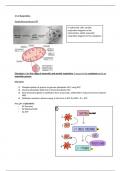
Respiration produces ATP
In eukaryotic cells, aerobic
respiration happens in the
mitocondria, whilst anaerobic
respiration happens in the cytoplasm
Glycolysis is the first stage of anaerobic and aerobic respiration. It occurs in the cytoplasm and is an
anaerobic process
Glycolysis
1) Phosphorylation of glucose to glucose phosphate (6C), using ATP
2) Glucose phosphate splits into 2 triose phosphate (3C)
3) Each triose phosphate is oxidised to form 2 pyruvate, whilst NAD is reduced to form reduced
NAD
4) Oxidation reactions release energy in the form of ATP for ADP + Pi = ATP
Net gain of glycolysis:
- X2 Pyruvate
- X2 Reduced NAD
- X2 ATP
, Redox reactions – oxidation and reduction reactions are incredibilidades important in respiration
and photosynthesis
Reduction Oxidation Co-enzymes
Gain of hydrogen Loss of hydrogen NAD
Gain of electrons Loss of electrons FAD
Loss of oxygen Gain of oxygen
Electrons and hydrogen cannot appear and disappear out of thin air. As such, oxidation and
reduction reactions always occur at the same time, as electrons and hydrogen are transferred from
one molecule to another
EXAMPLE in glycolysis:
The Link Reaction
1) If respiration is aerobic, pyruvate from glycolysis enters the mitochondrial matrix by active
transport (in a carrier protein)
2) Pyruvate (3C) is oxidised and decarboxylated to form acetate (2C) (loses 1 CO2 and 2H+),
whilst NAD is reduced to form reduced NAD
3) Acetate combines with coenzyme A in the link reaction to produce acetylcoenzyme A (2C)
(Note: dehydrogenation and oxidation means the same thing)
Net gain of Link Reaction:
- X2 CO2
- X2 NADH
- X2 Acetyl coenzyme A
REMEMBER:
2 of everything because there was 2
pyruvate molecules
Respiration produces ATP
In eukaryotic cells, aerobic
respiration happens in the
mitocondria, whilst anaerobic
respiration happens in the cytoplasm
Glycolysis is the first stage of anaerobic and aerobic respiration. It occurs in the cytoplasm and is an
anaerobic process
Glycolysis
1) Phosphorylation of glucose to glucose phosphate (6C), using ATP
2) Glucose phosphate splits into 2 triose phosphate (3C)
3) Each triose phosphate is oxidised to form 2 pyruvate, whilst NAD is reduced to form reduced
NAD
4) Oxidation reactions release energy in the form of ATP for ADP + Pi = ATP
Net gain of glycolysis:
- X2 Pyruvate
- X2 Reduced NAD
- X2 ATP
, Redox reactions – oxidation and reduction reactions are incredibilidades important in respiration
and photosynthesis
Reduction Oxidation Co-enzymes
Gain of hydrogen Loss of hydrogen NAD
Gain of electrons Loss of electrons FAD
Loss of oxygen Gain of oxygen
Electrons and hydrogen cannot appear and disappear out of thin air. As such, oxidation and
reduction reactions always occur at the same time, as electrons and hydrogen are transferred from
one molecule to another
EXAMPLE in glycolysis:
The Link Reaction
1) If respiration is aerobic, pyruvate from glycolysis enters the mitochondrial matrix by active
transport (in a carrier protein)
2) Pyruvate (3C) is oxidised and decarboxylated to form acetate (2C) (loses 1 CO2 and 2H+),
whilst NAD is reduced to form reduced NAD
3) Acetate combines with coenzyme A in the link reaction to produce acetylcoenzyme A (2C)
(Note: dehydrogenation and oxidation means the same thing)
Net gain of Link Reaction:
- X2 CO2
- X2 NADH
- X2 Acetyl coenzyme A
REMEMBER:
2 of everything because there was 2
pyruvate molecules