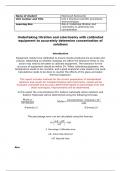
Name of student Maimunah Ramouche
Unit number and Title Unit 2 Practical scientific procedures
and techniques
Learning Aim Aim A, Undertake titration and
colorimetry to determine the
concentration
Undertaking titration and colorimetry with calibrated
equipment to accurately determine concentration of
solutions
Introduction
Equipment needs to be calibrated to ensure results produced are accurate and
precise. Depending on whether readings are within the tolerance limits or not,
action may need to be taken to calibrate equipment. The tolerance for the
accuracy of equipment should be within 2%. When calibrating glassware, the
temperature needs to be constant, and a good analytical scale needs to be used.
Calculations needs to be done to counter the effects of the glass and water
thermal expansion.
This report includes methods for the correct preparation of standardized
solutions and results for multiple titrations and colorimetry, results will be
analysed, evaluated and accuracy determined based on percentage error and
other techniques. Improvements will be determined.
In this report the concentrations HCl, Sodium carbonate (stock solution) and
Sodium Hydroxide will be determined using the following formulas;
𝑀𝑎𝑠𝑠 ( 𝑔 ) 𝐶𝑜𝑛𝑐𝑒𝑡𝑟𝑎𝑡𝑖𝑜𝑛×𝑉𝑜𝑙𝑢𝑚𝑒 ( 𝑐 𝑚 3 )
𝑀𝑜𝑙𝑒𝑠=
𝑀𝑟 |𝑀𝑜𝑙𝑒𝑠| 1000
(Formula.1) (Formula.2)
The percentage error can be calculated using the formula:
𝛿= |𝜐 𝐴−𝜐 𝐸𝜐 𝐸 |×100
𝛿 Percentage / Calibration error
υA Actual value observed
𝜐 𝐸 Expected value
Aim
,Calibrate equipment, prepare a standard solution of sodium carbonate and
determine concentration of sample solutions, HCl and sodium hydroxide. Find
the concentration of copper sulphate solutions A and B using a calibration curve.
Calibration of equipment
pH meter
Method:
- Turn on pH meter
- Place electrode in the pH 7.00 buffer solution at room temperature and
allow the reading to stabilise
- Record reading
- Using a small screwdriver adjust the screw on the meter, ensuring it reads
correctly if needed
- Remove and rinse electrode with deionised water
- Repeat previous steps using the buffers for pH 4.00 and pH 9.22
Results:
pH buffer Reading Calibration/
percentage
error (%)
pH 4 4.01 0.25
pH 7 7.14 2
pH 9.22 9.26 0.43
The pH meter is sufficiently calibrated and within the tolerance. It is adequate for experimental use.
Pipette
Method:
- Weigh a beaker using analytical scales and record weight
- Fill a 25cm3 graduated pipette with distilled water accurately, till meniscus
rests on graduation mark
- Transfer water to a beaker and weigh
- Subtract weight of beaker from weight of beaker + water and record
- Calculate volume of water and record
- Repeat
Results:
Formula: V = m/D
V- volume
m- mass
D – density
, Temperature- 19°C
Density- 0.998
Results:
Trial 1 Trial 2 Mean
Weight of
48.14 48.14 48.14
beaker (g)
Weight of
beaker + 73.17 73.29 -
water (g)
Mass of water
25.03 25.15 25.09
(g)
Volume of
water
25.08 25.20 25.14*
calculated
(cm3)
*25.09/0.998= 25.14
Percentage Error for pipette: 0.56% which is within the tolerance and can be
used.
(25.14-25)/25=0.0056 x 100= 0.56
Burette
Capacity and grade; 50ml B
- Fill the burette
- Place the beaker on the scale and zero
- Run the tap to desired amount and note the mass
- Calculate volume using density table
Indicated volume Mass of water (g) Calculated Percentage error
(ml) volume (ml) (%)
10 10.06 10.08 0.8
20 10.07 20.11 0.55
30 30 30.06 0.2
10.06/0.998= 10.08
(10.08-10)/10 x100= 0.8%
Unit number and Title Unit 2 Practical scientific procedures
and techniques
Learning Aim Aim A, Undertake titration and
colorimetry to determine the
concentration
Undertaking titration and colorimetry with calibrated
equipment to accurately determine concentration of
solutions
Introduction
Equipment needs to be calibrated to ensure results produced are accurate and
precise. Depending on whether readings are within the tolerance limits or not,
action may need to be taken to calibrate equipment. The tolerance for the
accuracy of equipment should be within 2%. When calibrating glassware, the
temperature needs to be constant, and a good analytical scale needs to be used.
Calculations needs to be done to counter the effects of the glass and water
thermal expansion.
This report includes methods for the correct preparation of standardized
solutions and results for multiple titrations and colorimetry, results will be
analysed, evaluated and accuracy determined based on percentage error and
other techniques. Improvements will be determined.
In this report the concentrations HCl, Sodium carbonate (stock solution) and
Sodium Hydroxide will be determined using the following formulas;
𝑀𝑎𝑠𝑠 ( 𝑔 ) 𝐶𝑜𝑛𝑐𝑒𝑡𝑟𝑎𝑡𝑖𝑜𝑛×𝑉𝑜𝑙𝑢𝑚𝑒 ( 𝑐 𝑚 3 )
𝑀𝑜𝑙𝑒𝑠=
𝑀𝑟 |𝑀𝑜𝑙𝑒𝑠| 1000
(Formula.1) (Formula.2)
The percentage error can be calculated using the formula:
𝛿= |𝜐 𝐴−𝜐 𝐸𝜐 𝐸 |×100
𝛿 Percentage / Calibration error
υA Actual value observed
𝜐 𝐸 Expected value
Aim
,Calibrate equipment, prepare a standard solution of sodium carbonate and
determine concentration of sample solutions, HCl and sodium hydroxide. Find
the concentration of copper sulphate solutions A and B using a calibration curve.
Calibration of equipment
pH meter
Method:
- Turn on pH meter
- Place electrode in the pH 7.00 buffer solution at room temperature and
allow the reading to stabilise
- Record reading
- Using a small screwdriver adjust the screw on the meter, ensuring it reads
correctly if needed
- Remove and rinse electrode with deionised water
- Repeat previous steps using the buffers for pH 4.00 and pH 9.22
Results:
pH buffer Reading Calibration/
percentage
error (%)
pH 4 4.01 0.25
pH 7 7.14 2
pH 9.22 9.26 0.43
The pH meter is sufficiently calibrated and within the tolerance. It is adequate for experimental use.
Pipette
Method:
- Weigh a beaker using analytical scales and record weight
- Fill a 25cm3 graduated pipette with distilled water accurately, till meniscus
rests on graduation mark
- Transfer water to a beaker and weigh
- Subtract weight of beaker from weight of beaker + water and record
- Calculate volume of water and record
- Repeat
Results:
Formula: V = m/D
V- volume
m- mass
D – density
, Temperature- 19°C
Density- 0.998
Results:
Trial 1 Trial 2 Mean
Weight of
48.14 48.14 48.14
beaker (g)
Weight of
beaker + 73.17 73.29 -
water (g)
Mass of water
25.03 25.15 25.09
(g)
Volume of
water
25.08 25.20 25.14*
calculated
(cm3)
*25.09/0.998= 25.14
Percentage Error for pipette: 0.56% which is within the tolerance and can be
used.
(25.14-25)/25=0.0056 x 100= 0.56
Burette
Capacity and grade; 50ml B
- Fill the burette
- Place the beaker on the scale and zero
- Run the tap to desired amount and note the mass
- Calculate volume using density table
Indicated volume Mass of water (g) Calculated Percentage error
(ml) volume (ml) (%)
10 10.06 10.08 0.8
20 10.07 20.11 0.55
30 30 30.06 0.2
10.06/0.998= 10.08
(10.08-10)/10 x100= 0.8%