Class and Identity (education class notes)
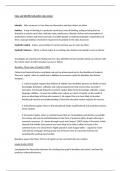
Identity – Who as person is, how they see themselves and how others see them
Habitus – A way of thinking in a particular social class (way of thinking, acting or being that are
shared by a certain social class. Indicates taste, preferences, lifestyle choices and consumption of
productions, fashion and leisure pursuits. It enables people to understand people’s expectations of
them. A groups habitus is formed in response to its position in the class structure)
Symbolic Capital – Status, your position in society and how you are seen by others
Symbolic Violence – When a school makes it so working-class habitus and capital is seen as inferior
Sociologists are interested in finding out how class identities formed outside school can interact with
the school values to either produce success or failure.
Bourdieu: Three types of Capital (1984)
Cultural and material factors contribute not only to achievement but to the identities of students.
The term ‘capital’ refers to wealth but in addition to economic capital he identities two further
subtypes;
- 1. Cultural Capital: Argued that children of middle-class/wealthier parents are likelier to have
knowledge, behaviour, attitudes and cultural experiences that ensures they succeed in
education. Intrinsically linked to economic capital. Refer to the knowledge, attitudes, values,
language, abilities – he sees the middle-class culture as a form of capital, as like wealth it
gives an advantage to those who possess it. He argues they are more likely to develop
intellectual interests and understanding of what the education system requires for success.
- 2. Educational Capital: refers to the educational assets (qualifications) and academic prowess
of the student
- 3. Economic Capital: refers to material assets that are ‘immediately and directly convertible
into money and may be institutionalised in the form of property rights. Simply referring to
economic resources. I.E. shown through Leech and Campos’ (2003) study of Coventry, which
showed that middle-class parents are more likely to be able to afford a house in the
catchment area of a school that is highly placed in exam league tables – argued to create
‘selection by mortgage’ driving up the cost of houses near to successful schools and
excluding the working-class families.
Bourdieu argues that these 3 forms of capital can be converted into one another.
Louise Archer (2010)
Investigated the interaction between the working-class pupil’s identities and school, and how this
produces underachievement.
Identity – Who as person is, how they see themselves and how others see them
Habitus – A way of thinking in a particular social class (way of thinking, acting or being that are
shared by a certain social class. Indicates taste, preferences, lifestyle choices and consumption of
productions, fashion and leisure pursuits. It enables people to understand people’s expectations of
them. A groups habitus is formed in response to its position in the class structure)
Symbolic Capital – Status, your position in society and how you are seen by others
Symbolic Violence – When a school makes it so working-class habitus and capital is seen as inferior
Sociologists are interested in finding out how class identities formed outside school can interact with
the school values to either produce success or failure.
Bourdieu: Three types of Capital (1984)
Cultural and material factors contribute not only to achievement but to the identities of students.
The term ‘capital’ refers to wealth but in addition to economic capital he identities two further
subtypes;
- 1. Cultural Capital: Argued that children of middle-class/wealthier parents are likelier to have
knowledge, behaviour, attitudes and cultural experiences that ensures they succeed in
education. Intrinsically linked to economic capital. Refer to the knowledge, attitudes, values,
language, abilities – he sees the middle-class culture as a form of capital, as like wealth it
gives an advantage to those who possess it. He argues they are more likely to develop
intellectual interests and understanding of what the education system requires for success.
- 2. Educational Capital: refers to the educational assets (qualifications) and academic prowess
of the student
- 3. Economic Capital: refers to material assets that are ‘immediately and directly convertible
into money and may be institutionalised in the form of property rights. Simply referring to
economic resources. I.E. shown through Leech and Campos’ (2003) study of Coventry, which
showed that middle-class parents are more likely to be able to afford a house in the
catchment area of a school that is highly placed in exam league tables – argued to create
‘selection by mortgage’ driving up the cost of houses near to successful schools and
excluding the working-class families.
Bourdieu argues that these 3 forms of capital can be converted into one another.
Louise Archer (2010)
Investigated the interaction between the working-class pupil’s identities and school, and how this
produces underachievement.