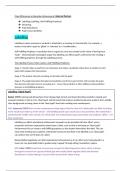
Class Differences in Education Achievement: Internal Factors
Labelling (Labelling, Self-Fulfilling Prophecy)
Streaming
Pupil Subcultures
Pupil’s Class Identities
Labelling
Labelling is when someone is ascribed or attached to a meaning or characteristic, for example, a
teacher may label a pupil as ‘gifted’ or ‘talented’ or a ‘troublemaker’.
Self-Fulfilling Prophecy: A prediction that is argued to come true simply by the virtue of having been
made – interactionalist sociologists argue that labelling can affect pupil’s achievement be creating a
self-fulfilling prophecy, through the labelling process.
The Labelling Process (that creates a Self-Fulfilling Prophecy):
Stage 1: Teacher labels a pupil from an impression and makes a prediction about them in relation to their
label which shapes their interactions.
Stage 2: The teacher interacts according to the label with the pupil
Stage 3: The pupil internalises the label and prediction and it forms part of their self-concept, the pupil
thus becomes the label and acts according to it – hence the prediction is often fulfilled as the prediction
becomes a self-fulfilling prophecy.
Labelling (‘Ideal Pupil’)
Becker (1971) interviewed 60 teachers from Chicago high-schools and found that they tended to classify and
evaluate students in terms of an ‘ideal pupil’ and he found that teachers tended to perceive students from middle-
class backgrounds as being closer to the ‘ideal pupil’ than their working-class counterparts.
A03: Jorgensen (2009) from a more contemporary study argues that the view of an ideal pupil can differ according
to the social class make-up of the school – and labelling based upon social class is less prevalent. She noted that in
predominantly middle-class schools, the ‘ideal pupil’ was instead based upon personality and academic ability – not
their social class.
Labelling can affect educational achievement as pupils can be provided with less effort, worse
treatment and lower expectations based upon a label, such as that of not being an ‘ideal pupil’,
furthermore this can create a self-fulfilling prophecy as the student internalises the label. This can
mean that working-class students, who Becker found are less likely to be labelled as an ‘ideal pupil’
can achieve less on the basis of a label.
Being labelled negatively can affect educational achievement as it can affect sets, being placed in a
lower set may potentially lead to grades being ‘capped’ through sitting ‘foundation’ papers.
A03: Fuller (1984) found that not everyone accepts the label imposed on them, which is shown
through his research on a group of black girls who resisted their negative labels and devoted
themselves to study leading to success which proved their labels wrong.
, Labelling in secondary schools: Dunne and Gazeley (2008)
Dunne and Gazeley (2008) argue that schools persistently produce working-class underachievement because of the
labels and assumptions of teachers, and they found that teachers ‘normalised’ the underachievement of working-
class pupils and seemed unconcerned about their underachievement, feeling there is little they could do to
overcome it.
They found that teachers saw home-backgrounds as a major reason for this, labelling the working-class parents as
uninterested in education, whilst the middle-class parents as supportive. Thereby, teachers supported the middle-
class students (i.e. by setting extension work) but for working-class children they were simply placed in lower sets,
with easier exams, ‘foundation’ papers which essentially ‘cap’ their grades.
Therefore, class differences in educational achievement are shown through the acceptance of the failure of working-
class and the label afforded to their home-backgrounds as uninterested and thus unable to be supported and hence
‘normalising’ the prospect of underachievement for the working-class.
A03: This is a deterministic approach, as success and failure are not entirely determined by the attitudes of teachers
as students retain control over their own success.
Labelling in primary schools: Rist (1970)
Rist (1970) through a study on English primary schools found that teachers used information about the pupil’s home
backgrounds and their appearance to place students into separate groups, which sat at different tables and received
varying levels of support and attention.
Those perceived as inferior, were often those from working-class backgrounds with a more ‘ragged’ appearance
were labelled as ‘Clowns’ and seated further away from the teacher, given less attention and lower age reading
books.
Whilst the predominantly middle-class children were labelled as ‘Tigers’ who were sat closer to the teacher were
given increased attention and support.
Therefore, Rist (1970) found that labels which affected support and arguably academic achievement at such a young
stage were based not on evidence of ability, but predominantly on appearance and their home-background.
A03: This is seen less in modern schooling, perhaps leading to this being outdated, seating plans are often conducted
less often, and later into the academic cycle when more knowledge on academic ability is known and in recent times,
teachers have seated the ‘smarter’ children at the back so the weaker pupils can be given support and attention.
Effect of Labelling (SFP): Rosenthal and Jacobsen (1968) – Pygmalion Effect
Rosenthal and Jacobsen (1968) studied a Californian primary school and identified 20% of the class (at random) and
told the teachers they were ‘spurters’ with the ability for rapid intellectual growth. After a year, they found these
children had shown greater gains in IQ compared to others in the class, as well as progressing to a higher reading
age. They judged that on the basis of the label ‘spurter’, the Self-Fulfilling Prophecy was created.
They argued that the teachers provided a warmer climate and greater input as well as positively reinforcing those
labelled as ‘spurters’, these actions arguably helped form a positive self-concept and thus creating the self-fulfilling
prophecy and through this labelling process there was noted academic improvement.
A03: They did not observe the classroom interactions, so this argument is not supported with evidence.
A03: May be inconsistent or an anomaly – and something cannot be assumed on the basis of one isolated study.
Labelling (Labelling, Self-Fulfilling Prophecy)
Streaming
Pupil Subcultures
Pupil’s Class Identities
Labelling
Labelling is when someone is ascribed or attached to a meaning or characteristic, for example, a
teacher may label a pupil as ‘gifted’ or ‘talented’ or a ‘troublemaker’.
Self-Fulfilling Prophecy: A prediction that is argued to come true simply by the virtue of having been
made – interactionalist sociologists argue that labelling can affect pupil’s achievement be creating a
self-fulfilling prophecy, through the labelling process.
The Labelling Process (that creates a Self-Fulfilling Prophecy):
Stage 1: Teacher labels a pupil from an impression and makes a prediction about them in relation to their
label which shapes their interactions.
Stage 2: The teacher interacts according to the label with the pupil
Stage 3: The pupil internalises the label and prediction and it forms part of their self-concept, the pupil
thus becomes the label and acts according to it – hence the prediction is often fulfilled as the prediction
becomes a self-fulfilling prophecy.
Labelling (‘Ideal Pupil’)
Becker (1971) interviewed 60 teachers from Chicago high-schools and found that they tended to classify and
evaluate students in terms of an ‘ideal pupil’ and he found that teachers tended to perceive students from middle-
class backgrounds as being closer to the ‘ideal pupil’ than their working-class counterparts.
A03: Jorgensen (2009) from a more contemporary study argues that the view of an ideal pupil can differ according
to the social class make-up of the school – and labelling based upon social class is less prevalent. She noted that in
predominantly middle-class schools, the ‘ideal pupil’ was instead based upon personality and academic ability – not
their social class.
Labelling can affect educational achievement as pupils can be provided with less effort, worse
treatment and lower expectations based upon a label, such as that of not being an ‘ideal pupil’,
furthermore this can create a self-fulfilling prophecy as the student internalises the label. This can
mean that working-class students, who Becker found are less likely to be labelled as an ‘ideal pupil’
can achieve less on the basis of a label.
Being labelled negatively can affect educational achievement as it can affect sets, being placed in a
lower set may potentially lead to grades being ‘capped’ through sitting ‘foundation’ papers.
A03: Fuller (1984) found that not everyone accepts the label imposed on them, which is shown
through his research on a group of black girls who resisted their negative labels and devoted
themselves to study leading to success which proved their labels wrong.
, Labelling in secondary schools: Dunne and Gazeley (2008)
Dunne and Gazeley (2008) argue that schools persistently produce working-class underachievement because of the
labels and assumptions of teachers, and they found that teachers ‘normalised’ the underachievement of working-
class pupils and seemed unconcerned about their underachievement, feeling there is little they could do to
overcome it.
They found that teachers saw home-backgrounds as a major reason for this, labelling the working-class parents as
uninterested in education, whilst the middle-class parents as supportive. Thereby, teachers supported the middle-
class students (i.e. by setting extension work) but for working-class children they were simply placed in lower sets,
with easier exams, ‘foundation’ papers which essentially ‘cap’ their grades.
Therefore, class differences in educational achievement are shown through the acceptance of the failure of working-
class and the label afforded to their home-backgrounds as uninterested and thus unable to be supported and hence
‘normalising’ the prospect of underachievement for the working-class.
A03: This is a deterministic approach, as success and failure are not entirely determined by the attitudes of teachers
as students retain control over their own success.
Labelling in primary schools: Rist (1970)
Rist (1970) through a study on English primary schools found that teachers used information about the pupil’s home
backgrounds and their appearance to place students into separate groups, which sat at different tables and received
varying levels of support and attention.
Those perceived as inferior, were often those from working-class backgrounds with a more ‘ragged’ appearance
were labelled as ‘Clowns’ and seated further away from the teacher, given less attention and lower age reading
books.
Whilst the predominantly middle-class children were labelled as ‘Tigers’ who were sat closer to the teacher were
given increased attention and support.
Therefore, Rist (1970) found that labels which affected support and arguably academic achievement at such a young
stage were based not on evidence of ability, but predominantly on appearance and their home-background.
A03: This is seen less in modern schooling, perhaps leading to this being outdated, seating plans are often conducted
less often, and later into the academic cycle when more knowledge on academic ability is known and in recent times,
teachers have seated the ‘smarter’ children at the back so the weaker pupils can be given support and attention.
Effect of Labelling (SFP): Rosenthal and Jacobsen (1968) – Pygmalion Effect
Rosenthal and Jacobsen (1968) studied a Californian primary school and identified 20% of the class (at random) and
told the teachers they were ‘spurters’ with the ability for rapid intellectual growth. After a year, they found these
children had shown greater gains in IQ compared to others in the class, as well as progressing to a higher reading
age. They judged that on the basis of the label ‘spurter’, the Self-Fulfilling Prophecy was created.
They argued that the teachers provided a warmer climate and greater input as well as positively reinforcing those
labelled as ‘spurters’, these actions arguably helped form a positive self-concept and thus creating the self-fulfilling
prophecy and through this labelling process there was noted academic improvement.
A03: They did not observe the classroom interactions, so this argument is not supported with evidence.
A03: May be inconsistent or an anomaly – and something cannot be assumed on the basis of one isolated study.