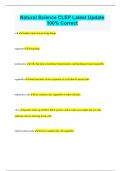
Natural Science CLEP Latest Update 100% Correct
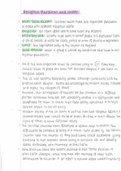
Natural Science CLEP Latest Update 100% Correct cell smallest unit of most living things organism living thing prokaryotes cells that lack a membrane-bound nucleus and membrane-bound organelles organelles small structures in the cytoplasm of a cell that do special jobs eukoryotic cells has a nucleus, has organelles or other cell parts virus particle made up of DNA, RNA, protein, and in some cases lipids that can only replicate only by infecting living cells electron microscope used to examine tiny cell organelles cell membrane composed of a bilayer of lipids embedded with globular proteins endocytic vesicles Formed when cell membrane surrounds a molecule outside the cell and ingests it microvilli projections on cell membrane increase surface area cytoskeleton provides structural support to a cell composed of microtubules, microfilaments, centrioles microtubules hollow tubes of protein about 25 nanometers in diameter, support the cell and moves organelles within the cell microfilaments double-stranded chains of proteins which give structure to the cell centrioles tubes, One of two tiny structures located in the cytoplasm of animal cells near the nuclear envelope; play a role in cell division. ribosomes site of protein synthesis. Free ribosomes - float unattached; attached ribosomes - attached to the ER endoplasmic reticulum an internal membrane system in which components of cell membrane and some proteins are constructed. rough - instrumental in protein synthesis; smooth - processes lipids fats and steroids golgi apparatus stores, packages and ships proteins secretory vesicles packaged protein or other substance produced by golgi apparatus/endoplasmic reticulum exocytosis process by which a cell releases large amounts of material lysosomes cell organelle filled with enyzmes need to break down certain materials in the cells mitochondria Powerhouse of the cell, organelle that is the site of ATP (energy) production cristae numerous folds in the inner membrane of a mitochondrion, the site of cellular respiration endosymbiont hypothesis Theory which suggests mitochondria and chloroplasts were once prokaryotic organisms in a symbiotic relationship with eykorytic cells nucleolus small, dense region within most nuclei in which the assembly of RNA proteins begins nuclear pores pores which allows materials to move in and out of the cell nucleus cell wall strong layer around the cell membrane in plants, algae, and some bacteria made of cellulose and lignin stroma body of a chloroplast containing grana grana disk-like plates which are the site of photosynthesis in chloroplasts vacuole membrane-bound organelle that stores water and soluble substances tonoplast vacuole membrane facilitated diffusion passive transport of materials across a plasma membrane by transport proteins embedded in the plasma membrane active transport transport of a substance across a cell membrane against the concentration gradient metabolism set of chemical reactions through which an organism builds up or breaks down materials as it carries out its life processes anabolism Process of building up complex materials (proteins) from simple materials catabolism breakdown of more complex substances into simpler ones with release of energy ATP (adenosine triphosphate) main energy source that cells use for most of their work chlorophyll green pigment contained in the grana photolysis In photosynthesis, this is the splitting of water by light carbon dioxide fixation photosynthetic reaction in which carbon dioxide is attached to an organic compound (glucose - polysaccharides) glycolysis first step in releasing the energy of glucose, in which a molecule of glucose is broken into two molecules of pyruvic acid krebs cycle stage of cellular respiration that finishes the breakdown of pyruvic acid molecules to carbon dioxide, releasing energy electron transport uses electrons from the Krebs cycle to change ADP to ATP (cytochromes on surface of cristae of mitochondria, contain protein and heme (iron containing) groups, electrons pass along them and ATP is produced) fermentation anaerobic cellular respiration in which pyruvic acid is broken down into end products such as lactic acid genome the complete genetic material contained in an individual gene sequence of DNA that codes for a protein and thus determines a trait mutation change in a DNA sequence that affects genetic information transcription the organic process whereby the DNA sequence in a gene is copied into mRNA post-transcriptional processing modifications of pre-mRNA that make it into mature mRNA, so that it is ready for protein synthesis codon three-nucleotide sequence on messenger RNA that codes for a single amino acid translation the process whereby genetic information coded in messenger RNA directs the formation of a specific protein at a ribosome in the cytoplasm through tRNA transduction the process of transfering genetic material from one cell to another transformation modification of a cell by the incorporation of exogenous DNA DNA a long linear polymer found in the nucleus of a cell and formed from nucleotides and shaped like a double helix nucleosome bead-like structure in chromatin, composed of a short length of DNA wrapped around a core of histone proteins chromatin consists of DNA tightly coiled around proteins chromatids two identical chromosomes that split and contain the same genetic material centromere area where the chromatids of a chromosome are attached homologs Matching Chromosomes that are similar but not identical alleles different forms of a gene cell cycle The regular sequence of growth and division that cells undergo interphase a period during which the cell grows - G1, copies its DNA - S, and synthesizes proteins - G2 mitosis cell division which produces two identical cells prophase the first stage of mitosis, forming spindle fibres attached to the centromere metaphase the second phase of mitosis, during which the chromosomes line up across the center of the cell anaphase the stage of meiosis or mitosis when chromosomes move toward opposite ends of the nuclear spindle telophase the final stage of mitosis or meiosis, during which a nuclear membrane forms around each set of new chromosomes cytokinesis division of the cytoplasm during cell division - new cell is formed meiosis cell division that produces reproductive cells in sexually reproducing organisms haploid a cell having only one complete set of chromosomes diploid a cell having two sets of chromosomes or twice the haploid number gametes reproductive cells, have only half the number of chromosomes reduction reducing the ploidy level of nucleus from diploid to haploid in meiotic cell division crossing over the interchange of sections between pairing homologous chromosomes during the prophase of meiosis biosynthesis production of a chemical compound by a living organism enzymes proteins that act as biological catalysts substrate the substance acted upon by an enzyme active site the part of an enzyme where the chemical reaction occurs cofactor a substance that must join with the enzyme to enable it to fit the substrate prosthetic group A non-protein, but organic, molecule (such as vitamin) that is covalently bound to an enzyme as part of the active site inhibitor a substance that retards or stops enzymatic activity vascular plants have tissues made of cells that transport water and nutrients throughout the plant angiosperms classification of plant which forms seeds inside a protective chamber called an ovary, inside a flower gymnosperms classication of plant which produce seeds which are "naked" (in cones) annuals classification of plant which survives only a single season biennial classification of plant whose life cycle survives two seasons perennial plants that grow year after year pedicel stalk that supports the flower pistil the female part of a flower composed of ovary and style and stigma and ovules stigma sticky portion at the top of the style which traps pollen ovary the organ that bears the ovules of a flower, base of the pistil ovules Structure within ovary of plant that contains egg cells stamen the male reproductive organ of a flower consisting of anther, filament, and pollen anther the part of the stamen that contains pollen filament the stalk of a stamen that supports the anther shoot apex part of stem where growth occurs, contains meristem tissue that is capable of quick growth
Written for
- Institution
- Natural Science CLEP
- Course
- Natural Science CLEP
Document information
- Uploaded on
- September 7, 2023
- Number of pages
- 13
- Written in
- 2023/2024
- Type
- Exam (elaborations)
- Contains
- Questions & answers
Subjects
-
natural science clep latest update 100 correct

Also available in package deal