Lecture 18 – visual processing and agnosia
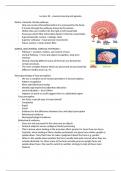
Retino- Geniculo- Striate pathway;
- How we receive information before it is processed by the brain.
- It travels through the pathway shown by the picture.
- Within they eye it either hits the right or left visual field.
- Processes which filter information before it hits the visual fields;
- Suprachiasmatic nucleus = biologic clock
- Superior colliculus = head and eye movements
- Pulvar nucleus = body motion filter
DORSAL AND VENTRAL CORTICAL PATHWAYS ;
- Pathway = Location, motion, and control of eyes
- Ventral Pathway = Form and object recognition, long term
memory
- Already showing different areas of the brain are devised for
certain processes.
- The more complex feature which are processed are processed by
different medial areas e.g. V1.
Neuropsychology of face perception;
- We use a complex set of mental operations in face perception;
- Pattern recognition
- More specialised processing
- Identity/age/expression/attention/attraction
- social evaluation – trust 100ms
- happens so quick so could suggest there is a dedicated region.
Face perception;
- Are faces a special type of visual stimuli?
- Complexity
- Rapid
- Social
- Evidence for the difference between face and object perception
- Behavioural evidence
- Neuropsychological evidence
Behavioural evidence;
- Faces are not processed in the same way as objects
- Featural (objects) versus configural (faces) processing
- This is shown when looking at the inversion effect greater for faces than non-faces.
- Typically, when looking at these studies participants are given faces either upright or
upside-down. They then have to make a judgment about the faces e.g. gender.
- When in the upside-down position the faces usually look quite normal when they are
actually distorted. So, these areas of the brain actually process upright faces not
upside-down faces. We need to switch to another strategy to look at these more
featural.
Retino- Geniculo- Striate pathway;
- How we receive information before it is processed by the brain.
- It travels through the pathway shown by the picture.
- Within they eye it either hits the right or left visual field.
- Processes which filter information before it hits the visual fields;
- Suprachiasmatic nucleus = biologic clock
- Superior colliculus = head and eye movements
- Pulvar nucleus = body motion filter
DORSAL AND VENTRAL CORTICAL PATHWAYS ;
- Pathway = Location, motion, and control of eyes
- Ventral Pathway = Form and object recognition, long term
memory
- Already showing different areas of the brain are devised for
certain processes.
- The more complex feature which are processed are processed by
different medial areas e.g. V1.
Neuropsychology of face perception;
- We use a complex set of mental operations in face perception;
- Pattern recognition
- More specialised processing
- Identity/age/expression/attention/attraction
- social evaluation – trust 100ms
- happens so quick so could suggest there is a dedicated region.
Face perception;
- Are faces a special type of visual stimuli?
- Complexity
- Rapid
- Social
- Evidence for the difference between face and object perception
- Behavioural evidence
- Neuropsychological evidence
Behavioural evidence;
- Faces are not processed in the same way as objects
- Featural (objects) versus configural (faces) processing
- This is shown when looking at the inversion effect greater for faces than non-faces.
- Typically, when looking at these studies participants are given faces either upright or
upside-down. They then have to make a judgment about the faces e.g. gender.
- When in the upside-down position the faces usually look quite normal when they are
actually distorted. So, these areas of the brain actually process upright faces not
upside-down faces. We need to switch to another strategy to look at these more
featural.