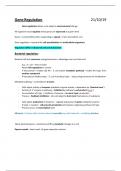
Gene Regulation 21/10/19
- Gene regulation allows us to adapt to environmental change
All organisms must regulate which genes are expressed at a given time
Genes = turned off/on when responding to signals – from internal/ext. env.
Gene regulation = essential for cell specialization for multicellular organisms
Regulation differs in Bacterial cells and Eukaryotes
Bacterial regulation:
Bacterial cell that conserves energy/resources = advantage over one that can’t
- E.g. = E. coli – lives in Colon
- Needs AA tryptophan to survive
- If host person ≠ intake said AA – E. coli actives metabolic pathway – makes AA trypt. from
another compound
- If host person intakes trypt. – E. coli ≠ produce trypt. – stops using resources for metabolism
Metabolic pathway = controlled on 2 levels:
- Cells adjust activity of enzymes (catabolic enzyme activity = dependent on ‘chemical cues’)
- Activity of 1st enzyme in pathway = inhibited by pathway’s end product (trypt.)
- Accumulation of trypt. = inhibition of enzyme = no more trypt. production
- Process = feedback inhibition – lets cell adapt to short-term fluctuations of substance
- Cells adjust production of enzymes – regulate expression of genes coding for enzyme
- If trypt. ≠ needed – cell prevents production of enzymes catalysing synthesis of trypt.
- Process occurs at transcription level
Allosteric = Protein with structure altered reversibly by small molecule – modifying function
Many bacterial genes = switched on/off by metabolic changes in a cell
Operon model = basic mech. of gene expression control
, Operons:
Operon = cluster of functionally related genes – co-ordinately controlled by single ‘on/off switch’
- One promoter = sufficient for all 5 operon genes coding for enzymes for metabolic pathway
- One long mRNA strand = produced – all code for pp for enzymes
- Translation = separate due to presence of start/stop codons
Enzymes = simultaneously synthesised due to on/off switch
- On/off switch = segment of DNA (Operator)
- Controls access of RNA Polymerase to said genes
Operator, Promotor and genes being controlled = Operon
Operon = switched off by Repressor
- Binds to operator – blocks attachment of RNA pol. to promotor region
- Transcription of genes ≠ occur
- Rep. protein = specific for operator of certain operon
- Active or inactive form – determined by presence of other molecules
Rep. Protein = encoded by regulatory gene
- Expressed continuously (at low rate)
- Binding of repressors = reversible
- Operator = in 2 states – repressor bound and repressor unbound
- Repressor = allosteric – 2 shapes - active and inactive
- Inactive version = synthesized – low affinity for operator
Tryptophan = corepressor
- Small mol – binds to allosteric site of repressor – activates it
- More trypt. = more assoc. with repressor – less transcription of operon genes = less enzyme
- Less trypt. = less assoc. with repressor – more transcription of operon genes = more enzyme
Enzymes = repressible enzymes
Inducible Operons:
Inducible operons = usually off – stimulated/induced to be on when small molecule interacts with
different regulatory protein
- E.g. = lac operon (lactose)
Lac operon = genes coding for enzymes for hydrolysis & metabolism of lactose
- Lactose = available for E. coli – if host has milk
- Metabolism = hydrolysis of lactose to glucose and galactose
- Gene regulation allows us to adapt to environmental change
All organisms must regulate which genes are expressed at a given time
Genes = turned off/on when responding to signals – from internal/ext. env.
Gene regulation = essential for cell specialization for multicellular organisms
Regulation differs in Bacterial cells and Eukaryotes
Bacterial regulation:
Bacterial cell that conserves energy/resources = advantage over one that can’t
- E.g. = E. coli – lives in Colon
- Needs AA tryptophan to survive
- If host person ≠ intake said AA – E. coli actives metabolic pathway – makes AA trypt. from
another compound
- If host person intakes trypt. – E. coli ≠ produce trypt. – stops using resources for metabolism
Metabolic pathway = controlled on 2 levels:
- Cells adjust activity of enzymes (catabolic enzyme activity = dependent on ‘chemical cues’)
- Activity of 1st enzyme in pathway = inhibited by pathway’s end product (trypt.)
- Accumulation of trypt. = inhibition of enzyme = no more trypt. production
- Process = feedback inhibition – lets cell adapt to short-term fluctuations of substance
- Cells adjust production of enzymes – regulate expression of genes coding for enzyme
- If trypt. ≠ needed – cell prevents production of enzymes catalysing synthesis of trypt.
- Process occurs at transcription level
Allosteric = Protein with structure altered reversibly by small molecule – modifying function
Many bacterial genes = switched on/off by metabolic changes in a cell
Operon model = basic mech. of gene expression control
, Operons:
Operon = cluster of functionally related genes – co-ordinately controlled by single ‘on/off switch’
- One promoter = sufficient for all 5 operon genes coding for enzymes for metabolic pathway
- One long mRNA strand = produced – all code for pp for enzymes
- Translation = separate due to presence of start/stop codons
Enzymes = simultaneously synthesised due to on/off switch
- On/off switch = segment of DNA (Operator)
- Controls access of RNA Polymerase to said genes
Operator, Promotor and genes being controlled = Operon
Operon = switched off by Repressor
- Binds to operator – blocks attachment of RNA pol. to promotor region
- Transcription of genes ≠ occur
- Rep. protein = specific for operator of certain operon
- Active or inactive form – determined by presence of other molecules
Rep. Protein = encoded by regulatory gene
- Expressed continuously (at low rate)
- Binding of repressors = reversible
- Operator = in 2 states – repressor bound and repressor unbound
- Repressor = allosteric – 2 shapes - active and inactive
- Inactive version = synthesized – low affinity for operator
Tryptophan = corepressor
- Small mol – binds to allosteric site of repressor – activates it
- More trypt. = more assoc. with repressor – less transcription of operon genes = less enzyme
- Less trypt. = less assoc. with repressor – more transcription of operon genes = more enzyme
Enzymes = repressible enzymes
Inducible Operons:
Inducible operons = usually off – stimulated/induced to be on when small molecule interacts with
different regulatory protein
- E.g. = lac operon (lactose)
Lac operon = genes coding for enzymes for hydrolysis & metabolism of lactose
- Lactose = available for E. coli – if host has milk
- Metabolism = hydrolysis of lactose to glucose and galactose