Enzymes and Enzyme kinetics 07/10/19
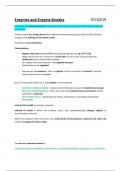
An enzyme is a biological catalyst that speeds up the rates of a reaction without being used up in
the process.
Enzymes lower free energy barrier that separates reactants and products (lowers the activation
energy (EA) by offering an alternative route).
Enzymes are macromolecules
Characteristics:
- Organic molecules (proteins/RNAs) speeding up reactions by up to 1012-fold
- Highly specific (due to 3° structure of active site) so act on only 1 type of substrate
- Unaffected by the reaction they catalyse
- Can catalyse the same reaction in the opposite direction
- Said activity can be regulated
- Enzymes are like spanners – they can tighten a nut on a screw or can loosen it, and the
spanner (enzyme) is unchanged
Due to how specific active site is, E-S complex is determined by:
- Geometric complementarity – Active site and Substrate must be of complimentary shape
- Electronic complementarity – Active site must have complimentary electrostatic surface
potentials to substrate
- Non-covalent forces – (Weak) Van der Waals, electrostatic, H+ bonding, hydrophobic
interactions
Lock and Key model is no longer accepted
Induced fit model is where the enzymes active site’s geometry/shape changes slightly, to
accommodate substrate
When the substrate enters the active site, weak bonds formed between substrate and active site
initiates changing of enzyme shape
The rate of a chemical reaction is:
The [Product] that is formed in a unit of time or the [Substrate] that is consumed in a unit of time
An enzyme is a biological catalyst that speeds up the rates of a reaction without being used up in
the process.
Enzymes lower free energy barrier that separates reactants and products (lowers the activation
energy (EA) by offering an alternative route).
Enzymes are macromolecules
Characteristics:
- Organic molecules (proteins/RNAs) speeding up reactions by up to 1012-fold
- Highly specific (due to 3° structure of active site) so act on only 1 type of substrate
- Unaffected by the reaction they catalyse
- Can catalyse the same reaction in the opposite direction
- Said activity can be regulated
- Enzymes are like spanners – they can tighten a nut on a screw or can loosen it, and the
spanner (enzyme) is unchanged
Due to how specific active site is, E-S complex is determined by:
- Geometric complementarity – Active site and Substrate must be of complimentary shape
- Electronic complementarity – Active site must have complimentary electrostatic surface
potentials to substrate
- Non-covalent forces – (Weak) Van der Waals, electrostatic, H+ bonding, hydrophobic
interactions
Lock and Key model is no longer accepted
Induced fit model is where the enzymes active site’s geometry/shape changes slightly, to
accommodate substrate
When the substrate enters the active site, weak bonds formed between substrate and active site
initiates changing of enzyme shape
The rate of a chemical reaction is:
The [Product] that is formed in a unit of time or the [Substrate] that is consumed in a unit of time