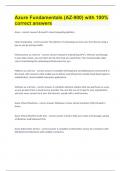
Azure Fundamentals (AZ-900) with 100% correct answers
Azure Microsoft's cloud computing platform Cloud Computing The delivery of computing services over the Internet using a pay-as-you-go pricing model. Infrastructure as a Service Instead of maintaining CPU's, Memory and Storage in your data center, you rent them for the time that you need them. The cloud provider takes care of maintaining the underlying infrastructure for you. Platform as a Service A complete development and deployment environment in the cloud, with resources that enable you to deliver everything from simple cloud-based apps to sophisticated, cloud-enabled enterprise applications. Software as a Service A complete software solution that you purchase on a pay-as-you-go basis from a cloud service provider. You rent the use of an app for your organization, and your users connect to it over the Internet, usually with a web browser. Azure Virtual Machines Windows or Linux virtual machines (VMs) hosted in Azure. Azure Virtual Machine Scale Sets A tool to help you create and manage a group of identical, load balanced VMs. Azure Kubernetes Service A complete orchestration service for containers with distributed architectures with multiple containers. Azure Service Fabric Distributed systems platform. Runs in Azure or on-premises. Azure Batch Managed service for parallel and high-performance computing applications. Azure Container Instances Offers the fastest and simplest way to run a container in Azure. You don't have to manage any virtual machines or configure any additional services. It is a PaaS offering that allows you to upload your containers and execute them directly with automatic elastic scale. Azure Functions An event-driven, serverless compute service for when you're concerned only about the code running your service, and not the underlying platform or infrastructure. They're commonly used when you need to perform work in response to an event, often via a REST request, timer, or message from another Azure service and when that work can be completed quickly, within seconds or less. Azure Virtual Network The fundamental building block for your private network in Azure. It will enable many types of Azure resources, such as Azure Virtual Machines (VM), to securely communicate with each other, the internet, and on-premises networks. While similar to a traditional network that you'd operate in your own data center, it will also bring with it additional benefits of Azure's infrastructure such as scale, availability, and isolation. Azure VPN Gateway A specific type of virtual network gateway that is used to send encrypted traffic between an Azure virtual network and an on-premises location over the public Internet. You can also use a VPN gateway to send encrypted traffic between Azure virtual networks over the Microsoft network. Each virtual network can have only one VPN gateway Azure DNS Provides ultra-fast DNS responses and ultra-high domain availability. Azure Content Delivery Network A distributed network of servers that can efficiently deliver web content to users. It is a way to get content to users in their local region to minimize latency. It can be hosted in Azure or any other location. You can cache content at strategically placed physical nodes across the world and provide better performance to end users. Azure DDoS Protection Protects Azure-hosted applications from distributed denial of service (DDOS) attacks. Azure Traffic Manager A service that uses the DNS server that's closest to the user to direct their client browser to the nearest endpoint, it can also direct a user to the endpoint with the lowest latency. Azure ExpressRoute Connects to Azure over high-bandwidth dedicated secure connections Azure Network Watcher Monitors and diagnoses network issues using scenario-based analysis. Azure Firewall A managed, cloud-based, network security service that protects your Azure Virtual Network resources. It is a fully stateful firewall as a service with built-in high availability and unrestricted cloud scalability. Azure Virtual WAN Creates a unified wide area network (WAN), connecting local and remote sites. Azure Blob storage Storage service for very large objects, such as video files or bitmaps. Azure File storage File shares that you can access and manage like a file server Azure Queue storage A data store for queuing and reliably delivering messages between applications. Azure Table storage A NoSQL store that hosts unstructured data independent of any schema. Azure Cosmos DB globally distributed database service. It supports schema-less data that lets you build highly responsive and always on applications to support the constantly changing data held in NoSQL type databases. Azure Database for MySQL Fully managed and scalable MySQL relational database with high availability and security. Azure Database for PostgreSQL Fully managed and scalable PostgreSQL relational database with high availability and security. SQL Server on VM's Host enterprise SQL Server apps in the cloud. Azure Database Migration Service Migrates your databases to the cloud with no application code changes. Azure Cache for Redis Caches frequently used and static data to reduce data and application latency Azure Database for MariaDB Fully managed and scalable MariaDB relational database with high availability and security. Azure App Service An HTTP-based platform-as-a-service (PaaS) offering in Azure that is designed to host enterprise-grade web-oriented applications. You can meet rigorous performance, scalability, security, and compliance requirements while using a fully managed platform to perform infrastructure maintenance. Microsoft Azure Marketplace An online store that hosts applications that are certified and optimized to run in Azure. Many types of applications are available, ranging from AI + Machine Learning to Web applications. As you'll see in a couple of minutes, deployments from the store are done via the Azure portal using a wizard-style user interface. This user interface makes evaluating different solutions easy. Resource Group A free service used to group together all the services, disks, network interfaces, and other elements that potentially make up our solution as a unit in order to administer them more effectively. Azure Notification Hubs Send push notifications to any platform from any back end. Azure API Management Publish APIs to developers, partners, and employees securely and at scale. Web Apps feature of Azure App Service. Create and deploy mission-critical web apps at scale. Azure SignalR Service Add real-time web functionalities easily. IoT Central Fully-managed global IoT software as a service (SaaS) solution that makes it easy to connect, monitor, and manage your IoT assets at scale. Azure IoT Hub Messaging hub that provides secure communications and monitoring between millions of IoT devices. IoT Edge Push your data analysis models directly onto your IoT devices, allowing them to react quickly to state changes without needing to consult cloud-based AI models. Azure SQL Data Warehouse un analytics at a massive scale using a cloud-based Enterprise Data Warehouse (EDW) that leverages massive parallel processing (MPP) to run complex queries quickly across petabytes of data. Azure HDInsight A full managed cloud distribution of Hadoop components that makes it easy, fast, and cost-effective to process massive amounts of data. It also supports a broad range of scenarios, like extract, transform, and load; data warehousing; machine learning; and Internet of Things. Azure Databricks Collaborative Apache Spark-based analytics service that can be integrated with other Big Data services in Azure. Azure Machine Learning Service Cloud-based environment you can use to develop, train, test, deploy, manage, and track machine learning models. It can auto-generate a model and auto-tune it for you. It will let you start training on your local machine, and then scale out to the cloud. Azure Machine Learning Studio Collaborative, drag-and-drop visual workspace where you can build, test, and deploy machine learning solutions using pre-built machine learning algorithms and data-handling modules. Azure Vision API Image-processing algorithms to smartly identify, caption, index, and moderate your pictures and videos. Azure Speech API Convert spoken audio into text, use voice for verification, or add speaker recognition to your app. Azure Knowledge Mapping API Map complex information and data in order to solve tasks such as intelligent recommendations and semantic search. Bing Search API Add Bing Search APIs to your apps and harness the ability to comb billions of webpages, images, videos, and news with a single API call. Azure Natural Language Processing API Allow your apps to process natural language with pre-built scripts, evaluate sentiment and learn how to recognize what users want. Azure DevOps Azure DevOps Services (formerly known as Visual Studio Team Services, or VSTS), provides development collaboration tools including high-performance pipelines, free private Git repositories, configurable Kanban boards, and extensive automated and cloud-based load testing. Azure DevTest Labs Quickly create on-demand Windows and Linux environments you can use to test or demo your applications directly from your deployment pipelines. Serverless Computing A cloud-hosted execution environment that runs your code but completely abstracts the underlying hosting environment. You create an instance of the service, and you add your code; no infrastructure configuration or maintenance is required, or even allowed. Containers A virtualized environment for running applications. Just like virtual machines, they are run on top of a host operating system. But unlike VMs, they won't include an operating system for the apps running inside the container. Instead, they bundle the libraries and components needed to run the application and use the existing host OS to run them. Vertical Scaling Known as "scaling up", is the process of adding resources to increase the power of an existing server. Some examples of vertical scaling are: adding more CPUs, or adding more memory. Horizontal Scaling Known as "scaling out", is the process of adding more servers that function together as one unit. For example, you have more than one server processing incoming requests. General Data Protection Regulation An European privacy law in effect that imposes new rules on companies, government agencies, non-profits, and other organizations that offer goods and services to people in the European Union (EU), or that collect and analyze data tied to EU residents Economies of Scale The ability to do things more efficiently or at a lower-cost per unit when operating at a larger scale. Capital Expenditure The decision to spend money on physical infrastructure up front, and then deducting that expense from your tax bill over time. Operational Expense The decision to spend money on services or products now and being billed for them now. Public Cloud When have no local hardware to manage or keep up-to-date - everything runs on your cloud provider's hardware. In some cases, you can save additional costs by sharing computing resources with other cloud users. Private Cloud A cloud environment in your own datacenter and provide self-service access to compute resources to users in your organization. This offers a simulation of a public cloud to your users, but you remain completely responsible for the purchase and maintenance of the hardware and software services you provide Hybrid Cloud The combination of both public and private clouds, allowing you to run your applications in the most appropriate location. For example, you could host a website in the public cloud and link it to a highly secure database hosted in your private cloud. Availability Zones Availability Zones are unique physical locations within an Azure region. Each zone is made up of one or more datacenters equipped with independent power, cooling, and networking. Azure Policy A service in Azure that is a default-allow-and-explicit-deny system that can be used to create, assign, and manage policies. These policies enforce different rules and effects over your resources, so those resources stay compliant with your corporate standards and service level agreements. Azure Data Lake Analytics An on-demand analytics job service that simplifies big data. Instead of deploying, configuring, and tuning hardware, you write queries to transform your data and extract valuable insights. Azure Event Hubs A big data streaming platform and event ingestion service. It can receive and process millions of events per second. Data sent to an event hub can be transformed and stored by using any real-time analytics provider or batching/storage adapters. Azure Monitor A sophisticated set of tools for collecting and analyzing telemetry that allow you to maximize the performance and availability of your cloud and on-premises resources and applications. RBAC for Azure a system that provides fine-grained access management of Azure resources. Locks You may need to lock a subscription, resource group, or resource to prevent other users in your organization from accidentally deleting or modifying critical resources. You can set your lock level to CanNotDelete or ReadOnly. In the portal, the locks are called Delete and Read-only respectively. Azure Virtual networks The fundamental building block for your private network in Azure. It enables many types of Azure resources, such as Azure Virtual Machines (VM), to securely communicate with each other, the internet, and on-premises networks. A similar technology to a traditional network that you would operate in your own data center, but brings with it additional benefits of Azure's infrastructure such as scale, availability, and isolation.
Written for
- Institution
- AZ-900 Microsoft Azure Fundamentals
- Course
- AZ-900 Microsoft Azure Fundamentals
Document information
- Uploaded on
- September 5, 2023
- Number of pages
- 18
- Written in
- 2023/2024
- Type
- Exam (elaborations)
- Contains
- Questions & answers
Subjects
- azure fundamentals az 900
-
azure fundamentals az 900 with 100 c

Also available in package deal