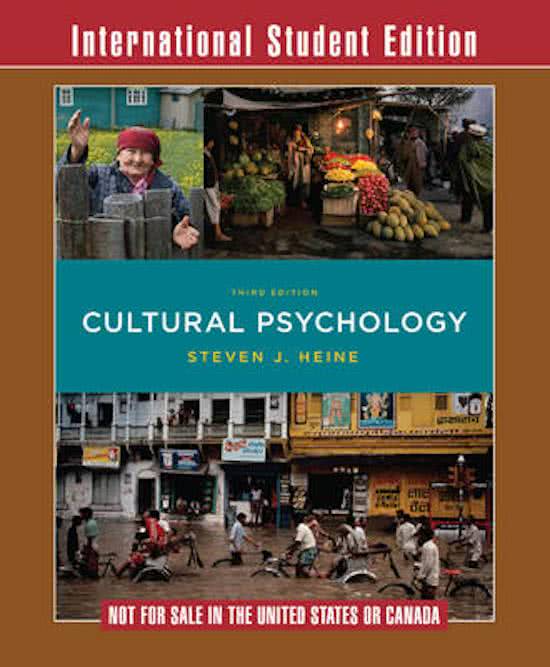
Cultural Psychology (Steven J. Heine)
Chapter 4: Methods for studying culture and psychology
Considerations for Conducting Research Across Cultures
What Cultures Should We Study?
How do we decide which cultures to study out of the thousands of cultured around
the world. It is not recommended to use the shotgun method.
Shotgun method
= Randomly select cultures to study.
You are more likely to find meaningful and easy-to-interpret results if you let your
research question guide your choice of research samples.
Like choosing your samples based on a theoretical variable that you are investigating.
(So if you’re researching how collectivism shapes the way people view their
relationships, you select cultures that clearly differ in terms of their collectivism.
If you find no difference it suggest collectivism and people’s view of relationships
are unrelated.)
(Or if you want to explore the degree of universality of a particular psychological
fining. You select cultures that vary greatly on as many theoretically relevant
dimensions as possible (language, geography, etc.).
If you find similarity between cultures compelling evidence for a high degree of
universality for that process.)
Making Meaningful Comparisons Across Cultures
The importance of developing knowledge about the cultures under study:
For a cultural psychologist studying a different culture it is not always clear how the
researcher’s own experiences generalize to the people they are studying.
The initial step when studying people from other cultures is to learn something about
the culture under study. This can be done by:
- Reading existing texts and ethnographies about the cultures. (Although this
only highlights what the author felt was relevant and is also filtered through
the authors own peculiar set of beliefs and biases.)
- Find a collaborator who is from the culture you are studying and who is
interested in pursuing the same research with you.
- Immerse oneself in another culture to learn it first-hand. (Can be time-
consuming and costly.)
Contrasting highly different cultures versus similar cultures:
There are culturally learned skills regarding competing surveys or participating in
psychological studies.
This means that the standard survey methodologies are useful for conducting cross-
cultural research among people of industrialized societies who have comparable
Chapter 4: Methods for studying culture and psychology
Considerations for Conducting Research Across Cultures
What Cultures Should We Study?
How do we decide which cultures to study out of the thousands of cultured around
the world. It is not recommended to use the shotgun method.
Shotgun method
= Randomly select cultures to study.
You are more likely to find meaningful and easy-to-interpret results if you let your
research question guide your choice of research samples.
Like choosing your samples based on a theoretical variable that you are investigating.
(So if you’re researching how collectivism shapes the way people view their
relationships, you select cultures that clearly differ in terms of their collectivism.
If you find no difference it suggest collectivism and people’s view of relationships
are unrelated.)
(Or if you want to explore the degree of universality of a particular psychological
fining. You select cultures that vary greatly on as many theoretically relevant
dimensions as possible (language, geography, etc.).
If you find similarity between cultures compelling evidence for a high degree of
universality for that process.)
Making Meaningful Comparisons Across Cultures
The importance of developing knowledge about the cultures under study:
For a cultural psychologist studying a different culture it is not always clear how the
researcher’s own experiences generalize to the people they are studying.
The initial step when studying people from other cultures is to learn something about
the culture under study. This can be done by:
- Reading existing texts and ethnographies about the cultures. (Although this
only highlights what the author felt was relevant and is also filtered through
the authors own peculiar set of beliefs and biases.)
- Find a collaborator who is from the culture you are studying and who is
interested in pursuing the same research with you.
- Immerse oneself in another culture to learn it first-hand. (Can be time-
consuming and costly.)
Contrasting highly different cultures versus similar cultures:
There are culturally learned skills regarding competing surveys or participating in
psychological studies.
This means that the standard survey methodologies are useful for conducting cross-
cultural research among people of industrialized societies who have comparable