Kettering Patient Assessment –A questions
with correct answers
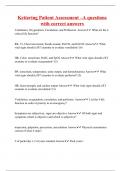
Ventilation, Oxygenation, Circulation, and Perfussion. Answer✔✔ What are the 4
critical life function?
RR, Vt, Chest movement, breath sounds, PaCO2, and EtCO2 Answer✔✔ What
vital signs should a RT examine to evaluate ventilation? (6)
HR, Color, sensorium, PaO2, and SpO2 Answer✔✔ What vital signs should a RT
examine to evaluate oxygenation? (5)
BP, sensorium, temperature, urine output, and hemodynamics Answer✔✔ What
vital signs should a RT examine to evaluate perfusion? (5)
HR, heart strength, and cardiac output Answer✔✔ What vital signs should a RT
examine to evaluate circulation? (3)
Ventilation, oxygenation, circulation, and perfusion. Answer✔✔ List the 4 life
function in order of priority in an emergency?
Symptoms are subjectives, signs are objective Answer✔✔ Of both signs and
symptoms which is objective and which is subjective?
inspection, palpation, percussion, auscultation Answer✔✔ Physical examination
consist of what 4 steps?
# of packs/day x # of years smoked Answer✔✔ Pack years=
,40 mL/hr (approximately 1Liter/day) Answer✔✔ Normal urine output is a
minimum of?
Sensible water loss Answer✔✔ Fluids lost through urination and vomiting is
considered what kind of water loss?
Insensible water loss Answer✔✔ Fluids lost through breathing and perspiration
(i.e. lungs and skin) in considered what kind of water loss?
fluid retention exceeding fluid output Answer✔✔ A patient is admitted to the ER
with noted weight gain and SOB. Upon further evaluation the patient was found to
have an electrolyte imbalance, increased hemodynamic pressures, and decreased
lung compliance what is the most likely cause of the patients symptom?
changes in fluid balance Answer✔✔ What can changes in central venous pressure
indicate?
2-6 mmHg Answer✔✔ Normal central venous pressure or CVP is?
fluid therapy Answer✔✔ A patient admitted to the ER presents with hypovolemia
what should the therapist recommend?
hypovolemia Answer✔✔ An evaluation of a patient's central venous pressure
(CVP) determined the patient's CVP to be 2 mmHg which indicates?
Hypervolemia Answer✔✔ An evaluation of a patient's central venous pressure
(CVP) determined the patient's CVP to be 6 mmHg which indicates?
,diuretics Answer✔✔ A patient admitted to the ER presents with hypervolemia
what should the therapist recommend?
Semicomatose Answer✔✔ A patient who only responds to painful stimuli is
described as?
sleep apnea or excessive O2 therapy in patients with COPD Answer✔✔ A patient
is described as lethargic, somnolent, or sleepy the therapist should consider?
Stuporous or confused Answer✔✔ A patient who responds inappropriately, drug
overdose, or intoxicated is described as?
comatose Answer✔✔ A patient who does not respond to painful stimuli is
described as?
Obtunded Answer✔✔ A patient who is in a drowsy state and a decreased cough or
gag reflex is said to be?
CHF Answer✔✔ A patient complains of SOB while laying down what is the most
likely cause?
difficulty breathing except in the upright position Answer✔✔ Orthopnea is defined
as?
general malaise Answer✔✔ A patient presents to the ER feeling run down,
nauseous, weak, fatigued, and with a headache is described as having?
, a feeling of SOB and difficulty breathing. Answer✔✔ Dyspnea is defined as?
4 Answer✔✔ A patient present to the ER with dyspnea while slowly walking short
distances. What grade of dyspnea does the patient have
dyspnea occurring after unusual exertion Answer✔✔ Dyspnea grade 1 is defined
as?
5 Answer✔✔ A patient has dyspnea while at rest, shaving, dressing, etc. The
patient has grade ___ dyspnea?
breathless after going up hills or stairs Answer✔✔ Grade 2 dyspnea is defined as?
dyspnea while walking at normal speed Answer✔✔ Grade 3 dyspnea is defined
as?
Activities of daily living Answer✔✔ Katz scoring system is used to evaluate
what?
Presence of excessive fluid in the tissue known as pitting edema Answer✔✔
Peripheral edema is defined as?
CHF and renal failure Answer✔✔ Peripheral edema is most commonly caused by?
Diuretics Answer✔✔ The most common therapy for peripheral edema is?
with correct answers
Ventilation, Oxygenation, Circulation, and Perfussion. Answer✔✔ What are the 4
critical life function?
RR, Vt, Chest movement, breath sounds, PaCO2, and EtCO2 Answer✔✔ What
vital signs should a RT examine to evaluate ventilation? (6)
HR, Color, sensorium, PaO2, and SpO2 Answer✔✔ What vital signs should a RT
examine to evaluate oxygenation? (5)
BP, sensorium, temperature, urine output, and hemodynamics Answer✔✔ What
vital signs should a RT examine to evaluate perfusion? (5)
HR, heart strength, and cardiac output Answer✔✔ What vital signs should a RT
examine to evaluate circulation? (3)
Ventilation, oxygenation, circulation, and perfusion. Answer✔✔ List the 4 life
function in order of priority in an emergency?
Symptoms are subjectives, signs are objective Answer✔✔ Of both signs and
symptoms which is objective and which is subjective?
inspection, palpation, percussion, auscultation Answer✔✔ Physical examination
consist of what 4 steps?
# of packs/day x # of years smoked Answer✔✔ Pack years=
,40 mL/hr (approximately 1Liter/day) Answer✔✔ Normal urine output is a
minimum of?
Sensible water loss Answer✔✔ Fluids lost through urination and vomiting is
considered what kind of water loss?
Insensible water loss Answer✔✔ Fluids lost through breathing and perspiration
(i.e. lungs and skin) in considered what kind of water loss?
fluid retention exceeding fluid output Answer✔✔ A patient is admitted to the ER
with noted weight gain and SOB. Upon further evaluation the patient was found to
have an electrolyte imbalance, increased hemodynamic pressures, and decreased
lung compliance what is the most likely cause of the patients symptom?
changes in fluid balance Answer✔✔ What can changes in central venous pressure
indicate?
2-6 mmHg Answer✔✔ Normal central venous pressure or CVP is?
fluid therapy Answer✔✔ A patient admitted to the ER presents with hypovolemia
what should the therapist recommend?
hypovolemia Answer✔✔ An evaluation of a patient's central venous pressure
(CVP) determined the patient's CVP to be 2 mmHg which indicates?
Hypervolemia Answer✔✔ An evaluation of a patient's central venous pressure
(CVP) determined the patient's CVP to be 6 mmHg which indicates?
,diuretics Answer✔✔ A patient admitted to the ER presents with hypervolemia
what should the therapist recommend?
Semicomatose Answer✔✔ A patient who only responds to painful stimuli is
described as?
sleep apnea or excessive O2 therapy in patients with COPD Answer✔✔ A patient
is described as lethargic, somnolent, or sleepy the therapist should consider?
Stuporous or confused Answer✔✔ A patient who responds inappropriately, drug
overdose, or intoxicated is described as?
comatose Answer✔✔ A patient who does not respond to painful stimuli is
described as?
Obtunded Answer✔✔ A patient who is in a drowsy state and a decreased cough or
gag reflex is said to be?
CHF Answer✔✔ A patient complains of SOB while laying down what is the most
likely cause?
difficulty breathing except in the upright position Answer✔✔ Orthopnea is defined
as?
general malaise Answer✔✔ A patient presents to the ER feeling run down,
nauseous, weak, fatigued, and with a headache is described as having?
, a feeling of SOB and difficulty breathing. Answer✔✔ Dyspnea is defined as?
4 Answer✔✔ A patient present to the ER with dyspnea while slowly walking short
distances. What grade of dyspnea does the patient have
dyspnea occurring after unusual exertion Answer✔✔ Dyspnea grade 1 is defined
as?
5 Answer✔✔ A patient has dyspnea while at rest, shaving, dressing, etc. The
patient has grade ___ dyspnea?
breathless after going up hills or stairs Answer✔✔ Grade 2 dyspnea is defined as?
dyspnea while walking at normal speed Answer✔✔ Grade 3 dyspnea is defined
as?
Activities of daily living Answer✔✔ Katz scoring system is used to evaluate
what?
Presence of excessive fluid in the tissue known as pitting edema Answer✔✔
Peripheral edema is defined as?
CHF and renal failure Answer✔✔ Peripheral edema is most commonly caused by?
Diuretics Answer✔✔ The most common therapy for peripheral edema is?