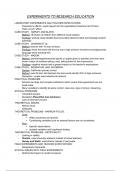
EXPERIMENTS TO RESEARCH EDUCATION
LABORATORY EXPERIMENTS AND TEACHER EXPECTATIONS:
- 'Expectancy effects': pupils played into the expectations teachers had of them.
- 'Halo vs horn' effect.
CASE STUDY - HARVEY AND SLATIN:
- Method: 18 photos of children from different social classes.
- Findings: working class labelled less favourably (teachers label and prejudge student
potential).
CASE STUDY - CHARKIN ET AL:
- Method: lessons with 10 year old boys.
- Findings: those that were told the boy was a high achiever showed encouraging body
language when teaching him.
CASE STUDY - MASON:
- Method: positive/negative/neutral reports on pupils given to teachers and then were
shown videos of students taking a test, asking them for first impressions.
- Findings: negative reports had a greater impact on the teacher's expectations.
CASE STUDY - ROSENTHAL AND JACOBSON:
- Sample: Californian primary school.
- Method: pupil IQ test, told teachers the test would identify 20% of high achievers
(deception - pupils were selected at random).
PRACTICAL PROBLEMS:
- Schools are large and complex institutions which means that experiments are too
small scale.
- Many variables to identify let alone control: class size, type of school, streaming.
ETHICAL PROBLEMS:
- Vulnerable groups.
- Deception (Rosenthal and Jacobson).
- Lack of informed consent.
THEORETICAL ISSUES:
- Narrow focus.
- Artificiality.
THEORETICAL PROBLEMS - NARROW FOCUS:
- Cons:
+ Wider processes are ignored.
+ Contributing variables such as external factors are not considered.
- Pros:
+ Specific observations.
+ Isolated variables and hypothesis testing.
THEORETICAL PROBLEMS - ARTIFICIALITY:
- Lacking in validity.
- Charkin: used university students instead of actual teachers.
- Harvey and Slatin: used photos instead of real pupils.
FIELD EXPERIMENTS AND TEACHER EXPECTATIONS:
- Subjectively interpreted.
ETHICAL ISSUES WITH FIELD EXPERIMENTS:
- Detrimental impact on student progress.
, - Deception is a key feature (improvement of children's rights since 1960s)
THEORETICAL ISSUES WITH FIELD EXPERIMENTS:
- Reliability:
+ Rosenthal and Jacobson's study was repeated 242 times.
+ However, variables cannot be replicated due to differences in teaching styles,
school types etc.
- Validity:
+ No observations of actual classroom interactions.
+ Claiborn: no evidence of teacher expectations passed through interactions.
- Broad focus:
+ Not identifying wider processes of labelling.
+ Can be longitudinal to identify trends over time.
LABORATORY EXPERIMENTS AND TEACHER EXPECTATIONS:
- 'Expectancy effects': pupils played into the expectations teachers had of them.
- 'Halo vs horn' effect.
CASE STUDY - HARVEY AND SLATIN:
- Method: 18 photos of children from different social classes.
- Findings: working class labelled less favourably (teachers label and prejudge student
potential).
CASE STUDY - CHARKIN ET AL:
- Method: lessons with 10 year old boys.
- Findings: those that were told the boy was a high achiever showed encouraging body
language when teaching him.
CASE STUDY - MASON:
- Method: positive/negative/neutral reports on pupils given to teachers and then were
shown videos of students taking a test, asking them for first impressions.
- Findings: negative reports had a greater impact on the teacher's expectations.
CASE STUDY - ROSENTHAL AND JACOBSON:
- Sample: Californian primary school.
- Method: pupil IQ test, told teachers the test would identify 20% of high achievers
(deception - pupils were selected at random).
PRACTICAL PROBLEMS:
- Schools are large and complex institutions which means that experiments are too
small scale.
- Many variables to identify let alone control: class size, type of school, streaming.
ETHICAL PROBLEMS:
- Vulnerable groups.
- Deception (Rosenthal and Jacobson).
- Lack of informed consent.
THEORETICAL ISSUES:
- Narrow focus.
- Artificiality.
THEORETICAL PROBLEMS - NARROW FOCUS:
- Cons:
+ Wider processes are ignored.
+ Contributing variables such as external factors are not considered.
- Pros:
+ Specific observations.
+ Isolated variables and hypothesis testing.
THEORETICAL PROBLEMS - ARTIFICIALITY:
- Lacking in validity.
- Charkin: used university students instead of actual teachers.
- Harvey and Slatin: used photos instead of real pupils.
FIELD EXPERIMENTS AND TEACHER EXPECTATIONS:
- Subjectively interpreted.
ETHICAL ISSUES WITH FIELD EXPERIMENTS:
- Detrimental impact on student progress.
, - Deception is a key feature (improvement of children's rights since 1960s)
THEORETICAL ISSUES WITH FIELD EXPERIMENTS:
- Reliability:
+ Rosenthal and Jacobson's study was repeated 242 times.
+ However, variables cannot be replicated due to differences in teaching styles,
school types etc.
- Validity:
+ No observations of actual classroom interactions.
+ Claiborn: no evidence of teacher expectations passed through interactions.
- Broad focus:
+ Not identifying wider processes of labelling.
+ Can be longitudinal to identify trends over time.