NREMT Paramedic Prep - |200 Questions| Correct | Verified
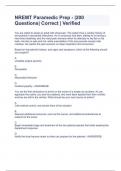
You are called to assist an adult with chest pain. The patient has a cardiac history of two-posterior myocardial infarctions. He is conscious and alert, stating he is having a hard time breathing, and the chest pain worsens when he attempts to lay flat on his back. His skin is pale and hot, while auscultation of his lung sounds reveals mild crackles. He reports the pain worsens on deep inspiration and movement. Based on the patient's history, and signs and symptoms, which of the following should you suspect? A. Unstable angina pectoris B. Pericarditis C. Myocardial infarction D. Cardiomyopathy - ANSWERSB. You are the first ambulance to arrive on the scene of a single-car accident. As you approach the scene, you see four patients, two have been ejected from their vehicle, and two are still in the vehicle. What should be your next course of action? A. Call medical control, and advise them of the situation B. Request additional resources, such as fire rescue, and additional ambulances to respond to the scene C. Begin immediate triage and treatment of the two patients ejected first while awaiting fire department response D. Notify the local trauma center so they can prepare for the patients - ANSWERSB. A patient is experiencing a possible neurological emergency from a blunt force closed head injury. He is found to have abnormal pupillary reactions to light and has lost the ability to move his eyes from side to side to follow your finger movements. He is also unable to identify the number of fingers you are holding up. He reports he is able to see the fingers but is not able to focus enough to identify how many fingers are present. Which of the following cranial nerves should you suspect may be involved in his injury? A. Cranial nerves I, V, and VI B. Cranial nerves V and VII C. Cranial nerves IX and X D. Cranial nerves II, III, and IV - ANSWERSD. Simply put, shock is a state of hypoperfusion due to several different causes. Which one of the following types of shock would be considered distributive shock? A. Hypovolemic shock B. Cardiogenic shock C. Anaphylactic shock D. Toxic shock syndrome - A
Written for
- Institution
- NREMT
- Course
- NREMT
Document information
- Uploaded on
- September 4, 2023
- Number of pages
- 72
- Written in
- 2023/2024
- Type
- Exam (elaborations)
- Contains
- Questions & answers
Subjects
- nremt paramedic prep
-
nremt paramedic prep 200 questions correct v
-
you are called to assist an adult with chest pain
-
you are the first ambulance to arrive on the scene

Also available in package deal