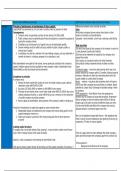
Equity finance (allotting new shares) Debt finance (company raises money by borrowing)
General Principle of maintenance of maintenance of share capital: Differences between loans and debt securities
Capital MUST be maintained as it is fund which creditors take for payment of debts Loan
Consequences Arises when company borrows money from banks or other
1- Company must not generally purchase its own shares (CA 2006, s658) lenders (ie directors and shareholders)
2- Public company may not generally give financial assistance to anyone for purposes of Examples – bank overdraft, a term loan, revolving credit facility
buying the company shares
3- Dividends must not be paid out of capital (only out of distributable profits) Debt securities
4- General meeting must be called to discuss problem if public company suffers a IOU which are issued by the company to the investor in return for
serious loss of capital a cash payment (usually with interest)
5- A subsidiary may not be a member of its own holding company, and any allotment or IOUs have to be redeemed (Ie repaid) by the company at an
transfer of shares in a holding company to its subsidiary is void agreed future date
Once issued, can usually be sold by the initial investors
After shareholders have paid for their shares, money produced constitutes the company’s Only publicly trading companies would use debt securities
capital. Creditors expect this fund available to meet company’s debts. Shareholders have Types
limited liability so this fund should not be diminished Commercial paper - short term debt security which has to be
repaid (mature) by company within 12 months of being issued to
Exceptions to principle investors. Alternative to short term borrowing from bank. Not
A company may: usually traded on London Stock Exchange
1- Reduce its share capital with consent of court (in private company, pass a special Bonds - medium – long term debt securities which will mature
resolution) under ss641-648 CA 2006 over a year after company has issued them to investors. Bonds
2- Buy back (CA 2006, s690) or redeem (ss 684-689) its own shares) admitted to London Stock Exchange to facilitate trading in them
3- Purchase its own shares under a court order made under s994 CA 2006 to buy out an by investors
unfairly prejudiced minority, or under s98-99 to but out a minority on the conversion EMTN programme – Euro Medium Term note programme.
of a public company to private company Another way for company to issue debt securities. Programme
4- Return capital to shareholders, after payment of the copmany’s debts in winding up allows company to issue to investors notes (IOUs) of varying
lengths (up to 30 years) in series of different issues over time.
Can be more flexible and efficient for company than issuing
Principle of maintenance of capital also applies to sums received when: separate bonds or commercial paper over time.
1- Redeemable shares are redeemed by the company (the money being paid in to the
capital redemption reserve); or
2- Shares are issued at a premium (the money being paid into the share premium Not a lot of legislation toward debt finance – the legislation that
account) there is mainly concerns debentures and granting of security by
companies). The law of contract applies
existing capital structure
If company has a lot of debt already (high ‘gearing’), it may be able to obtain more finance
only in form of equity finance (fresh issue of shares) There is a legal control on loans between the lender (usually a
bank) and the borrower (the company) apart from contract law
Gearing = ratio (comparison) of borrowings to shareholder funds
Terms agreed on:
High gearing means greater burden of borrowings and the greater possibility of insolvency if - Background and finances of the company
, trading conditions worsen - Relative bargaining power of parties
- General economic conditions
Existing restrictions
Articles may restrict company’s ability to borrow No legal requirement for company to give lender security for a
loan HOWEVER If lender has security then the loan (which is said
Terms of existing facility agreement may restrict taking of new loans or debt to be ‘secured’) can be more easily recovered if company
defaults and is unable to re-pay
Company will pay higher rate of interest for unsecured loan, as
risk that lender will not get re-paid is greater than it would be if
loan secured
Important clauses
Payment of money to the borrower
Initial clauses of facility agreement will set out:
1- Amount of loan
2- Currency
3- Type of loan (term loan or revolving credit facility)
4- Availability period during which the loan can be taken
(revolving credit facility almost entire length of facility)
In unlikely event that lender refused to lend in breach of facility
agreement, company would be entitled to damages. If company
able to obtain same loan elsewhere then damages would be
nominal
They may be regarded as damages for loss of expectation, to
compensate borrower for not being in position that they should
have been in Robinson v Harman (1848) 1 Exch 850
Reasonableness factor taken into account RuxleyElectronics &
Construction v Forsyth [1996] 1 AC 344)
Specific performance is usually refused where damages are an
appropriate remedy
Interest
No statutory control of the interest rate applicable to companies
General Principle of maintenance of maintenance of share capital: Differences between loans and debt securities
Capital MUST be maintained as it is fund which creditors take for payment of debts Loan
Consequences Arises when company borrows money from banks or other
1- Company must not generally purchase its own shares (CA 2006, s658) lenders (ie directors and shareholders)
2- Public company may not generally give financial assistance to anyone for purposes of Examples – bank overdraft, a term loan, revolving credit facility
buying the company shares
3- Dividends must not be paid out of capital (only out of distributable profits) Debt securities
4- General meeting must be called to discuss problem if public company suffers a IOU which are issued by the company to the investor in return for
serious loss of capital a cash payment (usually with interest)
5- A subsidiary may not be a member of its own holding company, and any allotment or IOUs have to be redeemed (Ie repaid) by the company at an
transfer of shares in a holding company to its subsidiary is void agreed future date
Once issued, can usually be sold by the initial investors
After shareholders have paid for their shares, money produced constitutes the company’s Only publicly trading companies would use debt securities
capital. Creditors expect this fund available to meet company’s debts. Shareholders have Types
limited liability so this fund should not be diminished Commercial paper - short term debt security which has to be
repaid (mature) by company within 12 months of being issued to
Exceptions to principle investors. Alternative to short term borrowing from bank. Not
A company may: usually traded on London Stock Exchange
1- Reduce its share capital with consent of court (in private company, pass a special Bonds - medium – long term debt securities which will mature
resolution) under ss641-648 CA 2006 over a year after company has issued them to investors. Bonds
2- Buy back (CA 2006, s690) or redeem (ss 684-689) its own shares) admitted to London Stock Exchange to facilitate trading in them
3- Purchase its own shares under a court order made under s994 CA 2006 to buy out an by investors
unfairly prejudiced minority, or under s98-99 to but out a minority on the conversion EMTN programme – Euro Medium Term note programme.
of a public company to private company Another way for company to issue debt securities. Programme
4- Return capital to shareholders, after payment of the copmany’s debts in winding up allows company to issue to investors notes (IOUs) of varying
lengths (up to 30 years) in series of different issues over time.
Can be more flexible and efficient for company than issuing
Principle of maintenance of capital also applies to sums received when: separate bonds or commercial paper over time.
1- Redeemable shares are redeemed by the company (the money being paid in to the
capital redemption reserve); or
2- Shares are issued at a premium (the money being paid into the share premium Not a lot of legislation toward debt finance – the legislation that
account) there is mainly concerns debentures and granting of security by
companies). The law of contract applies
existing capital structure
If company has a lot of debt already (high ‘gearing’), it may be able to obtain more finance
only in form of equity finance (fresh issue of shares) There is a legal control on loans between the lender (usually a
bank) and the borrower (the company) apart from contract law
Gearing = ratio (comparison) of borrowings to shareholder funds
Terms agreed on:
High gearing means greater burden of borrowings and the greater possibility of insolvency if - Background and finances of the company
, trading conditions worsen - Relative bargaining power of parties
- General economic conditions
Existing restrictions
Articles may restrict company’s ability to borrow No legal requirement for company to give lender security for a
loan HOWEVER If lender has security then the loan (which is said
Terms of existing facility agreement may restrict taking of new loans or debt to be ‘secured’) can be more easily recovered if company
defaults and is unable to re-pay
Company will pay higher rate of interest for unsecured loan, as
risk that lender will not get re-paid is greater than it would be if
loan secured
Important clauses
Payment of money to the borrower
Initial clauses of facility agreement will set out:
1- Amount of loan
2- Currency
3- Type of loan (term loan or revolving credit facility)
4- Availability period during which the loan can be taken
(revolving credit facility almost entire length of facility)
In unlikely event that lender refused to lend in breach of facility
agreement, company would be entitled to damages. If company
able to obtain same loan elsewhere then damages would be
nominal
They may be regarded as damages for loss of expectation, to
compensate borrower for not being in position that they should
have been in Robinson v Harman (1848) 1 Exch 850
Reasonableness factor taken into account RuxleyElectronics &
Construction v Forsyth [1996] 1 AC 344)
Specific performance is usually refused where damages are an
appropriate remedy
Interest
No statutory control of the interest rate applicable to companies