Unit 2 Assignment C Applied Science
Scenario:
I am a newly appointed technical assistant at a large chemical plant,
Chemcalequip. As part of my induction period and to progress in my role, I have
to demonstrate skills in a range of practical procedures and techniques. The
company is often required to identify substances. I need to demonstrate that I
can carry out different chromatographic techniques to separate and identify
components in mixtures. In a report of the techniques I have used, I will need to
explain the techniques, analyse and evaluate my results and suggest
improvements.
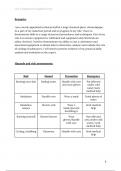
Risk assessment:
Risk Hazard Precaution Emergency
Cutting/stabbing Glass Handle all Seek medical help
yourself or beakers/Capillary glassware with it cut
someone tubes caution
Skin Ethanol solvent Wear gloves Run affected skin
irritation/redness while handling/ under running
handle with care water
Irritation to eyes Ammonia Acid Wear goggles Seek medical help
when working
with acid
Irritation to eyes Propane acid Wear goggles Seek medical help,
and skin and handle with run affected skin
care under running
water
Paper chromatography of dyes:
In order to separate mixtures of soluble compounds, paper chromatography is
used. Frequently, these are coloured materials like food colouring, inks, dyes, or
plant pigments.
1
, Unit 2 Assignment C Applied Science
Equipment:
● Chromatography paper
● Large beaker
● 5 dyes
● Capillary tubes
● Ethanol solvent
● Sticky tape
● String
● Paper clips
● Pencil and ruler
Method:
I began the experiment by drawing a line two centimetres from the bottom of
the chromatography paper. I then separated the colours and labelled where they
would go. I put all of the different dye spots with a capillary tube using a clean
new capillary tube each time to avoid contamination. I filled a large beaker 2cm
with ethanol solvent, then rolled up the chromatography paper and sticky taped
the back, then secured it to a thread with paper clips so it wouldn't move. I
waited until the solvent was almost to the upper edge of the paper, then quickly
removed it to draw a pencil line where it had reached. I drew around the spots of
the dyes to determine the RF value once the chromatography paper had dried.
The image shows the results of the separated dyes on the chromatography
paper.
2
Scenario:
I am a newly appointed technical assistant at a large chemical plant,
Chemcalequip. As part of my induction period and to progress in my role, I have
to demonstrate skills in a range of practical procedures and techniques. The
company is often required to identify substances. I need to demonstrate that I
can carry out different chromatographic techniques to separate and identify
components in mixtures. In a report of the techniques I have used, I will need to
explain the techniques, analyse and evaluate my results and suggest
improvements.
Risk assessment:
Risk Hazard Precaution Emergency
Cutting/stabbing Glass Handle all Seek medical help
yourself or beakers/Capillary glassware with it cut
someone tubes caution
Skin Ethanol solvent Wear gloves Run affected skin
irritation/redness while handling/ under running
handle with care water
Irritation to eyes Ammonia Acid Wear goggles Seek medical help
when working
with acid
Irritation to eyes Propane acid Wear goggles Seek medical help,
and skin and handle with run affected skin
care under running
water
Paper chromatography of dyes:
In order to separate mixtures of soluble compounds, paper chromatography is
used. Frequently, these are coloured materials like food colouring, inks, dyes, or
plant pigments.
1
, Unit 2 Assignment C Applied Science
Equipment:
● Chromatography paper
● Large beaker
● 5 dyes
● Capillary tubes
● Ethanol solvent
● Sticky tape
● String
● Paper clips
● Pencil and ruler
Method:
I began the experiment by drawing a line two centimetres from the bottom of
the chromatography paper. I then separated the colours and labelled where they
would go. I put all of the different dye spots with a capillary tube using a clean
new capillary tube each time to avoid contamination. I filled a large beaker 2cm
with ethanol solvent, then rolled up the chromatography paper and sticky taped
the back, then secured it to a thread with paper clips so it wouldn't move. I
waited until the solvent was almost to the upper edge of the paper, then quickly
removed it to draw a pencil line where it had reached. I drew around the spots of
the dyes to determine the RF value once the chromatography paper had dried.
The image shows the results of the separated dyes on the chromatography
paper.
2