Unit 2 Assignment A Applied Science
Scenario
I am a newly appointed technical assistant at a large chemical plant called
Chemcalquipe. For my induction period and the progression of my role I have to
demonstrate skills in a range of practical procedures and techniques. Part of my
role is to ensure equipment is calibrated and equipment and chemicals are
safety checked. A key part of my role is also to make and test standard solutions
by using colorimetry and titration.
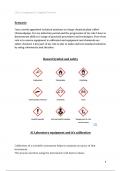
Hazard Symbol and safety
(1)
A1 Laboratory equipment and it’s calibration
Calibration of a scientific instrument helps to maintain accuracy of that
instrument.
The process involves using the instrument with known values.
1
,Unit 2 Assignment A Applied Science
This teaches the instrument to produce results that are more accurate.
Water is used to calibrate everything.
Since the density of pure water is 1gcm-3 , 1.0cm3 of water will weigh 1.0g
We can use this relationship to check the calibration of balances and volumetric
glassware.
Density = mass / volume
90. = 0.6
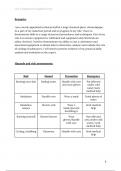
Risk Assessment:
Risk Hazard Risk Level Precaution
Glass beaker Can cut/slice Low Be cautious when
through skin handling glass
equipment
Weighing Electrical Low Do not make
balance shock contact with the
exposed
conductor.
Calibration of a balance:
The precision of an electronic balance is maintained by calibrating it. This
ensures the reliability and repeatability of students' weighing results. To acquire
more accurate outcomes, reliability and repeatability are crucial. (2)
Equipment:
● Electronic balance
● Burette
● Clamp stand and Clamp
● Waste beaker
● Beaker
● Plastic funnel
● Distilled water
2
, Unit 2 Assignment A Applied Science
Method:
1. Place a 100cm3 beaker on the electronic balance and set the reading to
'zero.'
2. I then record the mass of 1.00cm3 of water from the burette.
3. Step 2 should be repeated until 5.00cm3 has been added.
4. Then , up to 20.00cm3, I added 5.00cm3 sections.
5. Finally, up to 50.00cm3, I added 10.00cm3 sections.
6. After I repeated the whole procedure by refilling the burette.
Results Table:
Volume of Mass of Difference Volume of Mass of Difference
water water (g) between water water (g) between
added same added same
(cm3) volume (cm3) volume
additions additions
1.00 1.09 1.00 1.20
2.00 2.29 - 1.20 2.00 2.20 -1
3.00 2.94 - 1.85 3.00 3.28 - 2.08
4.00 4.24 - 3.15 4.00 4.30 - 3.10
5.00 5.24 - 4.15 5.00 5.33 - 4.13
10.00 10.08 - 8.99 10.00 10.25 - 9.05
15.00 15.25 - 14.16 15.00 15.17 - 13.97
20.00 20.36 - 19.27 20.00 20.21 - 19.01
30.00 30.30 - 29.21 30.00 30.17 - 28.97
40.00 40.05 - 38.96 40.00 40.14 - 38.94
50.00 49.96 - 48.87 50.00 50.08 - 48.88
3
Scenario
I am a newly appointed technical assistant at a large chemical plant called
Chemcalquipe. For my induction period and the progression of my role I have to
demonstrate skills in a range of practical procedures and techniques. Part of my
role is to ensure equipment is calibrated and equipment and chemicals are
safety checked. A key part of my role is also to make and test standard solutions
by using colorimetry and titration.
Hazard Symbol and safety
(1)
A1 Laboratory equipment and it’s calibration
Calibration of a scientific instrument helps to maintain accuracy of that
instrument.
The process involves using the instrument with known values.
1
,Unit 2 Assignment A Applied Science
This teaches the instrument to produce results that are more accurate.
Water is used to calibrate everything.
Since the density of pure water is 1gcm-3 , 1.0cm3 of water will weigh 1.0g
We can use this relationship to check the calibration of balances and volumetric
glassware.
Density = mass / volume
90. = 0.6
Risk Assessment:
Risk Hazard Risk Level Precaution
Glass beaker Can cut/slice Low Be cautious when
through skin handling glass
equipment
Weighing Electrical Low Do not make
balance shock contact with the
exposed
conductor.
Calibration of a balance:
The precision of an electronic balance is maintained by calibrating it. This
ensures the reliability and repeatability of students' weighing results. To acquire
more accurate outcomes, reliability and repeatability are crucial. (2)
Equipment:
● Electronic balance
● Burette
● Clamp stand and Clamp
● Waste beaker
● Beaker
● Plastic funnel
● Distilled water
2
, Unit 2 Assignment A Applied Science
Method:
1. Place a 100cm3 beaker on the electronic balance and set the reading to
'zero.'
2. I then record the mass of 1.00cm3 of water from the burette.
3. Step 2 should be repeated until 5.00cm3 has been added.
4. Then , up to 20.00cm3, I added 5.00cm3 sections.
5. Finally, up to 50.00cm3, I added 10.00cm3 sections.
6. After I repeated the whole procedure by refilling the burette.
Results Table:
Volume of Mass of Difference Volume of Mass of Difference
water water (g) between water water (g) between
added same added same
(cm3) volume (cm3) volume
additions additions
1.00 1.09 1.00 1.20
2.00 2.29 - 1.20 2.00 2.20 -1
3.00 2.94 - 1.85 3.00 3.28 - 2.08
4.00 4.24 - 3.15 4.00 4.30 - 3.10
5.00 5.24 - 4.15 5.00 5.33 - 4.13
10.00 10.08 - 8.99 10.00 10.25 - 9.05
15.00 15.25 - 14.16 15.00 15.17 - 13.97
20.00 20.36 - 19.27 20.00 20.21 - 19.01
30.00 30.30 - 29.21 30.00 30.17 - 28.97
40.00 40.05 - 38.96 40.00 40.14 - 38.94
50.00 49.96 - 48.87 50.00 50.08 - 48.88
3