Psychology A Level Essay Plans/Notes – Forensic Psychology
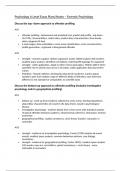
Discuss the top- down approach to offender profiling
AO1
offender profiling - behavioural and analytical tool, predict and profile ; top down -
US 1970s, 36 serial killers, collect data, predict other characteristics, then decide
what categories fit best
4 main stages: data assimilation, crime scene classification, crime reconstruction,
profile generation ; organised v disorganised offender
AO3
strength - research support, distinct organised, Canter (2004) analysis 100 murders,
smallest space analysis, identifies correlations, matching FBI typology for organised
strength - wider application, adapt to other crimes eg burglary, Meketa (2017) when
used 85% rise in solved cases across 3 US states, wider application than just severe
crimes
limitation - flawed evidence, developed using 36 US murderers, Canter argues
sample is poor (not random, large or different kinds of offender), each interview
different so not standard or comparable, no scientific basis
Discuss the bottom-up approach to offender profiling (includes investiagtive
pscyhology and/or geographical profiling)
AO1
bottom up - work up from evidence collected at crime scene, develop hypotheses
about likley characteristics etc (used in UK, data driven, based in psychological
theory)
investigative psychology - matches details from crime scene with statistical analysis
of typical offender behaviour patterns, interpersonal coherence, time/place, forensic
awareness
geographical profiling - spatial consistency, circle theory (Canter), marauder vs
commuter
AO3
strength - evidence for investigative psychology, Canter (1990) analysis 66 sexual
assault, smallest space analysis, common behaviour patterns, case linkage,
consistency
strength - evidence for geographical profiling, Canter (2001), smallest space analysis
120 murder cases inv. serial killers, spatial consistency + circle theory - more
noticeable in marauders
, limitation - geographical information insufficient, success reliant on quality of police
data, approx. 75% crimes unreported, questions utility/accuracy, other factors also
important eg time, age, experience etc
Discuss one historical explanation of offending behaviour
AO1
atavistic form, Lombroso (1876), offending behaviour rooted in genes/innate,
physiological markers eg facial assymetry, sloping brow, dark skin, extra toes, tattoos
etc
different types (murderers - bloodshot eyes, curly hair etc ; sexual deviants - glinting
eyes, fleshy lips etc)
AO3
strength - Lombroso’s legacy, ‘father of modern criminology’, shift towards scientific
position (evolutionary/genetics), heralded beginning of offender profiling
limitation - contradictory evidence, Goring (1913) 3000 offender vs 3000 non
offenders, no evidence for disting unusual facial/cranial features, challenges link
limitation - poor control, no control group to assess confounding variables, eg
research for crime+social conditions explains unemployment characteristic, doesn’t
meet scientific standards
Discuss genetic and/or neural explanations of offending behaviour
A01
genetic - inherited gene predisposes to commit, twin studies (concordance = 35%MZ,
13%DZ), adoption studies (biological mother = 50%, non = 5%), candidate genes
(MAOA regulates seritonin, CHD13 attention deficit hyperactivity disorder), diathesis
stress model
neural - antisocial personality disorder (reduced emotion + lack of empathy),
prefrontal cortex (reduced activity linked to APD), mirror neurons (can empthasise
when asked - neural switch)
AO3
limitation - issues with twin evidence, shared environment assumption, MZ twins
more equal environments than DZ, concordance rates may be due to similar
treatment
strength - support for diathesis stress, Mednick (1984) 13000 danish adoptees, no
parent convictions = 13.5%, biological = 20%, biological + adopted = 24.5% - nature
and nurture
strength - link between crime and frontal lobe, Kandel and Freed (1989) frontal lobe
damage and antisocial behaviour, impulsive and emotional and inability to learn
from mistakes
Discuss the top- down approach to offender profiling
AO1
offender profiling - behavioural and analytical tool, predict and profile ; top down -
US 1970s, 36 serial killers, collect data, predict other characteristics, then decide
what categories fit best
4 main stages: data assimilation, crime scene classification, crime reconstruction,
profile generation ; organised v disorganised offender
AO3
strength - research support, distinct organised, Canter (2004) analysis 100 murders,
smallest space analysis, identifies correlations, matching FBI typology for organised
strength - wider application, adapt to other crimes eg burglary, Meketa (2017) when
used 85% rise in solved cases across 3 US states, wider application than just severe
crimes
limitation - flawed evidence, developed using 36 US murderers, Canter argues
sample is poor (not random, large or different kinds of offender), each interview
different so not standard or comparable, no scientific basis
Discuss the bottom-up approach to offender profiling (includes investiagtive
pscyhology and/or geographical profiling)
AO1
bottom up - work up from evidence collected at crime scene, develop hypotheses
about likley characteristics etc (used in UK, data driven, based in psychological
theory)
investigative psychology - matches details from crime scene with statistical analysis
of typical offender behaviour patterns, interpersonal coherence, time/place, forensic
awareness
geographical profiling - spatial consistency, circle theory (Canter), marauder vs
commuter
AO3
strength - evidence for investigative psychology, Canter (1990) analysis 66 sexual
assault, smallest space analysis, common behaviour patterns, case linkage,
consistency
strength - evidence for geographical profiling, Canter (2001), smallest space analysis
120 murder cases inv. serial killers, spatial consistency + circle theory - more
noticeable in marauders
, limitation - geographical information insufficient, success reliant on quality of police
data, approx. 75% crimes unreported, questions utility/accuracy, other factors also
important eg time, age, experience etc
Discuss one historical explanation of offending behaviour
AO1
atavistic form, Lombroso (1876), offending behaviour rooted in genes/innate,
physiological markers eg facial assymetry, sloping brow, dark skin, extra toes, tattoos
etc
different types (murderers - bloodshot eyes, curly hair etc ; sexual deviants - glinting
eyes, fleshy lips etc)
AO3
strength - Lombroso’s legacy, ‘father of modern criminology’, shift towards scientific
position (evolutionary/genetics), heralded beginning of offender profiling
limitation - contradictory evidence, Goring (1913) 3000 offender vs 3000 non
offenders, no evidence for disting unusual facial/cranial features, challenges link
limitation - poor control, no control group to assess confounding variables, eg
research for crime+social conditions explains unemployment characteristic, doesn’t
meet scientific standards
Discuss genetic and/or neural explanations of offending behaviour
A01
genetic - inherited gene predisposes to commit, twin studies (concordance = 35%MZ,
13%DZ), adoption studies (biological mother = 50%, non = 5%), candidate genes
(MAOA regulates seritonin, CHD13 attention deficit hyperactivity disorder), diathesis
stress model
neural - antisocial personality disorder (reduced emotion + lack of empathy),
prefrontal cortex (reduced activity linked to APD), mirror neurons (can empthasise
when asked - neural switch)
AO3
limitation - issues with twin evidence, shared environment assumption, MZ twins
more equal environments than DZ, concordance rates may be due to similar
treatment
strength - support for diathesis stress, Mednick (1984) 13000 danish adoptees, no
parent convictions = 13.5%, biological = 20%, biological + adopted = 24.5% - nature
and nurture
strength - link between crime and frontal lobe, Kandel and Freed (1989) frontal lobe
damage and antisocial behaviour, impulsive and emotional and inability to learn
from mistakes