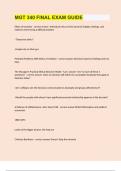
MGT 340 FINAL EXAM GUIDE|UPDATED&VERIFIED|100% SOLVED|GUARANTEED SUCCESS
Ethics of Intuition -Individuals rely on their personal insights, feelings, and instincts when facing a difficult problem -"Sleep-test ethics" -People rely on their gut Potential Problems With Ethics of Intuition Decisions based on feelings and not facts The Manager's Practical Ethical Decision Model: "Can I answer "yes" to each of these 3 questions? -Does my decision fall within the acceptable standards that apply in business today? -Am I willing to see the decision communicated to all people and groups affected by it? -Would the people with whom I have significant personal relationship approve of the decision? A Defense of Utilitarianism--John Stuart Mill British Philosopher and political economist Looks at the bigger picture, the long run Criticises Bentham: Doesn't help the minority Not everything put into the same currency 3 Things Mill Says- -Majority is not always in the right, listen to the minority bc it might be valuable -We need to challenge our beliefs, ask why and not just follow blindly and avoid having set in stone ideologies -Societies told what to believe are not creative, they conform What two factors does Justice involve? -Things and the persons to whom the things are assigned. -In general we say that persons who are equal should have equal things assigned to them. Argument over Callie the Cheerleader example: -Justice is teleological. Defining rights requires us to figure out telos (purpose, end, or essential nature) of social practice in question. -Justice is honorific. To reason about the telos of a practice, or to argue about it, is at least in part to reason or argue about what virtues it should honor and reward. Key Concept of Libertarianism: A right to choose freely and to live our lives as we please provided we respect other people's right to do the same. 3 Main Libertarian Arguments: -No moral laws -No paternalistic laws (no big brother saying you can't do that), an ex of paternalistic law would be the seatbelt law. -No redistribution of income from rich to poor Minimal State No forcing contracts, gov't should be so small it should only do these few things, protect private property (police force), keeps the peace (coast guard, army) Distributive Justice Depends on what Two Things? -Justice in initial holdings- is your money yours in the first place, did they steal anything -Justice in transfer- did you make your money through trade and gifts from others 5 Objections to Libertarianism (Michael Jordan example): -Taxation is not as bad as forced labor -The poor need the money more (stealing from the rich to give it to the poor is still stealing, it should be given by the rich through their own free choice). -Michael Jordan doesn't play alone. He therefore owes a debt to those who contribute to his success. -Jordan is not really being taxed without his consent. -As a citizen of a democracy, he has a voice in making the tax laws to which he is subject. -Jordan is lucky Kant Views - All about intrinsic values, he is not a consequentialist. -Pursuing something for pure pleasure, then -IF you hear a consequence, because of.., they aren't Kant. Kant is very focused on intrinsic reasons, not instrumental What matters is the motive... "do the right thing for the right reason". Kantian Quiz: Paying him the bonus and his two weeks pay after he put his two weeks before Christmas. What do you do? You should pay him both the bonus and the two weeks even though you have other feelings about it but you do it because it is the right thing to do. Kant Quiz: The candidate can only be there for 3 months but the employer needs them for 6 months, but he is the perfect candidate. Do you send them? Do you say anything to the employers? Kant says you talk to the candidate and ask him to stay for the position but if he can't you do not send him over. 3 Approaches to Justice: -Way to define justice would be utilitarianism, maximize welfare or the collective happiness of society as a whole -Connects justice to freedom, libertarianism, distribution of wealth and income is whatever distribution arises from the free exchange of goods and services. -Justice means giving people what they morally deserve-- allocating goods to reward and promote virtue. Aristotle, virtue based approach, connects justice to reflection about the good life. Kant Rejects approach one and three. He goes for approach two. Pain and pleasure are not our sovereign masters, we are all rational beings and capable of reason. Autonomous: Capable of acting freely, free will, acting according to the law I give myself. Heteronomous: Act on impulse, its non controllable and inherent, necessity. An example is alcoholism. What are the two types of Freedom? Autonomous and Heteronomous Deontology- Doing things based on our duty, study of duty Kant's 3 Contrasts: Morality- Motives: Duty vs. Inclination Freedom- Determination of Will: Autonomous vs. Heteronomous Reason- Imperatives: Categorical vs. Hypothetical The Formula of Universal Law- "Act only on that maxim whereby you can at the same time will that if should become universal law" The Formula of Humanity As An End - "Act in such a way that you always treat humanity, whether in your own person or in the person of any other, never simply as a means but always at the same time, an end." People exist for themselves, we deserve to not be used because we are autonomous beings. Can't use people to get ahead without their consent.
Written for
- Institution
- MGMT
- Course
- MGMT
Document information
- Uploaded on
- August 31, 2023
- Number of pages
- 25
- Written in
- 2023/2024
- Type
- Exam (elaborations)
- Contains
- Questions & answers
Subjects
-
mgt 340 final exam guideupdatedverified100 sol

Also available in package deal