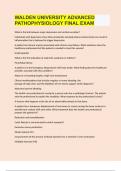
WALDEN UNIVERSITY ADVANCED PATHOPHYSIOLOGY FINAL EXAM|UPDATED&VERIFIED|100% SOLVED|GUARANTEED SUCCESS
What is the link between major depression and cortisol secretion? Individuals with depression show that persistently elevated plasma cortisol levels can result in inflammation that is believed to trigger depression A patient has chronic anemia associated with chronic renal failure. What substance does the healthcare professional tell the patient is needed to treat this anemia? Erythropoietin What is the first indication of nephrotic syndrome in children? Periorbital edema A patient is in the Emergency Department with heat stroke. What finding does the healthcare provider associate with this condition? Absence of sweating despite a high core temperature Clinical manifestations that include irregular or heavy bleeding, the passage of large clots, and the depletion of iron stores support which diagnosis? Abnormal uterine bleeding The health care professional is caring for a person who has a pathologic fracture. The patient asks the professional to explain the condition. What response by the professional is best? A fracture that happens at the site of an abnormality already in that bone. A patient has a temporary displacement of two bones in a joint causing the bone surfaces to partially lose contact with each other. What treatment does the health care professional prepare the patient for? Reduction and immobilization Cystic fibrosis is characterized by which symptom? Excessive mucus production Stroke Volume (SV) measurement of the amount of blood ejected from a ventricle in one contraction Multiple Sclerosis (MS) disease of the central nervous system characterized by the demyelination (deterioration of the myelin sheath) of nerve fibers, with episodes of neurologic dysfunction (exacerbation) followed by recovery (remission) Transient Ischemic Attack (TIA) Minor stroke; where neurological function is regained quickly with time Myasthenia Gravis autoimmune neuromuscular disorder characterized by weakness of voluntary muscles Headaches pain anywhere in the cranial cavity (a.k.a. cephalalgia) Seizure Disorders Head Injury Spinal Cord Injury the type of paralysis is determined by the level of the vertebra closest to the injury Inflammatory disease of the Musculoskeletal System Osteoporosis A condition in which the body's bones become weak and break easily. Osteopenia abnormal reduction of bone mass Bursitis inflammation of a bursa usually caused by a blow or friction Tendinitis inflammation of the tendons caused by excessive or unusual use of the joint Gout a type of arthritis characterized by deposits of uric acid crystals in the joints Lyme Disease Tick-borne disease caused by the spirochete Borrelia burgdorferi. Spondylosis a degenerative disorder that can cause the loss of normal spinal structure and function Fractures a crack or break in a bone Parkinson's A disorder of the central nervous system that affects movement, often including tremors. Alzheimer's A progressive disease that destroys memory and other important mental functions. Osteoblasts Bone building cells Osteocytes a bone cell, formed when an osteoblast becomes embedded in the matrix it has secreted. Osteoclasts large cells that resorb or break down bone matrix Generalized Anxiety Disorder an anxiety disorder in which a person is continually tense, apprehensive, and in a state of autonomic nervous system arousal Depression A prolonged feeling of helplessness, hopelessness, and sadness Bipolar Disorders disorders marked by alternating or intermixed periods of mania and depression Schizophrenia Delirium and Dementia hallucinations Obsessive Compulsive Disease OCD Growth and Development consistent growth and development controlled by inherited DNA Normal growth patterns Scoliosis (ortho) Kawasaki acute systemic vasculitis -inflammation of blood vessels Alterations in children Congenital (heart syndrome) PDAs Sudden Infant Death Syndrome (SIDS) the unexplained death of a seemingly healthy baby Asthma A chronic allergic disorder characterized by episodes of severe breathing difficulty, coughing, and wheezing. Lead poisoning and effects on neurological functioning Sickle Cell an abnormal red blood cell that has a crescent shape and an abnormal form of hemoglobin
Written for
- Institution
- NURS
- Course
- NURS
Document information
- Uploaded on
- August 31, 2023
- Number of pages
- 14
- Written in
- 2023/2024
- Type
- Exam (elaborations)
- Contains
- Questions & answers
Subjects
-
walden university advanced pathophysiology final e

Also available in package deal