WGU D017 School Law Latest Update Graded A+
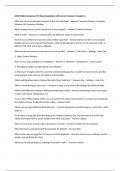
Common School Movement () Horace Mann and Henry Barnard Primary schools teaching the rudiments to all who needed it. Goal was to make the population more moral citizens. A Nation at Risk 1983 National Commission report calling for extensive educational reforms, including more academic course requirements, more stringent college entrance requirements, upgraded and updated textbooks, and longer school days and year. Types of Schools Public - funded through taxes and subject to all federal and state laws. Private - funded by grants, donations and student tuition and is not subject to federal or state laws. Charter- The charter is a performance contract which establishes the school's mission and goals. They can select (randomly) who attends the school and are funded by tax dollars and take the same tests as public schools. -Get less per pupil than public schools. Role of Government in Schools Federal - can influence education thorough funding powers and enforcement of constitutional rights. States - have absolute power to make laws governing education. Create state laws and has state agencies to adopt regulations. Federal Legislation Law at the highest or national level of a federal government, consisting of a constitution, enacted laws and court decisions pertaining to them. In education compliance is usually attached to funding. State Legislation State legislatures pass laws on issues. Example: compulsory attendance laws. Must be constitutional. Federal and State Regulations Supplements to the law that are legally binding. Help explain how the law should be interpreted and implemented. Case or Common Law the body of law made up of judicial opinions and precedents State Court Structure Varies by state but general includes trial court, state courts of appeal, and a state supreme court. Any federal question would go to the US District Court instead of the Trial court. Separate but Equal Doctrine The doctrine established in Plessy v. Ferguson that African Americans could constitutionally be kept in separate but equal facilities. De Jour Segregation vs De Facto Segregation De Jour - unnatural or forced state mandated segregation. -unconstitutional De Facto - natural segregation caused by house patterns for example. -not unconstitutional Brown v. Board of Ed. of Topeka "We conclude that in the field of public education the doctrine of 'separate-but-equal' has no place. Separate educational facilities are inherently unequal." Demonstrated that education is a civil right and therefore discrimination in education is unconstitutional. Unitary System Court has defined a unitary system as the status a school system achieves "when it no longer discriminates between school children on the basis of race," ReZoning of Schools Because of a long history of gerrymandering boundary lines with the intent to segregate, many school boundaries during the 1950s and 1960s had little to do with geographic barriers (e.g., rivers, hills); safety issues (e.g., location of busy roads, factories); or the size, location, or dispersion of the student population. When the schools were rezoned with good faith the schools were better integrated. 1st Amendment (Religion,speech, press, assembly, petition) Establishment Clause - Prohibits the government from establishing an official church Free Exercise Clause - Allows people to worship as they please
Written for
- Institution
- WGU D017
- Course
- WGU D017
Document information
- Uploaded on
- August 30, 2023
- Number of pages
- 28
- Written in
- 2023/2024
- Type
- Exam (elaborations)
- Contains
- Questions & answers
Subjects
-
wgu d017 school law latest update graded a

Also available in package deal