LCDC practice Exam Questions and Answers | Latest Update 2023/2024 | 100% Correct
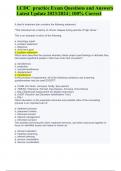
LCDC practice Exam Questions and Answers | Latest Update 2023/2024 | 100% Correct. In the process of assessment, all of the following substance use screening questionnaires may be used EXCEPT: a. CAGE (Cut down, Annoyed, Guilty, Eye-opener) b. TWEAK (Tolerance, Worried, Eye-Opener, Amnesia, K/Cut Down) c. DALI (Dartmouth Assessment of Lifestyle Instrument d. AUDIT (Alcohol Use Disorders Identification Test) c. DALI Client education on the expected outcomes and possible risks of the counseling process is an important part of: a. treatment process b. placement criteria c. informed consent d. referral management c. Informed Consent The activities that bring the client, treatment services, and other resources together to focus on identified issues and needs is known as: a. clinical evaluation b. treatment planning c. referral planning d. service coordination d. Service coordination Which of the following is NOT required to be documented in a client's release of information? a. date of last treatment b. client name c. date signed d. expiration date a. date of last treatment As part of informed consent, counselors should advise clients of the exact circumstances under which they are legally required to do which of the following? a. break confidentiality b. call the police c. cancel an appointment d. terminate treatment a. break confidentiality Administrative supervision provides an opportunity to address a. countertransference issues b. developing a therapeutic alliance c. mutuality, respect and connection for clients d. program policies and standards d. program policies and standards Which of the following client attributes is an important predictor of treatment outcomes? a. practicing self-care b. self-esteem c. self-efficacy d. ability to self-soothe c. self-efficacy What potential factors of each change strategy are considered when developing a solid plan for change? a. potential outcomes b. financial cost c. time restrictions d. environmental impact a. potential outcomes Knowledge of which of the following is MOST important for crisis management? a. client history of trauma b. patterns of violence demonstrated by client c. coping strategies used by the client d. continuum of client care a. client history of trauma Nutritional counseling, wellness programs, and preventative healthcare education are part of an important service for clients with substance use disorders known as a. psychoeducation b. health promotion c. medical care d. life skills b. health promotion 00:0201:30 Clients with low levels of motivation to abstain from substance use should be placed in which type of group? a. psychoeducational b. skill building c. process d. support a. psychoeducational The assessment process begins when the client a. admits they have a problem b. makes their first appoint for counseling c. attends their first counseling session d. first makes contact with their counselor c. attends their first counseling session To abstain from drug use and maintain abstinence, individualized counseling emphasizes short term behavioral goals and helps the client develop a. coping strategies and tools b. natural support systems c. community partners d. defense mechanisms a. coping strategies and tools A client who is thinking about overcoming a problem but has not yet made a commitment to finding a resolution is in which stage of change? a. preparation b. precontemplation c. action d. contemplation d. contemplation The identification of client's needs that cannot be met by the counselor or agency and assisting the client to use the support systems and community resources available to meet those needs is a. referral b. treatment planning c. service coordination d. clinical evaluation a. referral The purpose of an assessment is to a. gather detailed information for the treatment plan b. gauge the validity of the instrument c. provide a diagnosis d. quantify an symptomatology a. gather detailed information for the treatment plan Empty Chair, Behavior Contracts, Scaling Questions, Journaling and Art are all examples of techniques that help clients examine their a. behaviors, attitudes, and feelings b. unconscious feelings c. core belies d. creative self a. behaviors, attitudes, and feelings Counselors should foster the client's entry into treatment by stressing the importance of a. ending all relationships that cause emotional distress b. avoiding any and all substances c. complying with treatment recommendation to ensure positive outcomes d. attending self-help meetings c. complying with treatment recommendation to ensure positive outcomes The DSM-5 is a tool used to a. make a diagnostic impression based on presenting symptoms b. identify risk and protective factors relevant to the client c. determine the appropriate level of care d. develop symptom specific treatments a. make a diagnostic impression based on presenting symptoms Before a client in need of continued treatment is discharged, a counselor MUST a. provide the client with a list of resources available to assist in procuring further treatment b. make appropriate alternative arrangements c. have the client consent to the termination of treatment d. inform all concerned others involved in the treatment process. a. provide the client with a list of resources available to assist in procuring further treatment A clearly conceptualized treatment plan should have which of these three core elements? a. problem statements, goals, and objectives b. goals, strengths, and barriers
Written for
- Institution
- LCDC
- Course
- LCDC
Document information
- Uploaded on
- August 30, 2023
- Number of pages
- 10
- Written in
- 2023/2024
- Type
- Exam (elaborations)
- Contains
- Questions & answers
Subjects
- lcdc
- lcdc practice
- latest update 2023 2024
- correct
-
lcdc practice exam questions and answers

Also available in package deal