Ati Health Assessment Exam. Questions With Answers.
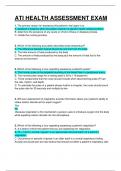
18. When taking a adults patient's temperature rectally, it is important to A. rotate the probe gently if you encounter any resistance. B. insert the probe so that you are aiming at patient's pelvic area. C. dip the probe 1-1.5 inch into a tube of lubricant. D. insert the probe about an inch and a half into the patient's anus 19. When assessing a patient's respiration, it is recommended that the patient A. Lie flat in bed. B. Continue to go about his/her usual activities. C. Have the head elevated 45-60degree. D. Take several deep breath before assessment. 20. You have assessed a 45 yr old patient's vital signs. Which of the following assessment values requires immediate attention A. 148/88 mmHg Blood pressure B. 100F tempeture. C. 30 respiration per min. D. 45 beats for 30 sec 21. You are preparing to use a tympanic thermometer. Which of the following steps has the highest priority in the accurate use of this piece of equipment for measuring body A. Attaching disposable probe cover. B. Assessing external redness of the ear. C. Pull pinna back and upward. D. Replace thermometer in the charger. 22. When preparing to measure vital signs of a patient, you should recognize which will affect the methods that you will use? - patient is 60 lbs overweight -patient is reporting a stuffy nose -patient is taking digoxin -patient had a mastectomy 2 years ago You are measuring a patient's temp. orally. You place the covered probe A. in the posterior linguinal pocket lateral to the midline B. so that it rest on the lower lingual frenulum. C. centrally on top of patient's tongue. D. under the tongue just beyond patient's teeth. 23. When auscultating a patient's apical pulse, you listen until you hear the S1 and S2 heart sounds clearly and regularly. S2 is produced when the A. atria contact vigorously. B. Ventricular walls vibrate. C. Semilunar valves close. D. Mitral valve snaps open. 24. Difference between systolic and diastolic pressure is A. Auscultatory gap B. Pulse pressure. C. Diurnal variation D. Pulse deficit. 25. When taking a patient's BP why is it important to notice the pressure on the manometer when you hear the fourth Korotkoff sound or phase? A. You might not hear a fifth Korotkoff sound B. Correspond to patient systolic pressure. C. You need to record patient diastolic pressure. D. It is the loudest Korotkoff sound. 26. You are assessing a patient's vital signs. the patient has a temp. of 102 degrees F. Which of the following do you expect to find? A. Elevated pulse rate. B. Decrease blood pressure. C. Elevated blood pressure. D. Decrease pulse rate.
Document information
- Uploaded on
- August 30, 2023
- Number of pages
- 6
- Written in
- 2022/2023
- Type
- Exam (elaborations)
- Contains
- Questions & answers