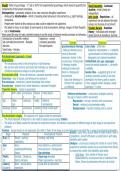
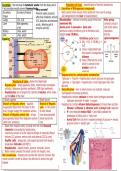
Coordination Neurones – specialised nerve cells transmit electrical impulses
Animals respond to Plants respond to Cell body – nucleus, cytoplasm, mitochondria, ribosomes
Blood glucose conc Cell ᴪ, light, Dendron – BEFORE cell body & carries impulses towards cell body.
Internal temp, blood ᴪ, water, Stimulus - Divides into dendrites (sensory & motor)
cell pH, humidity, light Axon – AFTER cell body & carries impulse away from cell body
intensity, sound Sensory Myelin sheath – fatty layer of Schwann cells insulates cell from other electrical
Cell signalling – cells release molecules receptor activity.
that bind with specific & complementary Action potential – moves from periphery to axon terminal.
Nerve
receptors on CSM. impulse
Sensory Relay Motor
Organisms must respond Sensory Action Sensory receptor to Connect sensory & motor CNS to effector
- By electrical impulses neurone potential? CNS neurones
- Hormonal system (adrenaline/ ADH) Cell Outside CNS in In CNS In CNS
- Excretion (liver, kidney, pancreas) CNS (brain & body? dorsal root
- Homeostasis (ᴪ of blood) spinal cord) ganglia.
Structure Long dendrons into Long axon out of
Relay neurone ? CNS CNS
Motor neurone
Effector
Myelinated neurones – saltatory conduction
Sensory receptors – specialised cells that detect changes - Schwann cells wrap tightly around neurone & layers of membrane form myelin
in surroundings. sheath (pp lipid bilayer mainly lipid)
- Transducers – convert one form of energy into another - Electrical Insulator – charged ions cannot diffuse through by pp-lipid bilayer
(electrical energy of nerve impulse) - Impulse forced to jump between Nodes of Ranvier
- Specific to single stimulus - Conduct impulses by Saltatory conduction = quicker & over larger
Receptor Stimulus detected distances.
Osmoreceptors Conc of body fluids Non-myelinated neurones – transmit impulse continuously along nerve fibre as a
Photoreceptors in eye retina Light intensity &
wavelength
Olfactory chemoreceptors Presence of chemicals
line nasal cavity
Thermoreceptors Presence of heat.
Pacinian corpuscles – sensory receptors detect changes in Saltatory conduction – action potential moves from node to node in myelinated
pressure on skin. neurones.
- Pressure deforms ring of connective tissue which push 1. Myelin sheath is impermeable to ions. Na+ and K+ ions cannot diffuse
against nerve endings through.
- Stop responding to constant pressure. 2. Action potential causes Na+ ions to enter at that point in neurone
3. At Nodes, localised currents of charge form in cytoplasm of neurone. (+ve)
4. Na+ ions begin to diffuse down the axon into regions of lower conc (next
node).
5. Local current causes slight depolarisation further down neurone stimulating
Na+ channels to open generator potential action potential
- Longer Schwann cells = quicker transmission.
Animals respond to Plants respond to Cell body – nucleus, cytoplasm, mitochondria, ribosomes
Blood glucose conc Cell ᴪ, light, Dendron – BEFORE cell body & carries impulses towards cell body.
Internal temp, blood ᴪ, water, Stimulus - Divides into dendrites (sensory & motor)
cell pH, humidity, light Axon – AFTER cell body & carries impulse away from cell body
intensity, sound Sensory Myelin sheath – fatty layer of Schwann cells insulates cell from other electrical
Cell signalling – cells release molecules receptor activity.
that bind with specific & complementary Action potential – moves from periphery to axon terminal.
Nerve
receptors on CSM. impulse
Sensory Relay Motor
Organisms must respond Sensory Action Sensory receptor to Connect sensory & motor CNS to effector
- By electrical impulses neurone potential? CNS neurones
- Hormonal system (adrenaline/ ADH) Cell Outside CNS in In CNS In CNS
- Excretion (liver, kidney, pancreas) CNS (brain & body? dorsal root
- Homeostasis (ᴪ of blood) spinal cord) ganglia.
Structure Long dendrons into Long axon out of
Relay neurone ? CNS CNS
Motor neurone
Effector
Myelinated neurones – saltatory conduction
Sensory receptors – specialised cells that detect changes - Schwann cells wrap tightly around neurone & layers of membrane form myelin
in surroundings. sheath (pp lipid bilayer mainly lipid)
- Transducers – convert one form of energy into another - Electrical Insulator – charged ions cannot diffuse through by pp-lipid bilayer
(electrical energy of nerve impulse) - Impulse forced to jump between Nodes of Ranvier
- Specific to single stimulus - Conduct impulses by Saltatory conduction = quicker & over larger
Receptor Stimulus detected distances.
Osmoreceptors Conc of body fluids Non-myelinated neurones – transmit impulse continuously along nerve fibre as a
Photoreceptors in eye retina Light intensity &
wavelength
Olfactory chemoreceptors Presence of chemicals
line nasal cavity
Thermoreceptors Presence of heat.
Pacinian corpuscles – sensory receptors detect changes in Saltatory conduction – action potential moves from node to node in myelinated
pressure on skin. neurones.
- Pressure deforms ring of connective tissue which push 1. Myelin sheath is impermeable to ions. Na+ and K+ ions cannot diffuse
against nerve endings through.
- Stop responding to constant pressure. 2. Action potential causes Na+ ions to enter at that point in neurone
3. At Nodes, localised currents of charge form in cytoplasm of neurone. (+ve)
4. Na+ ions begin to diffuse down the axon into regions of lower conc (next
node).
5. Local current causes slight depolarisation further down neurone stimulating
Na+ channels to open generator potential action potential
- Longer Schwann cells = quicker transmission.