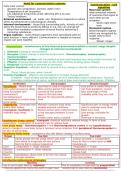
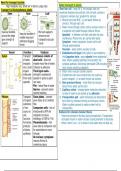
Transport system needed in mammals because; Blood
- Large = ↓SA: V, ↑metabolic rate, waste & gas transport, Plasma – carries glucose, aa, mineral ions, hormones & large plasma proteins.
Temp maintenance, Hormone circulation - Albumin – osmotic potential, Globulins – transport & immune, Fibrinogen – blood
Circulatory systems – carry gases, nutrients, waste products & clotting
hormones around the body. Platelets – initiate blood clotting
- Parts; Circulatory fluid, contractile pumping devise, tubes Erythrocytes – transport oxygen
which fluid circulates. Leucocytes
Single – once through heart per circuit. low pressure. - Neutrophils – engulf bacteria
- blood to gills (passes through capillaries, picks up O2 & ↓ - Lymphocytes – produce antibodies
pressure). Around body of fish, back to heart. Tissue fluid
- ↓pressure = ↓efficiency = ↓activity - Substances dissolved in plasma pass through capillary fenestrations (large plasma
Double – twice through heart per circuit proteins cannot).
- Deox blood to R artery & to lungs where picks up O2 (↓ - Therefore, tissue fluid has a higher water potential than plasma. Water moves from
pressure) surrounding tissue fluid into capillaries via osmosis.
- Ox blood to L artery & pumped to rest of body (↑pressure). - Tissue fluid supplies cells with glucose, aa, fatty acids, salts… & absorbs waste
Open (insects) – few vessels contain transport medium. products which return to capillaries & removed.
- Haemolymph (transport fluid) pumped straight from heart Oncotic pressure – pressure exerted by proteins that draws water in. -3.3kpa
to Haemocoel (body cavity) Hydrostatic pressure – pressure exerted by vol of fluid in enclosed space. 4.6kpa
- Haemocoel – blood under ↓pressure. Direct contact with Arterial end Venous end
tissues & cells. Exchanges occurs. 1. Blood arrives under ↑pressure 1. ↓HP than arterial end as fluid content lost
- Returns to heart through open ended vessel. from artery = ↑HP forcing fluid to surroundings (still higher than HP outside)
- Energy efficient. Slower, no control, reliant on body out capillary fenestrations. 2. Plasma proteins remain in capillary = ᴪ in
movement to transport material. 2. HP pushing fluid out greater than capillary remains low (same as arteriole
Closed – blood enclosed in blood vessels & not in direct OP of plasma proteins drawing end)
contact with cells. fluid in. 3. ↓HP inside capillary, means OP is now
- Heart pumps blood around body under ↑pressure quickly. 3. Fluid leaves capillary but plasma greater than HP and water is drawn in by
Blood returns directly to heart. proteins are too large. osmosis
- Substances leave & enter blood by diffusion, distribution of
blood adjusted by vasodilation/ constriction.
Lymph – fluid in lymphatic system
- Not all fluid returns to capillaries. Some drains into system of lymph capillaries which
join to lumpy vessels (lymph system)
- Slow flow of liquid. Lymph transported by squeezing of body muscles. Valves allow
lymph to enter & not leave, one direction flow from tissues to heart.
- Lymph nodes – intervals along lymph vessels. Lymphocytes (WBC) build up & are
passed into blood. Lymph nodes swell at times of infection
- Large = ↓SA: V, ↑metabolic rate, waste & gas transport, Plasma – carries glucose, aa, mineral ions, hormones & large plasma proteins.
Temp maintenance, Hormone circulation - Albumin – osmotic potential, Globulins – transport & immune, Fibrinogen – blood
Circulatory systems – carry gases, nutrients, waste products & clotting
hormones around the body. Platelets – initiate blood clotting
- Parts; Circulatory fluid, contractile pumping devise, tubes Erythrocytes – transport oxygen
which fluid circulates. Leucocytes
Single – once through heart per circuit. low pressure. - Neutrophils – engulf bacteria
- blood to gills (passes through capillaries, picks up O2 & ↓ - Lymphocytes – produce antibodies
pressure). Around body of fish, back to heart. Tissue fluid
- ↓pressure = ↓efficiency = ↓activity - Substances dissolved in plasma pass through capillary fenestrations (large plasma
Double – twice through heart per circuit proteins cannot).
- Deox blood to R artery & to lungs where picks up O2 (↓ - Therefore, tissue fluid has a higher water potential than plasma. Water moves from
pressure) surrounding tissue fluid into capillaries via osmosis.
- Ox blood to L artery & pumped to rest of body (↑pressure). - Tissue fluid supplies cells with glucose, aa, fatty acids, salts… & absorbs waste
Open (insects) – few vessels contain transport medium. products which return to capillaries & removed.
- Haemolymph (transport fluid) pumped straight from heart Oncotic pressure – pressure exerted by proteins that draws water in. -3.3kpa
to Haemocoel (body cavity) Hydrostatic pressure – pressure exerted by vol of fluid in enclosed space. 4.6kpa
- Haemocoel – blood under ↓pressure. Direct contact with Arterial end Venous end
tissues & cells. Exchanges occurs. 1. Blood arrives under ↑pressure 1. ↓HP than arterial end as fluid content lost
- Returns to heart through open ended vessel. from artery = ↑HP forcing fluid to surroundings (still higher than HP outside)
- Energy efficient. Slower, no control, reliant on body out capillary fenestrations. 2. Plasma proteins remain in capillary = ᴪ in
movement to transport material. 2. HP pushing fluid out greater than capillary remains low (same as arteriole
Closed – blood enclosed in blood vessels & not in direct OP of plasma proteins drawing end)
contact with cells. fluid in. 3. ↓HP inside capillary, means OP is now
- Heart pumps blood around body under ↑pressure quickly. 3. Fluid leaves capillary but plasma greater than HP and water is drawn in by
Blood returns directly to heart. proteins are too large. osmosis
- Substances leave & enter blood by diffusion, distribution of
blood adjusted by vasodilation/ constriction.
Lymph – fluid in lymphatic system
- Not all fluid returns to capillaries. Some drains into system of lymph capillaries which
join to lumpy vessels (lymph system)
- Slow flow of liquid. Lymph transported by squeezing of body muscles. Valves allow
lymph to enter & not leave, one direction flow from tissues to heart.
- Lymph nodes – intervals along lymph vessels. Lymphocytes (WBC) build up & are
passed into blood. Lymph nodes swell at times of infection