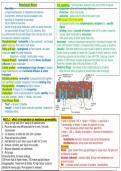
Phospholipid Bilayer Cell signalling – communication between cells using chemical signals
- 7nm thick - Endocrine – other cells over large distances
- compartmentalisation of cytoplasm and external - Paracrine – other cells locally
environment, chemical reactions between cells. - Autocrine – within cells or cells of the same types
- signalling & recognition & exchange CSM (synoptic link to Hormones)
- site of chemical reactions - glycoproteins/lipids have complementary receptors to a specific
- barrier to large polar molecules, small non-polar molecules signal
can pass straight through (H2O, CO2, vitamins, fats) - binding causes a cascade of events inside cell to create a response
e.g mitochondria has pp-lipid bilayer than controls entry & exit - release signal molecules by exocytosis
of molecules needed in respiration. - CSM allows entry of some signal molecules.
Phosphate head – hydrophilic so face outwards, -ve charged Hormones – chemical messengers transported in the blood to target cells
polar molecules that interact with water (cells with hormone receptor). Complementary binding causes a response.
Fatty acid tails – hydrophobic so face inwards, non-polar (Insulin) - Pancreas detects too much insulin in blood so secretes insulin,
molecules repel any polar molecules Insulin binds to receptor on target cell, Cascade of events leads to a vesicle
o Saturated = straight. Unsaturated = wavy containing a glucose carrier protein to fuse with CSM, ↑glucose channel
Channel Protein – hydrophilic channel allows facilitated proteins in CSM means ↑uptake of glucose from blood into cell. Insulin
diffusion of polar molecules hormone is broken down reducing proteins in CSM.
Carrier protein – conformational shape changes, transport Medicinal Drugs – developed to be complementary to receptors.
large molecules into cell. Facilitated diffusion & active - Beta blockers block receptors to prevent heart rate increasing
transport.
Extrinsic proteins –hydrophilic R groups bind cells together,
cell signalling & antigen recognition, hormone binding sites
Glycoproteins – receptors that form H bonds
Glycolipids –Antigens for cell recognition
Cholesterol – binds to phospholipid to regulate stability. Packs
and adds strength. ↓temp = ↑fluidity. Vice versa.
Fluid Mosaic Model –
- ‘fluid’ = dynamic & flexible.
- ‘mosaic’ = made of many molecules (proteins, cholesterol)
embedded within.
Temperature
PAG 5.1 – effect on temperature on membrane permeability. ↑temp = pp-lipids ↑KE = ↑gaps = ↑fluidity = ↓specificity =
1. Using syringe add 10cm3 water to 6 labelled tubes. ↑permeability of bilayer = easier for particles to cross.
2. Place test tube into diff temp bath for 5 mins. Test with - ↑ temp denatures protein stops their specificity.
thermometer ↓temp = ↓KE = ↓fluidity of pp-lipids = ↓function of membrane =
3. Cut beetroot, on white tile into 5mm cylinders ↓dynamic
4. Rinse and pat dry cylinders - Endotherms maintain constant body temp (homeostasis)
5. Add beetroot to each tube. Leave in bath for 15 mins - Ectotherms body temp varies with environment
6. Remove cylinders, poor liquid into cuvette. Solvents
7. Measure absorption on colorimeter. Water – polar solvent forms pp-lipid bilayer & keep intact. Pp-lipids will
8. Plot graph. not dissolve in water.
Increasing temp, increases leakage. Alcohols (ethanol) – dissolve lipids, disrupt cell membranes and
CSM more fluid at higher temps. ↑KE makes pp-lipid bilayer prevent function
disaggregated, ↑movement & fluidity. At high temps’ proteins PH – ↓changes tertiary structure of proteins ↑permeability
denature leaving gaps. More pigment is released.
- 7nm thick - Endocrine – other cells over large distances
- compartmentalisation of cytoplasm and external - Paracrine – other cells locally
environment, chemical reactions between cells. - Autocrine – within cells or cells of the same types
- signalling & recognition & exchange CSM (synoptic link to Hormones)
- site of chemical reactions - glycoproteins/lipids have complementary receptors to a specific
- barrier to large polar molecules, small non-polar molecules signal
can pass straight through (H2O, CO2, vitamins, fats) - binding causes a cascade of events inside cell to create a response
e.g mitochondria has pp-lipid bilayer than controls entry & exit - release signal molecules by exocytosis
of molecules needed in respiration. - CSM allows entry of some signal molecules.
Phosphate head – hydrophilic so face outwards, -ve charged Hormones – chemical messengers transported in the blood to target cells
polar molecules that interact with water (cells with hormone receptor). Complementary binding causes a response.
Fatty acid tails – hydrophobic so face inwards, non-polar (Insulin) - Pancreas detects too much insulin in blood so secretes insulin,
molecules repel any polar molecules Insulin binds to receptor on target cell, Cascade of events leads to a vesicle
o Saturated = straight. Unsaturated = wavy containing a glucose carrier protein to fuse with CSM, ↑glucose channel
Channel Protein – hydrophilic channel allows facilitated proteins in CSM means ↑uptake of glucose from blood into cell. Insulin
diffusion of polar molecules hormone is broken down reducing proteins in CSM.
Carrier protein – conformational shape changes, transport Medicinal Drugs – developed to be complementary to receptors.
large molecules into cell. Facilitated diffusion & active - Beta blockers block receptors to prevent heart rate increasing
transport.
Extrinsic proteins –hydrophilic R groups bind cells together,
cell signalling & antigen recognition, hormone binding sites
Glycoproteins – receptors that form H bonds
Glycolipids –Antigens for cell recognition
Cholesterol – binds to phospholipid to regulate stability. Packs
and adds strength. ↓temp = ↑fluidity. Vice versa.
Fluid Mosaic Model –
- ‘fluid’ = dynamic & flexible.
- ‘mosaic’ = made of many molecules (proteins, cholesterol)
embedded within.
Temperature
PAG 5.1 – effect on temperature on membrane permeability. ↑temp = pp-lipids ↑KE = ↑gaps = ↑fluidity = ↓specificity =
1. Using syringe add 10cm3 water to 6 labelled tubes. ↑permeability of bilayer = easier for particles to cross.
2. Place test tube into diff temp bath for 5 mins. Test with - ↑ temp denatures protein stops their specificity.
thermometer ↓temp = ↓KE = ↓fluidity of pp-lipids = ↓function of membrane =
3. Cut beetroot, on white tile into 5mm cylinders ↓dynamic
4. Rinse and pat dry cylinders - Endotherms maintain constant body temp (homeostasis)
5. Add beetroot to each tube. Leave in bath for 15 mins - Ectotherms body temp varies with environment
6. Remove cylinders, poor liquid into cuvette. Solvents
7. Measure absorption on colorimeter. Water – polar solvent forms pp-lipid bilayer & keep intact. Pp-lipids will
8. Plot graph. not dissolve in water.
Increasing temp, increases leakage. Alcohols (ethanol) – dissolve lipids, disrupt cell membranes and
CSM more fluid at higher temps. ↑KE makes pp-lipid bilayer prevent function
disaggregated, ↑movement & fluidity. At high temps’ proteins PH – ↓changes tertiary structure of proteins ↑permeability
denature leaving gaps. More pigment is released.